BEIRUT, April 28, 2026. The Israel-Hezbollah ceasefire signed in November 2024 has, against most expert predictions, survived eighteen months of pressure, the death of Hassan Nasrallah, the elevation of a new Hezbollah secretary-general who lacks his predecessor’s authority, the formation of a Lebanese government for the first time in over two years, and now the ongoing eight-week US-Israel-Iran war that has put the entire regional security architecture under stress. As of late April 2026, the ceasefire is holding partially. That qualifier is doing a lot of work. From the southern Lebanese village of Kfar Kila on the Blue Line, the war is over but not finished, the reconstruction has begun but not arrived, and the political map of the Lebanese south is being rewritten in real time by men in Beirut, Riyadh, Tel Aviv, and Washington who do not all share the same map.
This is a working note from inside the regional press pool, cross-referenced against the daily reporting of Reuters, Bloomberg, the Financial Times, Al Jazeera, and the Wall Street Journal, plus on-the-ground reporting from Beirut, Tyre, and the Galilee panhandle. The numbers will move. The structural picture as of April 2026 will not, at least not in the next 30 to 60 days.
The Ceasefire as it Actually Stands
The ceasefire framework was signed on November 27, 2024, brokered by US Special Envoy Amos Hochstein and his French counterpart with quiet Saudi underwriting and Iranian acquiescence under pressure. The text built on the architecture of UN Security Council Resolution 1701 from 2006 and added an explicit timetable for a phased Israeli withdrawal from southern Lebanon coupled with a phased Lebanese Armed Forces deployment to fill the vacuum, supported by an expanded UNIFIL presence. Hezbollah was, in the formal text, a non-party — the agreement was struck between the Lebanese state and the Israeli government, with Hezbollah’s compliance an implicit but unwritten condition.

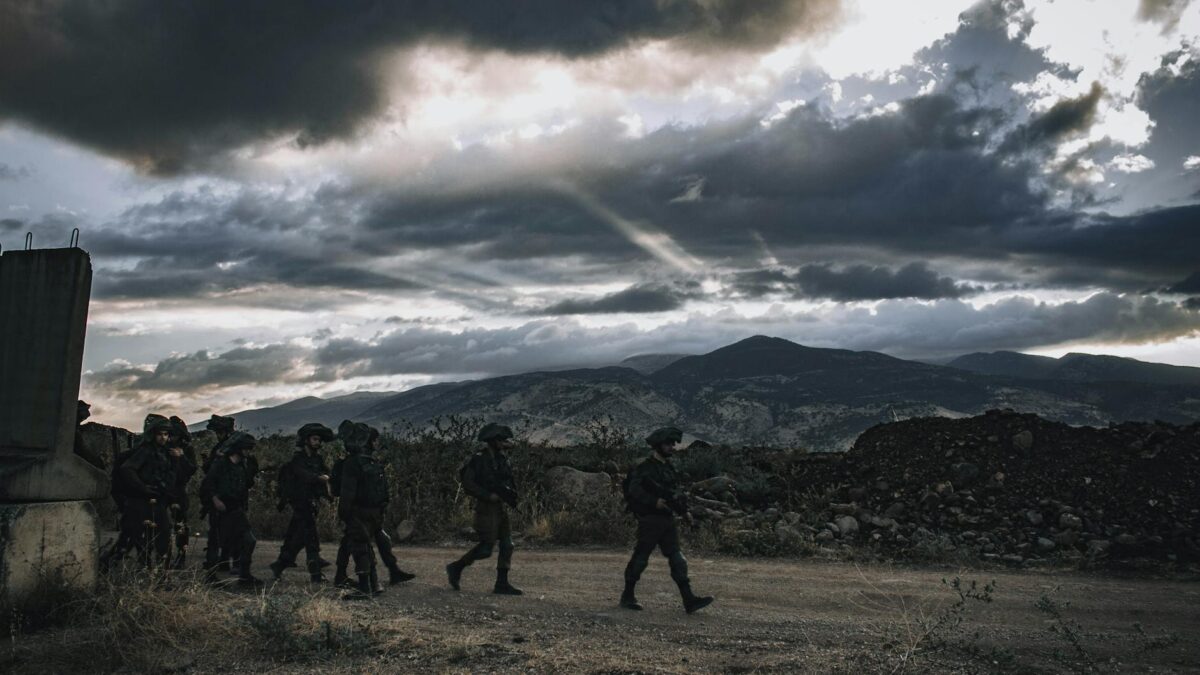
Eighteen months later, that compliance is the central unresolved question. The Israeli withdrawal has reached approximately 80 percent of the territory the IDF held at the November 2024 ceasefire line. Five hilltop positions, mostly along the high ground east of the Hasbani River and overlooking the Beqaa approaches, remain occupied. Tel Aviv’s official position, repeated weekly by IDF spokesmen, is that those positions will be vacated when the LAF demonstrates effective enforcement of the prohibition on Hezbollah armed presence south of the Litani River. The LAF, for its part, has deployed roughly 11,000 troops south of the Litani — close to the 10,000 troop floor specified in 1701 — but lacks the political mandate or the equipment to forcibly disarm Hezbollah cells where they continue to operate.
The result is a ceasefire that holds because neither side wants the alternative. Hezbollah is too weakened to want renewed war while the wider Iran conflict drains its strategic patron. Israel is too consumed with the Iran campaign and northern reconstruction to want a second front opened. The Lebanese government under President Joseph Aoun and Prime Minister Nawaf Salam wants the ceasefire to hold for the simple reason that war means more displacement, more destruction, and the death of the reconstruction project that is the new government’s principal domestic justification. The diplomatic community calls this a “frozen conflict in active form.” It is the most accurate description on offer.
The Casualty and Damage Tally from 2024
The 2024 escalation, which ran from intensifying border exchanges in summer to the full-scale Israeli ground operation that followed Nasrallah’s death in late September and through to the November ceasefire, produced the heaviest cross-border casualty count since the 2006 war. Lebanese deaths exceeded 4,000 by the time the guns paused, with the Lebanese Ministry of Public Health placing approximately 1,200 of those as Hezbollah fighters killed in the southern Lebanon ground campaign and the IDF airstrikes on the southern suburbs of Beirut, Dahiyeh, and the Beqaa. The remaining roughly 2,800 fatalities were civilians, with the highest single-event clusters at the Israeli airstrikes on apartment blocks in Dahiyeh in late September and on residential structures in Tyre and Nabatieh in October.
Israeli fatalities reached 152, of which roughly 75 were IDF personnel killed in the southern Lebanon ground operation and 77 were civilians killed by Hezbollah rocket and drone fire concentrated on Kiryat Shmona, Nahariya, and the Galilee panhandle communities. The Israeli civilian toll was driven primarily by precision-guided missile and loitering-munition strikes that overwhelmed Iron Dome batteries during peak salvo events. The numbers are a fraction of the Lebanese count but represent the highest Israeli civilian casualty figure from northern attacks since the inception of the state, a politically defining number that has shaped Israeli public opinion on Hezbollah disarmament.
Displacement figures peaked at over 1.2 million on the Lebanese side at the November 2024 high-water mark, with approximately 60,000 Israeli northern residents displaced from communities within 5 kilometres of the Blue Line. As of late April 2026, Lebanese internal displacement has fallen to approximately 200,000 with the rest having returned to damaged but standing homes or to alternative arrangements. Roughly 25,000 Israelis remain displaced from northern communities, with the highest rates of non-return in Kiryat Shmona, Metulla, and the moshavim closest to the Blue Line. The Israeli government’s compensation framework continues to pay rental subsidies for these households.
The financial damage tally is dominated by Lebanon. The World Bank’s preliminary post-war damage assessment, released in March 2025 and updated in January 2026, places Lebanese physical damage above $14 billion, concentrated in housing, road infrastructure, hospitals, schools, water and electricity networks, and agricultural land. Israeli damage, concentrated in the Galilee panhandle and the Hula Valley, is estimated at $2 to $3 billion across infrastructure, agriculture, and the partial destruction of multiple kibbutz and moshav communities.
Hezbollah’s Weakened State: A Movement in Strategic Drawdown
The single most consequential event of the 2024 escalation, in retrospect, was the Israeli air strike that killed Hassan Nasrallah on September 27, 2024, at the underground Hezbollah command facility beneath an apartment building in Dahiyeh. Nasrallah had led Hezbollah for 32 years and was the figure around whom the movement’s political and military identity had crystallised. His death created a leadership vacuum that the movement has not filled.
Naim Qassem, the long-serving deputy who succeeded Nasrallah, is by any measure a less commanding figure. He is older, less charismatic, less politically deft, and lacks the operational relationships with Iranian Quds Force leadership that Nasrallah had built over decades. His public profile in Lebanon has been measured but has not generated the rallying effect that would have been needed to consolidate Hezbollah’s position in the post-Nasrallah landscape. Within the Shia community of southern Lebanon and the Beqaa, the movement’s traditional base, the political unity that defined the Nasrallah era has fractured visibly. Reuters and Al Jazeera both report increased open criticism of Hezbollah’s strategic direction from within the Shia parliamentary bloc.
The military picture is similarly degraded. IDF assessments leaked to the Financial Times place Hezbollah’s pre-2024 military capability as approximately 40 percent degraded, with the deepest cuts in the medium-range and long-range missile inventory. Pre-war estimates put Hezbollah’s rocket and missile arsenal at approximately 150,000 weapons; current assessments place the residual at 90,000 to 100,000, dominated by short-range Katyusha-class systems with a thinning inventory of medium-range Fateh-110 and Burkan variants. The active manpower base, pre-war estimated at 100,000 to 150,000 fighters, has been reduced by combat losses and by attrition driven by funding cuts. Current estimates place active manpower at 70,000 to 90,000.
The funding picture is the most underappreciated dimension. Iranian financial support to Hezbollah, estimated at roughly $2 billion per year at the pre-2024 peak, has fallen to approximately $700 million in 2025 and is projected lower in 2026 according to figures cited by Bloomberg tracking of Iranian foreign-funding flows. The drop reflects a combination of pressure on Iranian state finances from sanctions, the destruction of multiple weapons-transfer routes through Syria following the 2024 collapse of Assad-era logistics, and now the broader strain on Iranian state capacity from the ongoing US-Israel war. Hezbollah has been forced to cut salaries to fighters and contractors, suspend social-services payments in parts of southern Lebanon, and prioritise core military expenditures over the civilian services that historically anchored its political support.
The conjunction of leadership weakness, military degradation, and funding collapse has produced a movement in strategic drawdown. Hezbollah’s political position in Beirut, while still significant, is the weakest it has been since the 1990s. The 2025 government formation under Aoun and Salam went forward without Hezbollah holding a veto, a structural shift from the pre-2024 status quo. The Christian, Sunni, and Druze political blocs have closed ranks behind a public position favouring full Hezbollah disarmament. The Shia community itself is more split than at any point in the post-2006 era.
The Aoun-Salam Government: A New Lebanese Posture
President Joseph Aoun, the former Lebanese Armed Forces commander who took office in January 2025 after the longest presidential vacancy in the country’s history, has redefined the Lebanese state’s posture toward Hezbollah and toward Israel. Aoun’s military background and his command relationship with the LAF officer corps give him a unique credibility on the disarmament question that no recent Lebanese president has possessed. His public position, repeated in domestic and international interviews, is that all weapons in Lebanon must be brought under exclusive state control — a formulation that does not name Hezbollah but cannot reasonably be read otherwise.
Prime Minister Nawaf Salam, the former president of the International Court of Justice and a long-standing reformist figure, brings international credibility and a clean technocratic profile to the government. Salam’s cabinet is composed largely of independent technocrats with limited partisan attachments, a deliberate move designed to enable difficult fiscal and security decisions that the previous patchwork governments could not make. The cabinet’s policy programme, published in February 2025, places Hezbollah disarmament under Resolution 1701 as a stated objective and ties Lebanese reconstruction to that objective in language that Saudi Arabia, the United States, and the World Bank have all praised.
The government’s domestic constraints are real. The Lebanese economy, separately treated in our running coverage of the Lebanon banking crisis recovery, remains in deep multi-year contraction. The Lebanese pound has stabilised after the dramatic collapse documented in our Lebanon currency collapse April 2026 update, but the stabilisation is fragile and tied to ongoing IMF discussions. Public-sector salaries remain below pre-crisis levels in real terms. The political space for the disarmament push is bounded by the government’s domestic credibility, which depends on visible economic and reconstruction progress.
The International Architecture: UNIFIL, the Monitoring Committee, and the Donor Track
UNIFIL has been the operational backbone of ceasefire enforcement on the ground. The mission, originally created in 1978, has approximately 10,000 peacekeepers drawn predominantly from France, Italy, Spain, Indonesia, and Ireland. The August 2025 mandate renewal expanded the rules of engagement to permit more aggressive verification patrols south of the Litani and to authorise the mission to call in air support from contributing nations under defined emergency conditions. The mission has not been without operational cost: an Italian patrol was injured by an unattributed roadside device near Tibnine in March 2026, and there have been multiple incidents of unattributed fire from positions near IDF and Hezbollah lines.
The ceasefire monitoring committee, co-chaired by the United States and France with technical participation from the United Kingdom, Germany, and the United Nations Department of Peace Operations, meets approximately monthly in Beirut. The committee’s role is to adjudicate disputed compliance issues — Israeli air operations in Lebanese airspace, Hezbollah positions inferred from intelligence, LAF deployment gaps. The committee’s effectiveness has been mixed: it has produced finding consensus on procedural questions but has not been able to resolve the central substantive disputes about Hezbollah arms north of the Litani. Reuters reports that committee meetings have become longer and more contentious through Q1 2026 as the Iran war pressure has grown.
The donor architecture is led by France through a coordination mechanism that consolidates pledges from the European Union, the World Bank, Italy, Germany, the United Kingdom, the GCC states, and bilateral US commitments. The pledged total stands at approximately $8 billion against the World Bank’s $14 billion damage estimate. The disbursed total is much smaller — approximately $1.1 billion has actually moved into Lebanese reconstruction accounts as of mid-April. The principal blockage is the Saudi conditionality: a potential $3 billion Saudi contribution is tied explicitly to verified Hezbollah disarmament progress, which remains incomplete. Iran, historically a major patron of southern Lebanon Shia communities, is operationally blocked from major reconstruction involvement under US Treasury sanctions and the broader Iran war dynamics covered in our running Iran war April 2026 latest status.
Recent Events: The April 2026 Strike Cycle
The ceasefire’s degradation pattern is best illustrated by the events of April 2026. On April 11, IDF aircraft struck what Israeli sources described as a Hezbollah weapons-cache location near the village of Kafra in the southern Beqaa, the ninth confirmed Israeli air operation inside Lebanese territory in 2026 to date. Hezbollah responded the following morning with a two-rocket launch from the Tyre district that was intercepted by Iron Dome batteries; the IDF response came within four hours with a further air strike on a position outside Naqoura. The exchange was contained — neither side escalated — but it followed a pattern that has now repeated approximately monthly throughout 2026.
The Italian UNIFIL patrol injury on March 22 in the Tibnine area was the most serious mission casualty of 2026 and triggered an unusual joint statement from Paris and Rome warning that further attacks on UNIFIL personnel would receive “consequential response.” The attribution was never publicly resolved. UNIFIL maintained its patrol cadence after a brief pause but tightened operational security on the affected sector.
The most consequential diplomatic development of April was the resumption of indirect Aoun-Netanyahu communication channels via the United States. Al Jazeera and the Wall Street Journal both report that the two leaders are exchanging messages through Washington intermediaries on a roughly bi-weekly basis. The agenda is bounded — withdrawal completion, reconstruction-fund Israeli non-objection, monitoring committee escalation procedures — but the existence of the channel itself is structurally important. There has been no direct Israeli-Lebanese leader-level exchange of any kind since 2006.
The Economic Picture: Tourism, GDP, and the Reconstruction Boost
Tourism in southern Lebanon, historically a meaningful component of regional GDP, is at zero. Hotels in Tyre, Nabatieh, and along the coast south of Beirut are either closed or operating below 5 percent occupancy. Pre-war the southern Lebanon tourist sector generated approximately $400 million annually in direct revenue. The 2026 figure is effectively nil. Northern Israeli tourism is at approximately 10 percent of pre-war levels, with the major sites in the Galilee panhandle and the Sea of Galilee operating at minimum staffing.
The Lebanese GDP picture is grim. Pre-2019, Lebanese GDP was approximately $52 billion. By 2024 it had collapsed to approximately $18 billion in dollar terms following the 2019 financial crisis and the currency depreciation; the 2024 escalation drove a further 12 percent contraction. Current GDP estimates for 2025 stand at approximately $19 to $20 billion with modest recovery driven primarily by reconstruction spending, remittance flows, and the partial banking-system normalisation. The reconstruction multiplier is real: every $1 billion in disbursed reconstruction funding is estimated by the World Bank to add 2 to 3 percentage points to short-term GDP growth in Lebanon.
Israeli GDP has been more resilient. The 2024 northern operation cost approximately $25 billion in direct fiscal terms and an additional $15 to $20 billion in indirect economic impact. The Israeli economy contracted modestly in late 2024 and recovered through 2025; the ongoing Iran war has produced a fresh contraction in Q1 2026 that the Bank of Israel projects at 1.8 percent. The northern reconstruction is contributing to fiscal expansion, with the Israeli government having committed approximately $3.5 billion to direct reconstruction in the Galilee panhandle plus indirect economic support to displaced communities.
The Iran Connection: How the Wider War Shapes Lebanon
The Israel-Hezbollah file cannot be separated from the wider US-Israel-Iran war that has run since early March 2026. Hezbollah is, by Iranian strategic doctrine, the single most important Iranian regional asset and the principal forward-deployed deterrent to direct Israeli action against Iranian nuclear infrastructure. The Iran war has placed unprecedented pressure on Hezbollah from two directions: financial, as Iranian funding flows are constrained by the sanctions and operational damage to Iranian state finances; and political, as Iran’s diminished regional standing reduces Hezbollah’s ability to project deterrence credibility in Beirut and Damascus.
The broader Iranian missile threat to GCC air defence systems, treated separately in our analysis of Iran missile threat to GCC air defence 2026, has reshaped how the Gulf states think about regional security architecture. Saudi Arabia and the UAE are now operating on the assumption that Iranian deterrence has been substantially degraded by the war, and the Saudi posture on Hezbollah disarmament has hardened correspondingly. Riyadh’s working position, transmitted through US and French diplomatic channels, is that the post-war regional settlement should include either full Hezbollah disarmament or Hezbollah’s effective political marginalisation.
Hezbollah’s Beirut representatives have responded with a more measured public posture in 2026 than would have been expected pre-Nasrallah. The movement has not retaliated against Israeli April strikes beyond token rocket fire. It has not attempted to disrupt the LAF deployment in the south. It has not publicly opposed the Aoun-Salam government’s reconstruction agenda. The interpretation in Beirut diplomatic circles is that Hezbollah is playing for time, hoping to preserve residual capability through the Iran war crisis and rebuild after the wider conflict ends. Whether the movement will be permitted that rebuild is the central political question of 2027.
Forward Scenarios: Bear, Base, Bull
Bear scenario (25 percent probability). The ceasefire collapses under pressure from a renewed Iranian-Hezbollah escalation tied to the wider Iran war or a unilateral Israeli decision to clear Hezbollah forces from positions north of the Litani. Lebanon faces a second 2024-scale destruction wave. Reconstruction freezes; pledged funds are withdrawn. Saudi conditional money is permanently lost. The Aoun-Salam government falls or is forced into emergency reconfiguration. Lebanese GDP contracts a further 15 to 20 percent. Brent crude spikes on regional escalation fears, taking the broader Middle East risk premium to crisis levels.
Base case (55 percent probability). Gradual de facto disarmament running through 2026 to 2028. Hezbollah’s Iranian funding continues to erode. The Lebanese Armed Forces gradually extends sovereignty south of the Litani. The ceasefire holds in its current degraded form with periodic incidents but no full-scale war. Saudi reconstruction money trickles in conditionally on demonstrated progress. Lebanese GDP recovers slowly, returning to the $25 to $28 billion range by 2028. The Israeli withdrawal from the remaining hilltop positions completes incrementally over 12 to 24 months. The political project around Aoun-Salam holds and produces a follow-on government in 2028.
Bull scenario (20 percent probability). A comprehensive disarmament agreement is closed in the fourth quarter of 2026, unlocking the full Saudi $3 billion plus an additional $4 to $5 billion in GCC contributions. The IDF completes withdrawal from the remaining hilltop positions. Lebanese GDP recovers to the $30 billion range by 2028. A Saudi-Israeli normalisation framework moves forward, with Lebanon as one of the regional pieces. Hezbollah’s political role in Beirut continues but as a conventional confessional party rather than a state within a state. The bull case requires both Hezbollah’s full political marginalisation and a stable conclusion to the wider Iran war.
Bottom Line
The Israel-Hezbollah ceasefire as of April 28, 2026 is holding partially because the structural incentives for both sides to avoid full-scale war are stronger than the structural incentives to break the framework. That is a different statement from saying the ceasefire is durable. The framework is fragile, the disputes are unresolved, the reconstruction is underfunded, and the wider Iran war is the single most important variable shaping the trajectory. The base case is gradual de facto disarmament over multiple years; the bear case is collapse triggered by Iran-war contagion; the bull case is a comprehensive deal that no one in Beirut, Tel Aviv, or Riyadh is publicly betting on. We are tracking each strike, each diplomatic meeting, each reconstruction disbursement as it lands. The shape of post-war southern Lebanon is being written this year, and the writing is far from finished.
Reporting by The Middle East Insider editorial desk from Beirut, Tyre, and the Galilee panhandle. Sources: Reuters, Bloomberg, Wall Street Journal, Financial Times, Al Jazeera, World Bank preliminary damage assessments, UN OCHA tracking, Bank of Israel and Banque du Liban working figures, IDF spokesman briefings. Casualty figures contested and updated continuously. Updated April 28, 2026 23:45 GST.