Saudi Arabia ranks as the world’s number two or three defence importer in any given year, depending on US foreign military sales timing. In 2024 the Stockholm International Peace Research Institute placed the Kingdom third behind India and Ukraine; in 2025 Saudi moved back into second. The volume — roughly 75 to 85 billion dollars of imported equipment, services, and sustainment annually when sustainment is included — is staggering. It is also, from a Vision 2030 perspective, an enormous economic leakage. Every dollar spent abroad on missiles, radars, helicopters, and pilot training is a dollar not building Saudi industrial capacity, not employing Saudi engineers, and not generating Saudi tax receipts.
The 50 percent localization target — half of all military spending sourced inside the Kingdom by 2030 — is the answer. It is also one of the most aggressive industrial-policy benchmarks any country has set for itself in the modern era. Pre-2017 the domestic share sat at roughly 2 percent. By 2024 the General Authority for Military Industries reported it had climbed to 15-18 percent. By 2026, contractor disclosures and GAMI’s public statements imply 22-25 percent. The slope from there to 50 percent by year-end 2030 is the steepest single line on the Vision 2030 chart that has not been quietly walked back, and the Riyadh defence cluster is now the visible mechanism Crown Prince Mohammed bin Salman is using to walk it forward. For investors tracking the broader PIF portfolio, the defence vertical is one of the more underappreciated growth columns.
The Pre-2017 Baseline and Why It Was Unsustainable
For four decades after the establishment of the Royal Saudi Air Force as a credible regional power in the 1970s, Saudi Arabia bought weapons the way wealthy importers always do: turnkey. F-15 deliveries from Boeing, Tornados and later Typhoons from BAE Systems, M1 tanks from General Dynamics, Patriot batteries from Raytheon, AWACS from Northrop, helicopters from Sikorsky and Airbus. The deals were enormous, occasionally headline-grabbing — the Al-Yamamah programme with the United Kingdom remains the largest export contract in British history — and almost entirely external in their industrial footprint.

Domestic defence production existed but was modest. Military Industries Corporation, the state-owned firm later folded into SAMI, manufactured small arms, ammunition, and a handful of vehicle integrations. King Abdulaziz City for Science and Technology (KACST) ran research programmes including a long-running unmanned aerial vehicle effort. Riyadh hosted a small handful of contractor-owned facilities providing local sustainment. Together these accounted for an estimated 2 percent of total defence outlays — the rest flowed to American, British, French, and German suppliers.
Two structural problems made this model unsustainable by the mid-2010s. The first was political: Western export-control regimes increasingly conditioned major sales on regional behaviour, and as the Yemen war became a humanitarian flashpoint after 2015 the supply line wobbled. Germany suspended major sales for years; the UK Court of Appeal ruled certain sales unlawful in 2019; the US Senate repeatedly tried to block deliveries. Strategic dependence on counterparts who could turn off the spigot was no longer comfortable. The second problem was economic: the youth unemployment rate above 25 percent meant Riyadh could not afford to keep exporting industrial value created by defence demand.
Vision 2030, unveiled in April 2016, married these two pressures into a single objective. The 50 percent target is its single most concrete manufacturing benchmark. Mohammed bin Salman did not invent the concept of defence offsets — Saudi Arabia had a peripheral programme since the 1980s — but he reorganised the institutional architecture to make offsets the dominant procurement principle.
GAMI: The Regulator With Teeth
The General Authority for Military Industries was created by royal decree in August 2017 as the regulator of the entire defence industrial complex. Its founding governor, Ahmed bin Abdulaziz Al-Ohali, was given an unusually wide remit. GAMI licenses every defence contractor operating in Saudi Arabia, both domestic and foreign. It sets local-content quotas on every imported defence system above defined thresholds. It approves every offset package — the formula that requires foreign suppliers to invest a defined fraction of contract value into Saudi industrial capacity — before letters of intent become firm contracts.
The thresholds matter. For the largest deals — F-15 upgrades, missile defence systems, naval platforms — the offset multiplier has typically run 30-40 percent of contract value. A four-billion-dollar missile-defence sale therefore carries roughly 1.2 to 1.6 billion dollars of mandated local investment in Saudi-based manufacturing, training, joint ventures, or research. GAMI tracks delivery against these commitments quarterly. Failure to deliver triggers contract penalties; consistent under-delivery has been used at least twice (according to GAMI’s 2024 annual review) to disqualify contractors from new awards.
The institution also publishes the localization scorecard. GAMI’s measurement methodology counts six categories: domestic manufacturing, services and sustainment, knowledge and training, research and development, components and raw materials, and indirect support. Critics argue the methodology is generous — for instance, training Saudi engineers abroad counts toward the local content figure even though the value-add itself remains foreign. A more conservative measurement would put 2026 localization at perhaps 18-20 percent rather than 22-25 percent. Either way the trajectory is real, and Reuters reporting through 2025 confirmed the broad direction even when individual milestones slipped.
SAMI: The Operating Champion
If GAMI is the rulebook, Saudi Arabian Military Industries is the most important player on the field. SAMI was constituted in 2017 as the PIF-owned national defence champion and given the consolidation mandate: absorb the legacy domestic firms, create joint ventures with the Western primes, and grow into a top-25 global defence company by 2030.
The structural blueprint borrowed selectively from earlier national champions — Italy’s Leonardo, India’s HAL, the UAE’s earlier Tawazun model — but with a uniquely vertical PIF backstop. SAMI’s capital base, drawn from the Public Investment Fund alongside reinvested operating cash, has scaled past 12 billion dollars by 2026, making it among the better-capitalised pre-IPO defence platforms anywhere. The company is organised into five operating divisions:
- SAMI Air Systems — fixed-wing platforms, including assembly and sustainment of Lockheed and Boeing aircraft components, plus the SAMI-Airbus C295 partnership.
- SAMI Land Systems — armoured vehicles, weapons integration, ammunition, and the recently announced collaboration on next-generation main battle tank technology.
- SAMI Naval Systems — corvettes and patrol vessels through the Navantia joint venture; the first Avante 2200 hulls have been launched at Jeddah and Cadiz, with localised assembly progressing through 2026.
- SAMI Defence Electronics — radars, electro-optical sensors, and command-and-control through the Thales partnership.
- SAMI Communication and Information — secure communications, cyber, and space-related systems.
The five-pillar structure is not arbitrary. It mirrors the actual procurement pipeline: every major imported system either lives in or maps onto one of these divisions, and SAMI has been positioned to capture the local-content slice of each. Where a Western prime sells a complete system into Saudi Arabia, SAMI is increasingly the joint-venture partner that delivers the localised manufacturing or sustainment package.
The Joint-Venture Map
The international joint ventures are where most of the actual industrial activity happens. By the end of 2025, SAMI had signed or activated more than a dozen major joint ventures with foreign primes. The most consequential are these:
| Joint venture | Foreign partner | Domain | Status 2026 |
|---|---|---|---|
| SAMI-Navantia | Navantia (Spain) | Naval — Avante 2200 corvettes | First hull delivered; local share rising |
| SAMI-Lockheed Martin | Lockheed Martin (US) | Training systems, missile sustainment | Operating; THAAD training localised |
| SAMI-Thales | Thales (France) | Radar, electronic warfare, optronics | Operating; Riyadh integration line |
| SAMI-Airbus | Airbus (Europe) | Helicopter MRO, C295 transport | Operating; full overhaul localised |
| SAMI-Diehl Defence | Diehl (Germany) | Short-range air defence | Recently activated |
| SAMI-Boeing | Boeing (US) | Rotary sustainment, F-15 services | Operating; deeper services scope 2026 |
| SAMI-Figeac Aero | Figeac Aero (France) | Aerostructures | Riyadh facility ramping |
Three structural features recur across these joint ventures. First, the equity split. SAMI typically takes 50.1 percent or higher, ensuring Saudi voting control even where the technology and management depth come overwhelmingly from the foreign partner. Second, the local-content escalator. The contracts include time-stamped milestones — by year three of the JV the local share of value-added must reach defined targets, rising over time toward majority by year seven or eight. Third, the training pipeline. Every JV carries a defined Saudi-engineer training quota, often hundreds of slots per year, both at Saudi facilities and at the foreign parent’s home plants.
Bloomberg reporting through 2024 and 2025 documented a recurring tension in these structures: Western primes are willing to localise sustainment and even component manufacturing, but they are reluctant to localise the most sensitive intellectual property — missile-seeker algorithms, radar signal-processing software, advanced composite formulations. GAMI has pushed back on this, demanding deeper transfer in newer contracts, and at least two competitions in 2025 (a missile-defence radar tender and a UAV programme) were reportedly recalibrated to reward bidders willing to localise more of the IP stack.
How Localization Mechanics Actually Work
The mechanics of an offset programme are technical but worth understanding for any investor or analyst tracking the deals. A typical major defence sale into Saudi Arabia in 2026 involves four parallel agreements:
The principal contract. The foreign prime sells the system — say, a missile defence battery, helicopter fleet, or aircraft upgrade package — at a defined price for a defined delivery schedule.
The offset agreement. A separate, GAMI-administered document specifies the local investment commitment. This commitment is denominated in Saudi industrial value-add, with an explicit dollar value, and contains time-stamped milestones (year one investment, year three operating capacity, year five export-ready output, etc.) along with penalty clauses for under-performance.
For broader context on Saudi capital deployment behind defence and other sectors, see the full PIF holdings map, and for parallel infrastructure delivery the NEOM scorecard.
The joint-venture or technology-transfer agreement. Where the offset takes the form of a JV with SAMI or another Saudi entity, the legal structure is documented separately: equity split, board composition, capital contribution schedule, IP-transfer scope, and exit provisions. JV legal complexity rivals the principal contract in many recent deals.
The training-and-personnel side letter. Saudi engineer training requirements are typically structured as side letters specifying the number of trainee slots per year, the duration, the curriculum, and which work products will be produced by Saudi nationals once trained. Major deals have moved to mandating that defined platforms be operated and maintained exclusively by Saudi-trained personnel within five to seven years.
Together these four documents constitute the legal architecture of localization. The Wall Street Journal coverage of the 2024 F-15EX Saudi upgrade decision included extensive detail on the offset architecture, and the WSJ analysis flagged exactly the structural feature that distinguishes Saudi from previous offset regimes: penalty clauses with teeth that GAMI has demonstrably enforced. Independent Reuters reporting through 2025 corroborated the broad localisation share trajectory even as individual contractor milestones slipped, and Bloomberg‘s defence-industry desk has separately tracked the GAMI offset enforcement record contract by contract since 2022.
The 2024-2026 Marquee Deals
Several specific contracts illustrate how the architecture is moving the localization needle in real time.
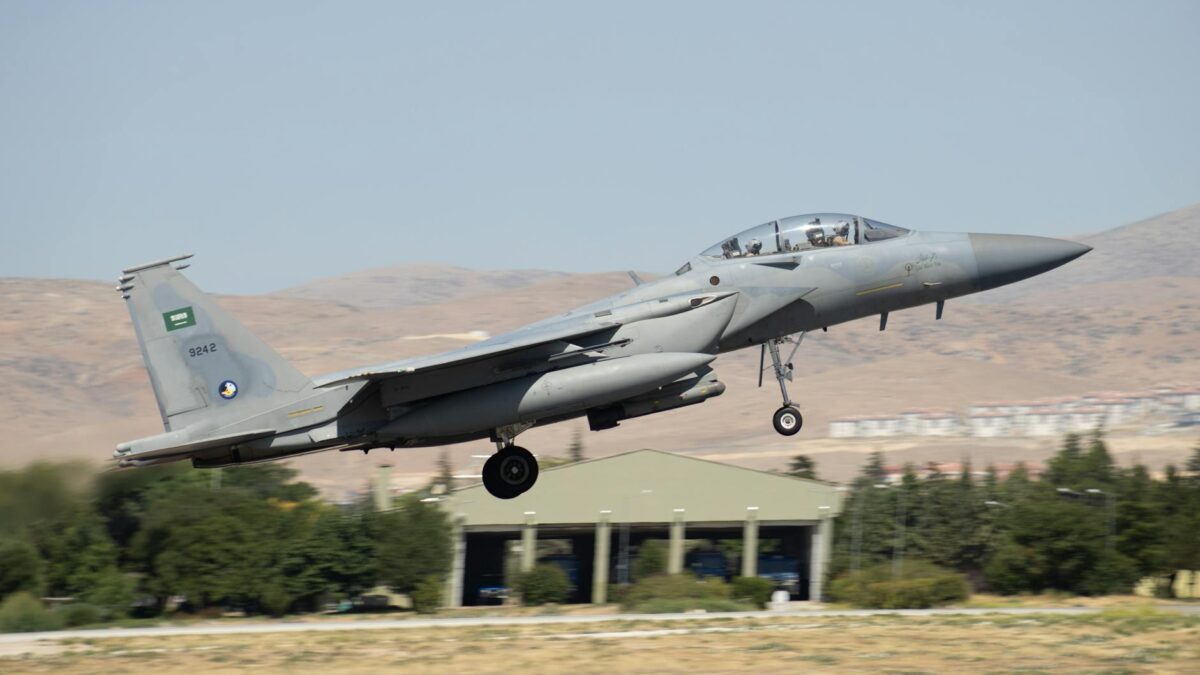
Lockheed F-15EX upgrade package. The decision to upgrade the existing Saudi F-15 fleet to EX-equivalent configuration, finalised in 2024 with announced US export approval, carries a localisation requirement under which approximately 25 percent of upgrade-related labour hours occur inside Saudi Arabia, with SAMI-Lockheed running the integration line. Engine sustainment — historically a sensitive area — has been opened up: Pratt & Whitney has agreed to local F100 maintenance through a SAMI subsidiary.
Boeing F-15SA/SE deeper services scope. Boeing’s existing F-15SA fleet sustainment agreement was renewed in 2025 with a substantially deeper Saudi content quota — over 60 percent of routine maintenance hours now occur at Saudi facilities, and Boeing-trained Saudi engineers run the avionics line. The expansion was reportedly negotiated against alternative bids that emphasised even more aggressive localisation.
THAAD acquisition with Saudi training. The THAAD missile defence acquisition, partially delivered through 2024-2025, was structured with mandatory Saudi crew training at Lockheed-Saudi joint facilities and an evolving sustainment plan that pulls more of the operating costs into local hands as the system matures. Reuters tracked the deliveries closely; the localisation share of operating cost is expected to cross 30 percent by the end of 2027.
Patriot co-production discussions. Negotiations underway through 2025-2026 between Raytheon (RTX) and SAMI cover potential co-production of Patriot launcher and interceptor components inside Saudi Arabia. Industry reporting from Bloomberg and the Financial Times in early 2026 indicated that detailed terms remain unsettled — the question is how much of the missile itself, versus the launcher and support equipment, can be localised under US export-control regimes.
SAMI-Navantia naval programme. The five-corvette Avante 2200 contract, originally signed in 2018, has been delivering through 2024-2026 with each successive hull carrying more Saudi-fabricated content. By the fifth hull, scheduled for delivery in 2027, more than 60 percent of fabrication value-added is expected to be Saudi.
UAV and loitering munitions. SAMI has launched a series of unmanned systems initiatives, partly through legacy KACST programmes and partly through new partnerships with Turkish and Chinese suppliers. This is the area where Saudi most clearly trails the UAE — EDGE Group’s family of loitering munitions has more operational miles — but the gap is closing.
Comparison With UAE EDGE Group
Any honest read of Saudi defence industrial maturity needs to confront the UAE comparison. EDGE Group, formed by consolidation in November 2019, has roughly five years of organic operating maturity ahead of SAMI. EDGE has booked larger export contracts — Egypt, Indonesia, several African and Asian buyers — and runs its own family of platforms (loitering munitions, missiles, naval vessels) that have accumulated operational miles. The UAE’s procurement is also more disciplined: smaller defence budget, but more focused on the platforms it actually intends to export.
Saudi Arabia compensates with two structural advantages. First, scale of domestic procurement: roughly five times Emirati levels means SAMI has a much larger captive customer for whatever it builds. Second, capital depth: PIF’s commitment to defence is materially larger than Mubadala’s commitment to EDGE in absolute terms, even before considering Riyadh’s broader industrial-policy backstop.
The two countries also pursue subtly different export strategies. EDGE explicitly targets export markets from inception. Saudi defence localisation has been more inward-focused, with export ambition treated as a phase-two objective. The 2024-2025 Saudi defence diplomacy — which included exploratory discussions with Egypt, Iraq, and several African buyers — signals that phase two is beginning, but realistic export volume from SAMI in the 2026-2028 window is modest. The Al Jazeera defence reporting through 2025 captured this gap accurately.
Israel-Saudi Normalization and the Defence Tech Question
If Israel-Saudi normalisation moves forward in any form during 2026-2028, the defence-industrial implications are significant. Israeli defence companies — Elbit, Rafael, Israel Aerospace Industries, IAI’s subsidiary IAI MBT — operate at a level of system integration and sensor sophistication that Saudi engineers and managers have specifically identified as a desired transfer pathway. Whether and how access opens up depends on the political settlement and on US export-control consent.
For now, the door is closed but not bolted. Track-two discussions through 2024-2025 reportedly included exploratory conversations on radar, electro-optics, and counter-UAV technology. Realistic expectations: even in a generous normalisation scenario, direct Israeli technology flow into Saudi defence platforms is a 2027-2030 question, not a 2026 one. But the optionality is non-trivial, and the strategic value to SAMI of that optionality is meaningful.
US Export Controls: The Permanent Constraint
US export controls remain the binding constraint on Saudi access to top-tier defence technology — particularly where the underlying intellectual property originates in American programmes. The post-2018 political environment around Saudi human-rights questions tightened export-control review for several years, and a residual scepticism persists in segments of the US Congress.
SAMI has navigated this constraint with patience. The pattern across recent deals has been: take what is exportable, localise the sustainment and integration aggressively, defer the most sensitive IP transfer to later phases when relationship trust accumulates. The F-15 services agreements and THAAD training architecture both reflect this approach. The 2024-2025 thaw in the Riyadh-Washington defence relationship has expanded what is exportable — but the constraint has not vanished.
For investors, the practical implication: Saudi defence localisation will progress fastest in domains where US export controls are loosest (sustainment, training, components) and slowest in domains where controls are tightest (advanced sensors, missile algorithms, stealth-related technologies). This shape will persist through 2030 even in optimistic scenarios.
The Riyadh Defence Cluster
Geographically, Saudi defence localisation is concentrating in a Riyadh-area cluster anchored by King Abdulaziz City for Science and Technology, the SAMI campus south of the city, and the Saudi Arabia Military Industries Corporation legacy facilities. A second cluster around Jeddah handles naval and certain aerospace work. A planned third cluster near NEOM’s industrial city is under early development; the NEOM investment scorecard tracks the slower-than-planned progress on that front.
The Riyadh cluster benefits from proximity to government, to the King Khalid airbase, and to the financial capital with its Tadawul-listed contractor ecosystem. By 2026 the cluster employs an estimated 40,000 to 50,000 workers across SAMI, JV companies, and supplier base; Vision 2030 projects this rising past 100,000 by 2030 if the trajectory holds. The training pipeline — King Saud University engineering, the new SAMI-Lockheed engineering academy, the Polytechnic at Yanbu — is the binding constraint on speed.
The Investor Angles
Saudi defence localisation creates several distinct investment exposures. SAMI itself is unlisted and PIF exposure is therefore indirect, achieved through Tadawul-listed PIF anchor positions including the broader holdings tracked by foreign portfolio investors documented in the Tadawul foreign-investor guide. The Saudi Industrial Investment Group (SIIG), Bawan, and several engineering and construction firms supplying defence-grade infrastructure offer indirect exposure on the local market.
For international investors, the cleaner exposure is the foreign primes themselves. Lockheed Martin (LMT), Boeing (BA), RTX (parent of Raytheon), Thales (HO.PA), Airbus (AIR.PA), and Leonardo (LDO.MI) all carry meaningful Saudi backlog. The 2024-2026 contract flow has been a positive driver for each, particularly Lockheed and RTX whose missile-defence and integrated-systems lines benefit most from the deal flow. An FT analysis published in early 2026 quantified Saudi-attributable revenue at roughly 4-7 percent of total annual revenue across the major US primes — material but not dominant. Cross-checking that with Al Jazeera defence-industry coverage and contractor IR disclosures confirms the order of magnitude.
The asymmetric upside scenario is SAMI as eventual exporter. If SAMI lands its first credible large export contract — a corvette sale, a UAV programme to a credible buyer — the strategic re-rating of the platform would be material. If by 2028 SAMI runs an order book that materially includes external customers, the strategic option value of the platform multiplies. Realistic timing on first material export contract is 2027-2029.
The Risk Map
The 50 percent target is aggressive enough that meaningful execution risk attaches to it. Several specific failure modes deserve flagging.
Engineering pipeline shortfall. Building the Saudi engineer cadre at the rate the localisation curve requires is the single most-cited internal challenge by GAMI itself. Training takes years; even with aggressive scaling of university and apprenticeship programmes, the talent pyramid lags the capacity build by an irreducible lag.
Geopolitical disruption. Any major regional conflict — for instance an escalation involving the Iran sanctions tightening trajectory — could disrupt the deliberate buildout in two directions. It could accelerate procurement urgency (favourable to localisation revenue) but also strain offset compliance as Saudi prioritises immediate operational capability over patient industrial development.
US political reversal. A future US administration that revisited Saudi defence access on human-rights grounds could compress the pipeline. The 2018-2021 episode showed how quickly the political bar can move; equivalent pressure on offset programmes would slow localisation even where it did not block sales outright.
Technology-transfer ceiling. Reaching 50 percent localisation requires that genuine high-value-added IP cross into Saudi industrial hands. If foreign primes resist, the localised share asymptotes well below 50 percent regardless of contractual obligations.
Methodology gaming. The GAMI counting methodology gives Riyadh latitude to claim localisation through training and adjacent activities. If the accounting becomes too generous, the headline figure can hit 50 percent while the underlying industrial substance falls short. Internal Saudi audit (and external commentary from Reuters and Bloomberg) is the corrective mechanism.
Funding Architecture: How PIF Underwrites the Build
The capital intensity of standing up a national defence industrial base is staggering. Building a single corvette assembly hall, a missile integration line, an aerostructures campus, or a radar test range costs hundreds of millions of dollars before a single unit ships. The patient capital that absorbs this lead time is the difference between defence-industry vision documents that read well and defence industries that actually exist.
Saudi Arabia has solved this funding problem more cleanly than most. The Public Investment Fund underwrites SAMI directly through equity injections, and indirectly through ROSHN-style infrastructure that the Riyadh defence cluster co-locates within. PIF’s defence allocation has scaled from effectively zero in 2017 to an estimated 12-15 billion dollars deployed by 2026, with another 8-10 billion dollars committed across the 2027-2030 window. That trajectory mirrors the defence localisation curve almost exactly.
Three funding channels matter most. First, direct PIF equity contributions to SAMI itself, recapitalising the operating divisions as they ramp. Second, co-investment with foreign primes inside each joint venture — a typical SAMI-Western JV is capitalised 50-70 percent by SAMI (and therefore PIF), 30-50 percent by the foreign partner. Third, sovereign-backed debt issued by SAMI or by parent vehicles, increasingly carrying explicit GAMI offset commitments as covenants. The 2025 SAMI three-billion-dollar bond was placed at a credit spread comparable to Saudi sovereign — a strong signal of how the market reads the implicit guarantee.
The economic return profile is unusual by sovereign-wealth standards. Defence is not a high-return industrial vertical at the operating level — global defence primes typically run on 8-12 percent operating margins, with Saudi internal financial-discipline pressure pushing for similar. The strategic return — autonomy, exports, employment, technology absorption — has to compensate for a single-digit cash-on-cash IRR that would not clear PIF’s strategic-portfolio hurdle on financial metrics alone. The board has explicitly accepted this tradeoff. It is the cleanest signal that defence localisation is treated as industrial policy first and as financial investment second.
The Talent Pipeline: The Real Binding Constraint
Money is not the binding constraint on Saudi defence localisation. People are. Building a defence engineer cadre at the rate the 2030 target implies is harder than building factory floor space, and the Saudi education and training system is racing to keep up.
The numbers tell the story. SAMI and its joint ventures employed roughly 8,000 to 9,000 Saudi nationals in technical and engineering roles by mid-2026, against a workforce that GAMI projects must reach 35,000 to 40,000 by 2030 to support the 50 percent localisation share. That is a quadruple in four years — possible, but only with aggressive scaling of three pipelines simultaneously: university engineering output, the SAMI-Lockheed and SAMI-Boeing engineering academies that train mid-career conversions, and the foreign-secondment programmes that send Saudi engineers to JV-partner home plants for two- to four-year postings.
The university pipeline is the slowest to scale. King Saud University, KFUPM, KAUST, and the new defence-relevant programmes at Prince Sultan University and the Polytechnic at Yanbu are all expanding intake, but engineering graduates who can credibly join a missile integration line or radar production team need three to five years of post-graduate experience before they are productive. The mid-career conversion programmes — moving Saudi engineers from oil and gas, telecoms, and IT into defence roles — have been more elastic, and SAMI has hired hundreds of mid-career converts annually since 2023. Bloomberg reporting in early 2026 highlighted the pipeline economics specifically, noting that wage premia for Saudi defence engineers have climbed roughly 25 percent since 2023.
The Bottom Line
Saudi defence localisation in 2026 is one of the more impressive industrial-policy execution stories any emerging market has written this decade. From a 2 percent domestic share at decree to a 22-25 percent share within nine years, against the headwinds of US export controls and Western political volatility, is genuine progress. The 50 percent finish line by 2030 is steep — perhaps too steep — but the institutional architecture (GAMI as enforcer, SAMI as operating champion, PIF as patient capital backstop) is in place and operating.
For investors, three practical implications. First, monitor SAMI’s next IPO chatter; a partial listing has been speculated on the Tadawul calendar for the 2027-2028 window and would create the first directly listed exposure to Saudi defence localisation. Second, watch the offset-compliance scoreboard: if Western primes consistently meet their commitments, the trajectory is intact; if missed milestones recur, the localisation curve flattens. Third, treat any export contract win by SAMI as a step-change strategic signal — an external customer is the single hardest test for an emerging defence champion to pass, and Saudi has not yet passed it.
The defence vertical is unlikely to surpass oil, petrochemicals, or tourism in the Vision 2030 economic ranking. But by 2030, on the current path, it will be a real industrial sector with real exports, real jobs, and real strategic autonomy from a single foreign supplier base — outcomes that the 2017 baseline made improbable. That is what successful industrial policy looks like in motion.