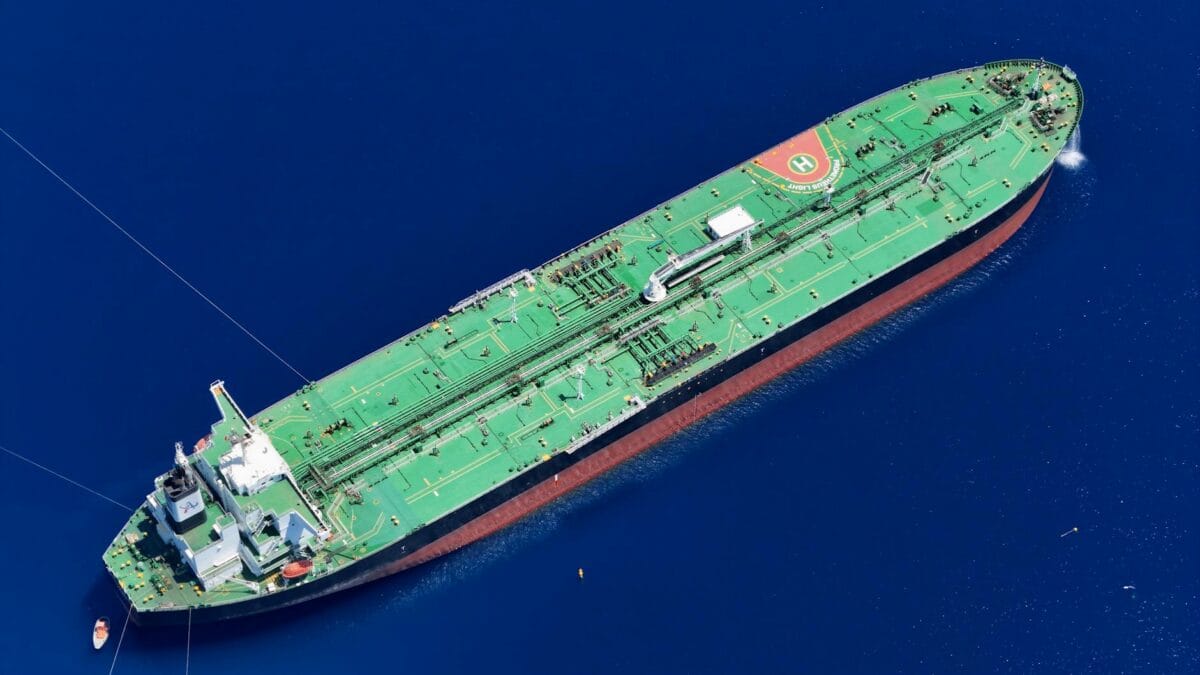
One and a half million barrels a day. That is the working figure that analysts at Kpler, Vortexa, and the major bank commodity desks are circulating for Iranian crude and condensate exports as of April 2026 — a number that, on its face, should not exist. Iran has been under a re-imposed United States sanctions regime since November 2018, when the Trump administration withdrew from the Joint Comprehensive Plan of Action and ordered the Treasury Department to reconstitute the pre-2015 framework of primary and secondary restrictions. The official policy objective was to drive Iranian exports to zero. Seven years on, exports have not gone to zero. They have tripled from the 2019 low of roughly 300,000 barrels per day, and the trajectory through the first four months of 2026 suggests Iran can plausibly sustain current volumes or push modestly higher through the rest of the year.
That outcome is not an accident, and it is not the result of a collapsed enforcement regime. It is the product of a specific and well-documented adaptation: the construction, across China and the Gulf, of a parallel maritime economy capable of moving sanctioned barrels outside the Western-anchored insurance, classification, and port-state architecture that historically made sanctions bite. This piece is a full working note on where the Iranian oil export situation stands in April 2026 — the volumes, the buyers, the transit mechanics, the enforcement posture, the market impact, and the macro stakes for Tehran and the broader Middle East. The audience is traders, allocators, and analysts who need a clear-eyed read on one of the two or three most consequential variables in the 2026 oil market.
The 1.5 Million Barrel Baseline: What The Data Actually Shows
The first thing to understand about Iranian export tracking in 2026 is that it is empirical rather than declaratory. Iran does not publish detailed export data in the way that OPEC members do through the monthly OPEC Secretariat submissions, and even the numbers that Tehran does release through the Oil Ministry or the National Iranian Oil Company are usually stripped down and occasionally inflated for domestic political purposes. What analysts rely on instead is a combination of satellite-tracked tanker movements, port-loading records from the export terminals at Kharg Island and Bandar Abbas, AIS data on the vessels themselves, and discharge records at the receiving refineries — particularly in Shandong Province — cross-referenced against the known crude inventory build at those facilities.

When those sources are layered together, the picture that emerges is remarkably consistent across the three major commercial trackers. Kpler, the Brussels-based commodity intelligence firm, puts Iranian crude and condensate exports at between 1.45 and 1.55 million barrels per day on a trailing three-month average basis as of early April 2026. Vortexa, which uses a slightly different methodology focused on satellite-confirmed discharge events rather than loading, reports 1.50 to 1.60 million. The US Energy Information Administration, in its Iran country analysis, publishes quarterly figures that cluster around the same band. All three sources have been drifting gently higher through the second half of 2025 and into 2026.
That is a sharp divergence from the 2019 nadir, when the maximum pressure regime under the first Trump term had driven verifiable exports to roughly 300,000 barrels per day. It is below the 2017 peak of 2.4 to 2.5 million barrels, which Iran achieved in the window between the JCPOA implementation in January 2016 and the Trump withdrawal announcement in May 2018. And it is well below the theoretical production ceiling that Iran could realistically hit if all sanctions were lifted — a number that most field-level analysts put at roughly 3.8 million barrels per day of sustainable production, with about 1.8 million absorbed by domestic refining and consumption and the remaining 2.0 million available for export.
The gap between the current 1.5 million export figure and the unconstrained 2.0 million potential is the best single measure of what the sanctions regime is actually achieving. That 500,000 barrel gap represents the barrels Iran cannot sell — the ones that are either not being produced because the ultimate buyer cannot be found at an acceptable price, or that are being produced and stored but not moved because the logistical friction is too high. It is a meaningful gap but not a crushing one. The sanctions are hurting, but they are not suffocating.
China: The Single Buyer That Changes Everything
The single most important variable in the Iranian export equation is China. Approximately 85 percent of Iranian crude and condensate flows, as of April 2026, land at Chinese ports — primarily at Qingdao, Rizhao, Yantai, and a cluster of smaller receiving terminals in Shandong Province on the Yellow Sea coast. The concentration is extreme: no other single country takes more than a marginal share, with Syria accounting for roughly 50,000 to 80,000 barrels per day under the political arrangement between Damascus and Tehran, and residual flows to Southeast Asian buyers passing through intermediate blending and re-labeling operations.
The receiving infrastructure on the Chinese side is dominated by the so-called teapot refineries — independent, privately owned refiners that historically ran on the cheapest available feedstock and have built their business model around discounted sanctioned crude over the past seven years. There are roughly thirty to forty teapot refineries of meaningful scale in Shandong, with total nameplate refining capacity above 4 million barrels per day. The teapots are small by global refining standards — most run between 50,000 and 200,000 barrels per day — and they are not systemically important to the Chinese economy or to the dollar payment system in the way that the state-owned majors Sinopec, CNPC, and CNOOC are. That distinction is what makes them the politically feasible buyers of last resort for Iranian barrels.
The discount structure on Iranian crude versus the relevant light-medium sour benchmarks runs at $8 to $12 per barrel as of April 2026, depending on the grade and the specific tanker-level trade. That is a material margin for a refinery operating on thin base-case crack spreads, and it explains why the teapot sector has absorbed the enforcement risk in exchange for the economics. The Chinese state banks and majors, by contrast, stay well clear of the trade because their international business and dollar clearing access would be at risk from a serious OFAC action. That division of labor — state sector clean, private sector dirty — is the central operational feature of the Iran-China oil relationship.
Beijing’s official position on the trade is that it is a sovereign matter between China and Iran, not covered by UN sanctions and therefore not binding on Chinese entities. That position has been consistent across multiple administrations of both countries. Under the Biden administration, the US Treasury made a deliberate choice not to escalate into direct confrontation with Chinese financial institutions over the trade, reasoning that the downside to the US-China relationship and the dollar payment system would exceed the upside from reduced Iranian exports. The Trump administration that returned to office in January 2025 has signaled an intent to tighten enforcement under the banner of maximum pressure 2.0, but as of April 2026 the practical changes have been limited to additional SDN designations of specific vessels and some smaller Chinese entities rather than a frontal confrontation with the Chinese banking system.
The Transit Mechanics: STS, AIS Spoofing, And Flag Hopping
The physical movement of 1.5 million barrels per day of sanctioned crude from Iranian loading terminals to Chinese discharge ports is one of the most operationally complex flows in the global oil market, and it operates through a well-developed playbook of evasion techniques that have evolved continuously since the 2018 reimposition. Understanding those techniques is essential to understanding why the sanctions regime has not been able to shut this trade down.
The core mechanic is the ship-to-ship transfer. A tanker loaded at Kharg Island or Bandar Abbas will typically proceed to a designated transfer zone — most commonly in the Gulf of Oman off the Omani coast, in Malaysian waters near the Straits of Malacca, or occasionally in Indonesian archipelagic waters — where it will rendezvous with a receiving vessel and pump its cargo across. The receiving vessel then continues on to the ultimate destination, often with cargo paperwork that labels the crude as Omani, Iraqi, or Malaysian in origin. The chain of custody is broken at each transfer point, and the Iranian origin is effectively laundered out of the documentation.
AIS spoofing — the manipulation of the Automatic Identification System signal that vessels are required to broadcast — is a routine operational tool for the shadow fleet. Tankers will transmit false location data while they are actually loading at Iranian terminals, often showing themselves as stationary in neutral waters thousands of miles from their real position. The spoofing has become sophisticated enough that it can fool the casual observer, though the commercial satellite tracking services have developed algorithms to flag suspicious AIS patterns — a vessel that transmits a static position while its actual draft shows it riding fully loaded, for example, is immediately suspicious. The cat-and-mouse game between the shadow fleet operators and the tracking analysts is a daily reality in the tanker-tracking industry.
Flag state registry is the third major pillar of evasion. Tankers move between registries with surprising fluidity, and the dominant jurisdictions for Iran-linked trades have shifted over the past several years. Panama was the historical default but has tightened its enforcement under US pressure. Liberia and the Marshall Islands have similarly become less accommodating. The current destinations for the shadow fleet are Cameroon, the Cook Islands, Comoros, and San Marino — small-economy registries with limited administrative capacity to police their flagged fleet. Vessels frequently flag-hop in response to specific US sanctions designations, with some tankers changing registry three or four times in a single year. The Reuters commodities desk maintains a running inventory of flag changes on designated vessels, and the data shows a clear pattern of concentration on small-registry jurisdictions.
Dubai and the broader UAE play an uneasy role in this system. Ship-to-ship transfers in UAE waters have historically been common, and Dubai’s position as a global ship repair and provisioning hub means that shadow fleet vessels pass through the emirate’s services regularly. UAE authorities have increased enforcement since 2024 in response to US pressure, but the practical compliance remains mixed, and the emirate continues to be a node in the broader transit network for Iranian barrels.
The Shadow Fleet: 250 Tankers And Counting
The Iran-dedicated shadow fleet — the tankers that routinely haul Iranian crude — numbers approximately 250 vessels as of April 2026, according to the tracking analyses published by Lloyd’s List Intelligence and the various commercial tanker-research desks. That figure has grown meaningfully since 2021, when the equivalent number was closer to 150 vessels, and the expansion has tracked the expansion of Iranian export volumes over the same period. The fleet overlaps with the larger Russia-dedicated shadow fleet — some vessels haul Iranian and Russian barrels in different quarters — but the Iran-specific core is distinct.
The vessels are typically older tonnage, with a median age above twenty years and several examples approaching the end-of-life scrapping zone. Acquisition prices for these ships have run well above prevailing scrap values as the demand for shadow fleet capacity has pushed up the resale market. Ownership structures are layered through shell companies in Panama, the British Virgin Islands, Marshall Islands, and various Chinese and UAE free-zone jurisdictions — the paper trail is deliberately opaque, and identifying the ultimate beneficial owner often requires months of investigative work even for professional compliance teams.
The P&I insurance situation is one of the most significant operational constraints on the fleet. The International Group of P&I Clubs — the thirteen mutuals that collectively insure roughly 90 percent of the global ocean-going tanker fleet — will not write coverage for vessels engaged in sanctioned trades. Shadow fleet tankers therefore operate either on alternative Russian P&I coverage that has developed since the 2022 Ukraine sanctions, on self-insurance pools funded by the trade’s principals, or on no formal coverage at all. The practical consequence is that a shadow fleet tanker that suffers a casualty — a grounding, a spill, a major machinery failure — faces a high risk of uncompensated loss, with neither the certainty of Western P&I payout nor the sovereign backstop that Russian state entities provide for their own fleet.
Classification societies — the bodies that certify vessel structural and operational integrity — have also largely withdrawn from the shadow fleet. The major Western classification societies, including Lloyd’s Register, DNV, and the American Bureau of Shipping, will not class vessels engaged in designated trades. Tankers in the fleet therefore work with secondary classification societies of varying quality, and in some cases operate without valid classification at all. That matters because flag states technically require valid class to register a vessel, and when the class lapses, the flag registration becomes formally invalid — creating a further layer of legal ambiguity around these ships.
The US Sanctions Framework: Maximum Pressure 1.0, 2.0, And The Biden Interlude
The sanctions architecture that governs the Iranian oil trade is the product of three distinct policy phases over the past eight years. Understanding the structure of the framework — and where the enforcement gaps are — is essential to understanding why the current regime has been unable to suppress exports to the levels Washington originally targeted.
The first phase, Maximum Pressure 1.0, began on November 5, 2018, with the Trump administration’s reimposition of sanctions following the May 2018 JCPOA withdrawal announcement. The framework was built on primary sanctions applying to US persons and entities, secondary sanctions threatening foreign buyers of Iranian crude with loss of US dollar clearing and market access, and the Specially Designated Nationals list maintained by OFAC that identified specific ships, entities, and persons for asset freezes. The administration granted initial 180-day significant reduction exceptions to eight major buyers — China, India, Japan, South Korea, Taiwan, Turkey, Italy, and Greece — but allowed those to expire in May 2019, after which no exemptions remained in force. The policy objective was verifiably stated as driving Iranian exports to zero, and for roughly eighteen months through 2019 and early 2020, verifiable exports did in fact fall to around 300,000 barrels per day.
The second phase, the Biden interlude, ran from January 2021 through January 2025. The Biden administration maintained the formal sanctions architecture in place but de-emphasized enforcement as part of a broader attempt to restart JCPOA negotiations. Multiple rounds of Vienna talks failed to produce a deal, and the administration’s posture shifted through the Gaza war period from neutral to tacitly more supportive of Israeli security priorities. Enforcement, however, remained uneven throughout the four-year window. OFAC designations of specific vessels and entities continued at a measured pace, but systemic enforcement against Chinese buyers did not materialize, and Iranian exports rose gradually from roughly 600,000 barrels per day at the start of the administration to approximately 1.4 million by the time President Biden left office.
The third phase, Maximum Pressure 2.0, began with the January 2025 return of the Trump administration. The rhetorical commitment to tightening enforcement has been clear, and the pace of new SDN designations has accelerated substantially — according to Bloomberg reporting on the Treasury action tracker, the number of new Iran-linked vessel designations in the first fifteen months of the administration has exceeded the equivalent count under the entire four-year Biden window. The practical enforcement posture, however, has not yet materialized into a direct confrontation with major Chinese financial institutions or the state-owned majors. The calculus appears to be that the collateral damage from secondary sanctions against Chinese state actors would exceed the political and economic payoff, and that targeted designations plus diplomatic pressure can achieve incremental results without triggering broader US-China consequences.
The cumulative effect of the three phases is an enforcement regime that has real bite at the margins but does not approach the objective of zero exports. The 2018-2019 collapse to 300,000 barrels proved not to be a durable equilibrium — it required continuous, maximally aggressive enforcement that the US political system has not sustained through changing administrations and competing priorities. The 1.5 million barrel level that has emerged in 2026 appears to be a more stable equilibrium, reflecting the balance between the evasion capacity that has been built up and the level of enforcement Washington is willing to impose.
Iranian Production Capacity: The 3.8 Million Barrel Ceiling
To make sense of the export numbers, it is necessary to understand what Iran could actually produce if all external constraints were lifted. The consensus view among upstream analysts who follow the Iranian fields closely — including the team that publishes the FT Energy country briefings — is that Iran’s sustainable production capacity is currently in the range of 3.8 million barrels per day, down from a peak of approximately 4.0 million achieved briefly in 2017 before the sanctions reimposition.
The Iranian upstream portfolio is anchored by a handful of major field clusters. The South Pars condensate development, which sits on the shared giant gas accumulation with Qatar’s North Field, is the single most important contributor, delivering roughly 700,000 barrels per day of condensate and natural gas liquids. The West Karun cluster — which includes the Azadegan, Yadavaran, Yaran, and Jofeir fields on the western border adjacent to the Iraqi giant fields — contributes around 500,000 barrels per day and has growth potential toward 800,000 if Chinese or other non-Western partners invest meaningfully in further development. The Ahvaz-Marun-Karanj-Agha Jari complex in Khuzestan, historically the core of the Iranian onshore production, contributes around 1.5 million barrels and is in mature decline but with substantial remaining reserves.
The offshore portfolio adds around 700,000 barrels per day from the various Gulf platforms operated through the Iranian Offshore Oil Company, with production centered on the Forouzan, Salman, and Reshadat fields. The remaining production comes from a long tail of smaller onshore and offshore reservoirs. The total consolidates to the 3.8 million sustainable number.
Against that production ceiling, domestic consumption absorbs approximately 1.8 million barrels per day, reflecting Iran’s 88 million population, the heavily subsidized domestic fuel pricing regime, the older vehicle fleet, and the significant industrial consumption including the power sector and the petrochemical complex. The domestic number has been remarkably stable over the past several years despite the broader economic stress, reflecting the relatively inelastic nature of subsidized consumption. That consumption line establishes that Iran’s maximum plausible export volume is approximately 2.0 million barrels per day — the difference between 3.8 million production and 1.8 million domestic use.
The gap between the 2.0 million maximum export potential and the 1.5 million actual current exports is the binding constraint imposed by the sanctions regime. It is the 500,000 barrels per day that Iran cannot find a buyer for, or cannot move through the logistical system at an acceptable cost. In a scenario of full sanctions removal — the JCPOA-plus scenario that remains politically remote but is not impossible — that gap closes within nine to twelve months as Iran restores sales to India, Japan, South Korea, and the European buyers who took Iranian barrels prior to 2018.
Market Impact: The Brent Elasticity Calculation
For traders, the relevant question is how Iranian export flows translate into Brent price impact. The calculation is straightforward in principle but loaded with assumptions about how OPEC+ responds. The simple elasticity framework starts with the observation that 1 million barrels of incremental supply in a balanced market generates roughly $5 to $10 of downward price pressure, depending on the prevailing spare capacity and inventory position. For a look at the detailed supply buffer picture, see our analysis of OPEC+ spare capacity in April 2026.
The scenario set breaks down as follows. If Iranian exports rise by 500,000 barrels per day over the next six months — closing the gap between current 1.5 million and the unconstrained 2.0 million — and OPEC+ does not respond, the incremental supply puts approximately $2 to $4 of downward pressure on Brent. If OPEC+, primarily Saudi Arabia and the UAE, absorb the Iranian increment by extending their own voluntary cuts, the net Brent impact is close to zero. This scenario is plausible because the Saudi policy framework explicitly prioritizes market balance over market share, and Riyadh has demonstrated the willingness to absorb unwelcome incremental supply from other producers in service of that objective.
The upside scenario — a full return to 2.0 million barrels plus enforcement of sanctions erosion allowing additional leakage — would put approximately $5 to $10 of downward pressure on Brent if OPEC+ did not respond, or $2 to $4 with a partial OPEC+ offset. The downside scenario — aggressive enforcement that drives Iranian exports back toward 0.5 million barrels per day — would cut global supply by roughly 1 million barrels, lifting Brent by approximately $3 to $5 with standard OPEC+ behavior or $5 to $10 if OPEC+ does not make up the shortfall. For broader context on the near-term oil price trajectory, our Brent crude Q2 2026 forecast incorporates these Iran scenarios into the price path.
The asymmetric feature of the market is that the downside for Iran — the 0.5 million barrel suppression scenario — is harder to achieve than the upside drift. The evasion infrastructure is in place, the Chinese buyer base is committed, and the US political willingness to impose the level of enforcement that would be required to drive exports back to the 2019 low has not been tested. The more realistic range of outcomes over the next twelve months is 1.3 to 1.8 million barrels per day, and within that band the Brent impact from Iranian flows is modest relative to other supply-side drivers.
OPEC+ And The Iran Factor In Production Decisions
Inside the OPEC+ ministerial process, the Iran variable is monitored closely but treated as an external factor rather than a group member’s quota decision. Iran is a founding member of OPEC but has been exempted from quota obligations since 2018 on grounds of the sanctions regime — an arrangement that was controversial at the time but has since become the operational default. Tehran’s actual production and export volumes are tracked by the Secretariat for reporting purposes but do not count against the voluntary cut framework that governs the rest of the group.
The practical consequence is that the OPEC+ voluntary cuts — currently running at approximately 2.2 million barrels per day below the baseline — are designed to balance the market net of assumed Iranian flows. If Iranian exports rise, the group is implicitly taking a deeper effective cut; if Iranian exports fall, the group’s effective contribution to supply tightness eases. Saudi Arabia, which anchors roughly half of the voluntary cut volume, watches the Iranian number carefully because it determines how much additional supply Riyadh can bring back online without tipping the market into glut. For more on the Saudi strategic calculus in this environment, see our OPEC+ May 2026 meeting preview.
The strategic concern in Riyadh is that a scenario in which Iranian exports rise materially while OPEC+ is still carrying its voluntary cuts would hand Iran the benefits of the Saudi-led market management without Tehran bearing any of the burden. That concern is manageable at the current 1.5 million level — it is absorbable within the overall market balance — but it would become acute if Iranian exports pushed toward 2.0 million while OPEC+ was still constrained by the voluntary cut framework. The Saudi Energy Minister Prince Abdulaziz bin Salman has made public references to the issue on multiple occasions, consistently framing the Saudi position as willing to absorb market imbalances only insofar as other producers are not free-riding on that restraint.
Iran’s Domestic Economic Stakes
From Tehran’s perspective, the oil export situation is the central economic variable. At 1.5 million barrels per day and a realized price net of discounts of approximately $70 per barrel, Iranian oil revenue runs at roughly $38 to $42 billion per year. That revenue represents approximately 40 percent of total Iranian government revenues and a substantially larger share of hard currency inflows, given that the non-oil export sector — primarily carpets, pistachios, petrochemicals, and steel — is structurally much smaller and faces its own sanctions-related frictions.
The rial has been under persistent depreciation pressure throughout the sanctions period, trading at roughly 550,000 rials to the dollar in the free market by early 2026 against an official rate that has been progressively adjusted but still sits well below the market rate. Inflation has run in the 35 to 45 percent range annually for most of the past three years, reflecting a combination of the rial depreciation pass-through to import prices, sustained fiscal deficits funded through central bank lending, and the structural supply constraints on imported goods. The official Central Bank of Iran inflation releases have been widely questioned for their accuracy, and the IMF Article IV consultations have not been completed in recent cycles, leaving the international community with incomplete data on the Iranian macroeconomic position.
The political implications of the economic situation are central to the Tehran leadership’s calculus. Rising domestic prices and a depreciating currency have fueled episodic unrest — the 2019 fuel-price protests, the 2022-2023 demonstrations sparked by the death of Mahsa Amini, and lower-grade protests in 2024 and 2025. The oil revenue is essential to the state’s ability to maintain subsidies, pay security services, and fund the regional policy that Washington and Tel Aviv are ultimately trying to constrain. At current export volumes, the domestic pressure is manageable — painful but not systemic. At 0.5 million barrels per day, the pressure becomes severe and the stability calculus shifts materially.
The JCPOA Question And The Deal Scenario
The single most important political variable that could change the export trajectory is a diplomatic breakthrough that restores some form of nuclear agreement. The original JCPOA, signed in July 2015 and implemented in January 2016, provided Iran with sanctions relief in exchange for constraints on its nuclear program — including enrichment caps, centrifuge restrictions, and an enhanced inspections regime under the International Atomic Energy Agency. The Trump withdrawal in May 2018 terminated the US participation, though the deal formally continued with the European signatories and Russia and China until Iranian compliance also eroded in the 2019-2020 window.
Multiple rounds of negotiations under the Biden administration, conducted primarily through European and Omani intermediaries, failed to produce a restored agreement. The Trump administration that returned in January 2025 has signaled a willingness to negotiate but on substantially tougher terms — including a longer-duration enrichment cap, constraints on ballistic missile development, and limits on Iranian regional proxy activity — that Tehran has thus far rejected. A plausible pathway to a deal exists, particularly if the domestic Iranian economic pressure intensifies or if the regional security situation deteriorates in a way that makes the status quo unsustainable for both sides, but the base case through 2026 is no deal.
If a deal were reached, the sanctions relief would unfold over several months rather than all at once, with an initial phase of OFAC license grants allowing the return of specific buyers, followed by broader de-designation of entities and vessels. Iranian exports would likely rise toward 2.5 million barrels per day within twelve months of implementation, restoring the pre-2018 volumes. The Brent impact would be material — approximately $8 to $12 of downward pressure if OPEC+ did not offset — though the Saudi-led response would likely absorb a substantial share of the incremental supply. The net impact on the average realized price through the transition period would likely run $3 to $6 below the no-deal counterfactual.
Tanker Seizures And The Hormuz Dimension
The enforcement and counter-enforcement dynamics in the Strait of Hormuz have become a regular feature of the Iranian oil export story over the past several years. The US Department of Justice has conducted multiple tanker seizures of shadow fleet vessels carrying Iranian cargo, typically through civil forfeiture actions that allow the cargo to be sold and the proceeds transferred to US victim compensation funds. The most significant seizures have involved cargoes of several hundred thousand barrels, and the cumulative effect over the past three years has been material, though still small relative to the overall export volume.
Iran’s response has been to conduct its own tanker seizures of Western-flagged or Western-linked vessels transiting the Strait of Hormuz. The Islamic Revolutionary Guard Corps Navy has boarded and detained multiple tankers over the past several years, typically holding them for weeks or months before release, and using the seizures as leverage in specific political or legal negotiations. The most high-profile incidents have involved Greek-owned, Marshall Islands-flagged vessels, and the pattern has been consistent with a reciprocal tit-for-tat logic rather than systematic escalation toward a broader shipping crisis.
The Houthi Red Sea campaign that began in late 2023 has overlapped with the Iranian oil transit system in complex ways. The Houthis have generally not targeted Iranian-linked tankers, reflecting the political alignment between the two, but the broader Red Sea disruption has raised freight premiums for all tanker trades and increased the operational complexity of the Iranian export system. Tankers that historically transited Suez are now routing around the Cape of Good Hope at meaningful cost premium, though Iranian flows to China do not directly touch the Red Sea and are more affected by the secondary impact on global freight rates than by direct Red Sea risk.
Alternative Crudes: What Displaces Iranian Barrels
For buyers who choose to stay out of the Iranian trade for enforcement-risk reasons, the substitute crude landscape has been reshaped by the combined pressure of Iranian, Russian, and Venezuelan sanctions regimes. The most important alternative is ADNOC’s Murban grade, which has emerged as a benchmark light sour crude with deep liquidity on the ICE exchange and a growing physical market share. Murban specifications are close to the traditional Iranian light export grades, and Asian refiners configured for Iranian feedstock can substitute Murban with modest operational adjustments.
Russian Urals grade has been sitting near or around the G7 price cap of $60 per barrel through most of 2024-2025, with the cap periodically breached on spot trades as market tightness has increased. Urals is a medium sour grade that historically complemented rather than substituted for Iranian, but in the current configuration many Chinese teapot refineries run blends of Iranian and Russian together, arbitrating the specific grade discount structure week to week. Brazilian pre-salt crude has also grown as an alternative, with roughly 3.8 million barrels per day of production and a light sweet quality that competes more directly with West African and North Sea grades than with Iranian, but with enough volume to influence the overall displacement math.
The strategic question for the Gulf producers is whether the Iranian sanctions regime provides a durable price support that they can rely on, or whether it is a temporary feature that will eventually resolve through a diplomatic breakthrough. The Saudi and UAE investment posture assumes the former for planning purposes but is flexible enough to accommodate the latter. The strategic reserves question also enters into the calculation — see our analysis of the US Strategic Petroleum Reserve position for how the US government itself thinks about the marginal barrel in this environment.
The 2026 Outlook And The Binding Constraints
Pulling all the threads together, the base case for Iranian exports through the rest of 2026 is a continuation of the 1.3 to 1.8 million barrel per day band, with the direction of drift depending on three variables. The first is the Chinese teapot demand, which is itself a function of Chinese refining margins, domestic fuel demand, and the specific regulatory posture of the Chinese authorities toward the teapot sector. That demand has been remarkably stable over the past two years and is unlikely to shift materially absent a major Chinese economic surprise.
The second is US enforcement intensity. The Trump administration has signaled a tightening posture but has not yet crossed the threshold to direct confrontation with the Chinese financial system, and as long as that threshold is not crossed, the marginal enforcement actions — additional vessel designations, smaller-entity designations, diplomatic pressure on flag states — will reduce exports incrementally but not systemically. A decision to go for a major confrontation with Chinese banks would change the picture substantially, but it would also carry significant broader consequences that Washington has to weigh.
The third is the diplomatic track. A JCPOA-like breakthrough would change the export trajectory dramatically, but the base case is no deal through the end of 2026. Partial deals — narrow nuclear arrangements in exchange for narrow sanctions relief — are conceivable but have not been seriously floated as of April 2026.
For the oil market, the Iranian variable is one of several moving pieces but is unlikely to be the dominant driver through the rest of the year. The larger drivers are OPEC+ cut unwind pace, Chinese demand recovery, US shale production response, and the broader geopolitical environment. The Iranian contribution is material — a 500,000 barrel swing in either direction is a real number — but it is not the central question. Investors and traders should monitor the enforcement posture and the diplomatic signals, but should not over-weight the Iran factor relative to the broader supply and demand architecture. For a perspective on the longer-term demand trajectory that will ultimately matter more than the short-term Iranian flow, see our global oil demand 2030 forecast and the related peak oil analysis.
The Iranian sanctions situation in April 2026 is a mature equilibrium — not a crisis, not a breakthrough, but a steady state that has developed specific and durable features over the past seven years. The 1.5 million barrel baseline, the 85 percent China concentration, the $8 to $12 discount, the shadow fleet of 250 tankers, the AIS spoofing, the flag hopping, the UAE transit nodes, the Russian P&I coverage, the teapot refinery economics — all of these are now structural rather than transitional features. Understanding them is the price of admission to thinking seriously about Middle East oil markets in the current year.