The call came at 4.47am from a second assistant director standing on a ridge above Liwa in the Rub al Khali, the Empty Quarter of the Arabian Peninsula. First team was in the chairs. The horizon behind them — three hundred and sixty degrees of unbroken sand, the nearest built structure forty kilometres back at Qasr Al Sarab — was already beginning to pick up the bruise-pink pre-dawn light that Greig Fraser, the cinematographer, had been waiting for since the previous Tuesday. Timothée Chalamet was in costume, a stillsuit rig modified to breathe in 38-degree heat. Denis Villeneuve was at video village, one hand on the monitor cage, the other holding the kind of small black notebook he has carried on every production since Prisoners in 2013. Somebody in the third row of crew was unwrapping a flatbread that had come up the dune road with the catering truck an hour earlier. Nobody spoke above a whisper. The sound department had been rolling for two minutes.
That is Dune: Part Three in April 2025 — though the industry has not yet decided whether to call it Part Three or Dune Messiah or both. It is Villeneuve’s third and final film in his Dune cycle, an adaptation of Frank Herbert’s 1969 Dune Messiah, and it is being assembled from four principal locations: the Liwa desert in Abu Dhabi, Wadi Rum in southern Jordan, Origo Studios in Budapest and — for a much smaller block of Caladan work — Sardinia. The Abu Dhabi block finished its primary May 2025 window and returned for additional dune-sequence photography in early 2026. The Wadi Rum block wrapped its February–April 2026 production push just before Ramadan. Interior photography in Budapest runs through spring and summer 2026. Warner Bros. has set 18 December 2026 as the release date.
This is the anatomy of that production. Which desert does what, why the franchise still films in Liwa when Saudi Arabia is offering a 40 percent rebate forty kilometres across the border, how the Jordanian Royal Film Commission moved a 500-person crew through Aqaba with five days of notice, what Greig Fraser and Patrice Vermette require from a location before they commit, and why the Middle East — not Morocco, not the American Southwest, not New Mexico — has become the default Hollywood desert since 2020. Our coverage of the broader regional entertainment economy runs alongside: our Ramadan 2026 series guide maps the Arabic-language production pipeline, our Red Sea International Film Festival 2026 guide tracks the festival calendar, and our NEOM investment scorecard covers the Saudi side of the ledger.

The Liwa Block: Why Abu Dhabi Gets the Big Dunes
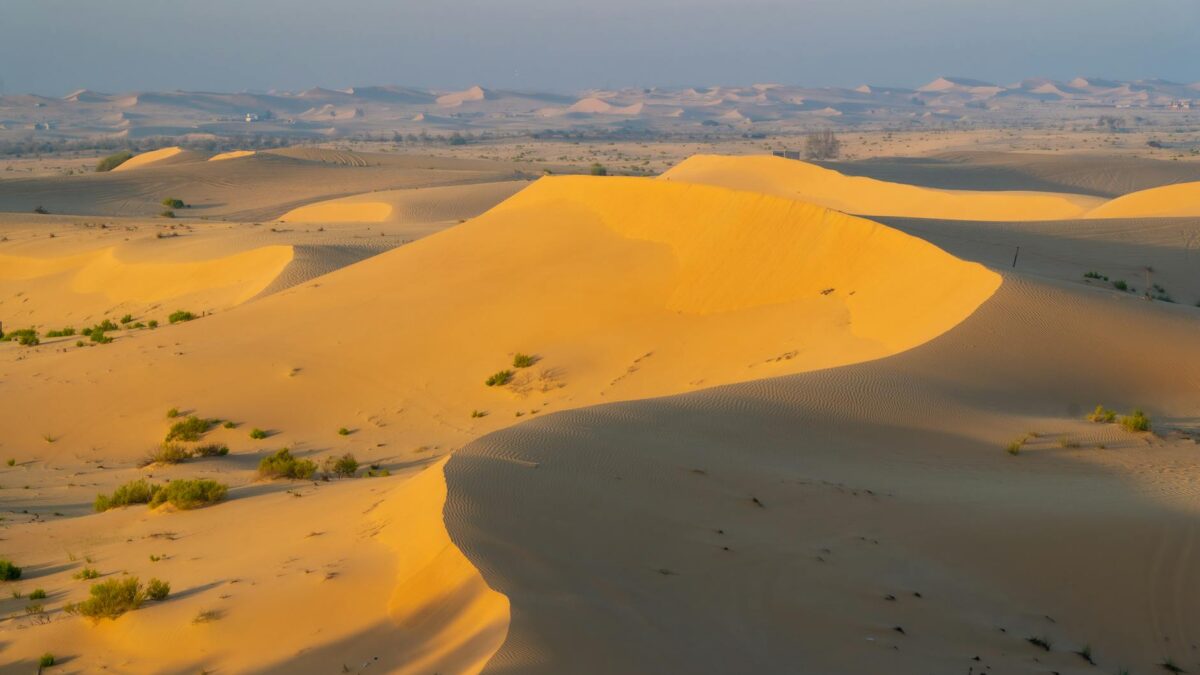
Liwa is the southern edge of Abu Dhabi emirate, roughly 250 kilometres southwest of the capital city, running in a crescent along the frontier between the UAE and Saudi Arabia’s Empty Quarter. The dunes there are among the tallest on the planet — Tel Moreeb, the most prominent of the Liwa formations, rises about 300 metres from its base and has served as a rally-racing venue since the 1990s. The dune seas extend unbroken for kilometres in every direction. There are no power lines, no fences, no roads beyond the single graded track in from Mezaira’a. For a cinematographer looking to sell Arrakis as an entire planet rather than a set, Liwa is not quite replaceable.
Dune (2021) filmed here. Dune: Part Two (2024) filmed here. Dune: Part Three has now filmed here across two production windows totalling roughly eleven weeks. The Abu Dhabi Film Commission, operating through twofour54 and the Creative Media Authority, administers the permits, the location access and the cash-rebate scheme that underwrites the financial logic. Crew on location at peak reached approximately 500 people across production, camera, grip, electric, art department, costume, hair and makeup, sound, second unit, aerial, stunts, transportation, catering, medical and security. Variety‘s on-set reporting from Part Two documented a similar crew scale and the operational pattern has held steady on Part Three.
The production base for the Liwa block is the Anantara Qasr Al Sarab Desert Resort, a 206-room property in the dune sea itself, which Warner Bros. block-booked for cast and senior crew across both 2025 and 2026 windows. Below-the-line crew accommodation spans a mix of the Qasr Al Sarab, the Tilal Liwa Hotel in Mezaira’a and purpose-built location-support camps erected within permitted distance of the shooting area. Catering ran from a mobile kitchen operation brought in by an Abu Dhabi-based contractor with hot meals delivered three times daily. Water trucks ran a continuous rotation from Mezaira’a. A medical tent with two physicians and four nurses was operational during every shoot day — standard practice for heat-exposure productions at this scale.
The technical constraints are distinctive. Sand is the enemy of cameras and the friend of costume. Greig Fraser’s camera team deploys custom housings for the Arri Alexa 65 bodies that have become the Dune visual signature — weather-sealed, with double-filter dust protection at the matte box and the sensor plane. Lens cleaning is continuous between setups. Crane and dolly work on sand is a different discipline from rock or tarmac; Liwa crews have built proprietary track-lay systems using aluminium mats that redistribute weight across soft substrate. Aerial work uses Cinestar and Freefly rigs plus a helicopter package flown out of Al Ain for the wide coverage that established Part Two’s opening. Sound capture is a problem: wind is constant, and even at dawn there is rarely a true silence window longer than two minutes. Post-production looping (ADR) carries more dialogue recovery than a typical soundstage production.
The heat. This is the thing that outsiders underestimate. Liwa in May 2025 hit 44 degrees Celsius on shoot days; the same location in August would have been impossible to film. Production windows for Dune have consistently clustered in the cooler half of the year — October through April — to avoid the peak summer range where ambient air temperature alone compromises both crew safety and equipment tolerance. The 2025 window stretched the schedule close to that seasonal ceiling because the overall production calendar required it. Salt tablets, electrolyte rehydration, shaded rest zones every 45 minutes of call, and a medical protocol that actively pulled crew off set when core body temperature readings crossed threshold — the safety architecture has become a genuine production craft, and UAE-based first assistant directors have accumulated expertise that is not easily replicated elsewhere.
Abu Dhabi’s cash rebate sits at 30 percent of qualifying local spend up to roughly 5 million US dollars per production. For a film the size of Dune: Part Three — with a budget reported by The Hollywood Reporter at around 190 to 210 million dollars — the rebate ceiling is reached quickly, but the 30 percent rate on accommodation, catering, transportation, local crew wages, equipment rental from Abu Dhabi-based houses, fuel, security and permits is meaningful cash back against the bottom line. The UAE also waives customs duties on production equipment imports under a well-rehearsed temporary-admission regime; Dune’s shipping container manifest from Toronto and Burbank through Jebel Ali port cleared in under 72 hours on both windows.
The emirate’s wider production ecosystem is worth a note. Abu Dhabi has accumulated roughly 2,000 film industry professionals across the 2024–2026 window — a mix of local-resident expats, UAE nationals trained through twofour54 programmes and the Image Nation Abu Dhabi apprenticeship pipeline, and experienced Arab crew drawn from Egypt, Lebanon and Jordan. That is not yet Hollywood-scale depth, but it is the deepest below-the-line pool in the Gulf. The property side of the emirate’s broader scaling — including the freehold zones that have made Abu Dhabi more attractive for international professionals to base themselves long-term — is covered in our Abu Dhabi freehold zones guide.
The Wadi Rum Block: Why Jordan Gets the Canyons
Wadi Rum is different geologically and therefore different cinematically. The valley sits in Jordan’s far south, about an hour’s drive from Aqaba on the Red Sea coast, inside a protected UNESCO World Heritage area administered jointly by the Aqaba Special Economic Zone Authority and the Bedouin communities who have lived in the valley for generations. Where Liwa is dunes, Wadi Rum is cliffs and canyons — sandstone massifs that rise hundreds of metres from a valley floor of reddish sand, carved by millennia of wind and infrequent water into formations that photograph as alien landscape without modification. Lawrence of Arabia (1962), Red Planet (2000), The Martian (2015), Rogue One (2016), Star Wars: The Rise of Skywalker (2019), Aladdin (2019) and both previous Dune films have all used the same valley for the same visual reason.
The Royal Film Commission of Jordan, established in 2003 under royal patronage and restructured in 2011 to offer formal rebate mechanisms, administers film permits and location access across Wadi Rum. Commission chairman Mohannad Al-Bakri’s leadership has overseen more than a decade of tent-pole international productions operating through Aqaba. The Dune: Part Three block ran February through April 2026. Crew on the ground peaked at around 450. Base camp operated out of SunCity Camp and the Wadi Rum Bubble Luxotel, with additional accommodation capacity in Aqaba for below-the-line crew who rotated on a commuting basis.
The aesthetic contribution Wadi Rum makes to the Dune visual language is close-form geometry — the massifs that fill the frame, the narrow passages through rock, the dramatic verticality that the flat dunes of Liwa cannot provide. Part Two used the valley heavily in its Fremen sietch exterior sequences. Part Three returns to the same formations for what production notes circulated through IMDb‘s production listings describe as a multi-week stretch of cliff-base and canyon-interior photography, likely matching the descriptions in Dune Messiah of the Fremen architecture that has evolved in the years between the two novels’ timeline.
The Jordanian production support architecture is mature. Bedouin guides — most drawn from the Zalabia, Zawaida and Ammarin communities who hold the traditional land rights across Wadi Rum — serve as location experts, driver-fixers and second-unit liaisons. Their knowledge of weather patterns, light timing in specific canyons, access routes through dune fields and the logistics of moving heavy equipment across soft substrate is genuinely not replaceable. One Bedouin family, the Al-Zalabia, has been credited on every major international production that has filmed in Wadi Rum since the 1990s. The Jordanian rebate scheme — 20 to 25 percent on qualifying spend, with additional fee waivers for first-time productions — has been extended to Dune: Part Three under the long-standing commission relationship.
Security during the production window was tightly managed. Jordan maintains a stable internal security environment, but the proximity to regional volatility — Syria, Iraq, the Israeli-Palestinian conflict to the immediate west — has occasionally added complexity to international film logistics. The 2026 Dune block took place against a notably calmer regional picture than productions of 2023 and 2024 operated in. Reports from Reuters‘ Amman bureau noted no disruption to the production schedule during the three-month window. Warner Bros. and Legendary maintained a standard security detail drawn from a Jordanian private contractor licensed to support international productions, with the Royal Film Commission functioning as the central coordination hub with the Ministry of Interior.
Weather in Wadi Rum during February through April delivers the region’s most photogenic light: daytime temperatures in the 18 to 26 degree range, overnight lows sometimes approaching freezing in February, and crystalline low-humidity air that gives cinematography the long-distance clarity that the eastern Mediterranean often lacks. Rain is rare but possible; the Dune production lost approximately three shoot days to weather across the ten-week block, within industry-standard parameters for desert work.
The Budapest Interiors: Why Origo Studios Still Hosts the Franchise
Desert locations can only carry a portion of a production the scale of Dune. The Atreides palace interiors, Fremen sietch chambers, imperial council rooms, the Harkonnen throne sequences, corridor walks, bedroom scenes and every close-quarters dialogue exchange that requires controlled lighting and sound all live on soundstages. Since the first Dune, Villeneuve’s production has based its interior work at Origo Studios in the northern district of Budapest — a facility with twelve soundstages across roughly 15,000 square metres, the largest of which (Stage 6) can accommodate the 40-metre-wide sets the franchise requires.
Budapest’s appeal is a combination of craft depth and financial structure. Hungarian below-the-line crew have accumulated generational expertise across two decades of international tentpole production — Blade Runner 2049, Dune, Dune: Part Two, multiple Marvel productions and a long list of HBO and Netflix limited series have filmed at Origo or at the other major Budapest facilities, Korda Studios and Fót. The Hungarian National Film Institute’s rebate scheme offers 30 percent on qualifying spend with no cap, which applies cleanly to Dune’s interior production budget and has been the single most reliable element of the franchise’s financial model. Budapest is also six to seven hours of flight time from both Abu Dhabi and Aqaba, which allows cast and key crew to move between the desert locations and interior work without the continental shift a Los Angeles-based interior block would require.
Patrice Vermette, the production designer, has worked at Origo across all three Dune films with an art department that has similarly stayed largely intact. The visual continuity of the Dune sets — the Atreides ochre-and-deep-green colour palette, the Fremen stillsuit leather-and-sand earth tones, the Harkonnen brutalist greyscale — is a product of that stability. Vermette’s interviews in The Financial Times and trade press have repeatedly credited the Hungarian craft departments for the detail work that defines the films’ texture.
Costume designer Jacqueline West’s department similarly operates from Budapest for fitting and maintenance, with travelling units accompanying the cast to Liwa and Wadi Rum. The stillsuit rigs used in Part Three are a further iteration of the costumes from Part Two — modified for improved heat dissipation (real-world heat, not in-universe), with embedded cooling channels that run micro-scale water circulation for long desert shoots. This is genuine costume engineering, not set dressing; the iterative improvements between the three films have been documented in craft trade publications and have begun to influence costume practice on other desert productions.
The Cinematography: What Greig Fraser Brings to the Desert
Greig Fraser is Australian, won the Academy Award for Best Cinematography for Dune (2021), was nominated again for Dune: Part Two, and has become — alongside Roger Deakins and Hoyte van Hoytema — one of the three or four cinematographers Hollywood reaches for on large-scale visual-first tentpoles. His work with Villeneuve on the Dune trilogy has been the single biggest creative variable holding the films’ aesthetic identity together across the six-year arc from principal photography on Part One (2019) through Part Three’s 2025–2026 windows.
Fraser shoots Dune on the Arri Alexa 65 — a 6.5K large-format digital camera that captures a sensor area closer to traditional 65mm film than to conventional digital cinema. The choice matters. Alexa 65 delivers the textural softness and highlight roll-off that Fraser and Villeneuve want for the desert sequences, holds its detail in the deep shadows where much of the interior work takes place, and integrates cleanly with the IMAX specification that the theatrical release requires. A second-unit package shoots on Arri Alexa Mini LF for handheld and confined-space work; aerial sequences use Red V-Raptor 8K for weight and durability reasons.
Lenses are anamorphic DNA Panavision glass — the same package Fraser used on the first two films and which produces the subtle horizontal flares, the oval out-of-focus highlights and the slight compression distortion at the frame edges that have become part of the Dune visual signature. The choice of anamorphic over spherical glass is deliberate; it distinguishes the Dune films from the sphere-shot crispness of most contemporary Hollywood tentpoles and ties the visual language to a 1960s and 1970s cinematic tradition (including the original David Lean desert epics) that Villeneuve has referenced repeatedly in press interviews.
Dailies workflow during the Liwa and Wadi Rum blocks ran through a hybrid on-set and off-site pipeline. On-set digital imaging technicians (DITs) handled primary ingest and LUT application; compressed dailies were uploaded nightly to a Burbank-based post facility via dedicated satellite links provided by a UAE-based uplink contractor. Senior crew and the director reviewed dailies at the end of each shoot day in a dedicated tent or hotel suite fitted with calibrated monitoring. Full offline editing continued in Los Angeles across the entire production period under editor Joe Walker, who has cut every Villeneuve feature since 12 Years a Slave.
The Casting: Who Returns, Who Joins
The returning cast is substantial. Timothée Chalamet remains as Paul Atreides, now in the early years of his reign as emperor — the source-material starting point for Dune Messiah. Zendaya returns as Chani, whose relationship with Paul sits at the emotional centre of the novel. Rebecca Ferguson as Lady Jessica, Florence Pugh as Princess Irulan (with a substantially expanded role in this film based on the trade reporting), Javier Bardem as Stilgar, Josh Brolin as Gurney Halleck and Jason Momoa as Duncan Idaho — reintroduced in a form that Dune Messiah readers will recognise — complete the continuity cast. Stellan Skarsgård appears in what industry reporting describes as an archival and reconstructed capacity as the late Baron Harkonnen, though the exact shape of that appearance has not been confirmed by production.
The new additions are significant. Anya Taylor-Joy plays Alia Atreides, Paul’s now-adult sister who was seeded in a brief cold-open in Part Two’s closing stretch and who in Dune Messiah occupies an expanded and ambiguous position within the imperial court. Robert Pattinson joins in what Al Jazeera‘s arts desk and Variety have both reported as a Harkonnen-cousin role, adapted for the screen from source-material material that some readers have argued was lightly treated in the original novel. Léa Seydoux joins as a Bene Gesserit figure whose name has been held confidential by production but which industry speculation has linked to the Reverend Mother Gaius Helen Mohiam legacy character.
The Chalamet reporting from the Part Two press cycle about the Abu Dhabi experience has continued into Part Three: he has spoken to multiple outlets about finding the Liwa dunes genuinely transformative for the performance, particularly in the pre-dawn and late-afternoon light windows. Rebecca Ferguson’s quote from a 2024 Hollywood Reporter interview — “the strangeness of real desert” — has become a kind of shorthand across the cast for what the locations contribute that a constructed set cannot.
The Rebate Economics: How the Numbers Work
Film rebates are the financial spine of the modern international production system. For Dune: Part Three, the stacked rebate mathematics works roughly as follows. Abu Dhabi contributes 30 percent on qualifying local spend up to a hard cap of approximately 5 million US dollars in rebate value per production — meaning a qualifying spend of approximately 16.7 million locally is the effective ceiling. Jordan contributes 20 to 25 percent on qualifying local spend; a 10-week block at Wadi Rum with 450 crew and accommodation, catering, fuel, equipment rental, Bedouin guide fees and other local costs of roughly 12 to 15 million dollars yields a rebate of approximately 2.5 to 3.8 million. Budapest’s 30 percent on the Origo Studios interior production — a substantially larger budget share than either desert block — can represent 10 to 15 million dollars of rebate value on the full interior spend.
In aggregate, the three-location rebate stack returns somewhere between 17.5 and 23.8 million US dollars to the production. That figure represents roughly 9 to 12 percent of the total film budget. It is not enough on its own to flip the production-location decision from a creative to a financial calculation, but it is more than enough to tip a marginal decision and to consolidate a multi-film franchise pattern around a stable set of locations. Coverage from Bloomberg and The Wall Street Journal on the global film-rebate landscape has noted repeatedly that the UAE, Jordan and Hungary are among the most efficient stacks for large-scale international tentpoles, and that the Middle East has now displaced Morocco — the previous default Hollywood desert — in the production-planning calculus.
The comparative cost advantage versus a US-based desert shoot is steeper still. Equivalent below-the-line costs for a Los Angeles or New Mexico desert production run 20 to 30 percent higher before rebates; the US state-level rebate schemes that compete on paper (New Mexico at 25 to 30 percent, Georgia at 30 percent, California at its own tier) have caps and eligibility rules that complicate their application to films of Dune’s scale. The net result is that filming Dune in the MENA region versus the American Southwest saves the production in the high tens of millions of dollars across its total budget — enough to materially influence the franchise’s profit trajectory at the scale of a 200-million-dollar tentpole.
The Cultural Navigation: Ramadan, Dress Code and Off-Set Life
Operating international productions in Muslim-majority countries carries cultural considerations that professional productions handle well and amateur productions handle badly. The Dune: Part Three schedule in 2026 overlapped the final days of Ramadan (1 March to 30 March 2026 in the Islamic calendar), and the production’s response was a model of competent regional practice. Shoot days during Ramadan shifted to avoid the fasting-break (iftar) window in late afternoon. Catering adapted to a later schedule that respected both the crew’s religious observance and local workforce practice. Local crew who fasted were not penalised through scheduling pressure. The production’s Jordanian fixer coordinated with the Royal Film Commission to ensure that the Ramadan adaptation was formalised rather than ad hoc.
Dress code off-set was modest. Cast members moving between the hotel accommodation and location, or in public spaces in Aqaba and Abu Dhabi, dressed in line with local norms — not a legal requirement for any of the locations, but a respect-driven standard that reflects how seriously the production takes its relationship with host communities. No reported cultural frictions surfaced across the 2025 or 2026 windows, which is itself a measure of how far the regional production ecosystem has matured: a decade ago, Hollywood productions in the Gulf frequently generated local controversies over casting choices, costume decisions or crew behaviour; the current generation of productions operates with substantially higher cultural fluency.
Alcohol logistics are a minor but real consideration. Abu Dhabi permits licensed alcohol sale in designated hotel venues but the desert location itself operated dry. Jordan permits alcohol broadly but the Wadi Rum Bedouin-managed accommodation operated by local convention without bar service. Cast and crew wrap parties for both desert blocks were held at the hotel bases closer to Abu Dhabi and Aqaba, respectively, where licensing aligned with expectation. The production did not make a production issue of either arrangement, and none of the cast or senior crew publicly complained — again, a marker of mature international production practice.
The Saudi Question: Why Not NEOM or AlUla?
Saudi Arabia’s production-location ambitions across 2023 through 2026 have been substantial. The Saudi Film Commission’s 40 percent cash rebate, the NEOM Studios backlot that became operational in 2024 with four soundstages plus outdoor scouting, and the AlUla ancient-city region that offers genuinely unique visual geography have all been marketed aggressively to international productions. Several medium-scale Hollywood and European productions have used Saudi locations across the window. So why did Dune: Part Three stay in Abu Dhabi and Jordan rather than crossing the border?
The answer is twofold. First, creative continuity — Villeneuve has built three films on the visual vocabulary of Liwa and Wadi Rum. Introducing a third desert aesthetic mid-trilogy would have broken the continuity that he has cited as central to the films’ identity. Second, production-ecosystem maturity — the Abu Dhabi and Jordanian below-the-line crews have now worked three full Dune films together. The institutional memory of how the franchise operates, the working relationships with the specific production craft departments and the proven logistical reliability matter enormously on a shoot of this scale. Saudi Arabia’s ecosystem is newer and, at the scale of a 200-million-dollar tentpole with extreme schedule sensitivity, the delta in operational risk is a real factor.
None of this is a structural verdict on Saudi Arabia’s production prospects. The Kingdom’s rebate is more generous, its desert landscapes are distinctive (AlUla in particular offers a visual register that Liwa and Wadi Rum do not match), and the NEOM studio infrastructure is genuinely new. Industry speculation — including recent reporting from CNBC on the regional production economy — has linked Saudi locations to the rumoured Dune: Sisterhood television prequel, which would not carry the same visual-continuity constraint that Part Three did. Future Dune-universe productions may well film in Saudi Arabia. Part Three did not, because Part Three was finishing a trilogy, not starting one.
The Local Crew and the Production Ecosystem Maturation
One of the quieter stories of Dune’s MENA-region filming is what it has contributed to the professionalisation of Arab below-the-line production crews. By 2026 the UAE has approximately 2,000 active film-industry professionals — a combination of resident expats, trained UAE nationals from the twofour54 and Image Nation apprenticeship pipelines, and Arab crew from Egypt, Lebanon and Jordan who have embedded in the Gulf production economy. Jordan has perhaps 800 to 1,200 active below-the-line professionals across Amman and Aqaba. Together with Egypt’s larger but more traditionally structured Cairo production workforce, this is the deepest Arab-region film-crew pool in a generation.
Dune has been one of the primary training grounds for this workforce. Part One and Part Two each accumulated thousands of crew-days in Liwa and Wadi Rum. Part Three has added further depth. The cumulative effect is that Arab crew now circulate on other international productions with credentials that reflect their Dune work — and that mobility has seeded further work for the same crew on other tentpole productions across the region. The connection between entertainment industry scaling and the broader UAE and Jordan soft-power economy runs through the same infrastructure as the airline industry that moves cast and crew; our Gulf carrier comparison guide tracks the aviation side of the same regional mobility story.
The below-the-line pay scale across the region deserves a note. UAE below-the-line rates for experienced grip, electric, camera assistant, costume and hair-makeup department roles run approximately 60 to 80 percent of equivalent Los Angeles union rates. Jordanian rates run lower still, approximately 45 to 65 percent of LA union scale. Both are substantially above Cairo, Casablanca or Istanbul rates — the arbitrage is genuine but not extreme, and it reflects the professional credential accumulation that the Gulf ecosystem now commands. Productions that try to pay Cairo rates for UAE-based crew quickly discover that the experienced professionals have options and will not work below market.
The Tourism Aftermath and What Arrakis Does for Arrival Numbers
Tourism impact from major Hollywood productions is a studied phenomenon — New Zealand’s Lord of the Rings economy, Iceland’s Game of Thrones-driven arrivals spike, Thailand’s post-The Beach Phi Phi Islands surge. The Middle East is now generating its own version of the pattern. The Abu Dhabi Department of Culture and Tourism has reported an estimated 20,000 additional tourists annually since 2021 specifically linked to “Dune tourism” — visitors who book the Liwa desert experience because of the films. Qasr Al Sarab has seen occupancy increase meaningfully in the off-peak summer months as dedicated Dune-location enthusiasts accept the heat cost for the specific experience.
Wadi Rum has a longer tourism history — Lawrence of Arabia’s cultural tail has run more than six decades — but the Dune layer has measurably added to arrival numbers across 2021 through 2025, and the SunCity Camp and Wadi Rum Bubble Luxotel operators have reported occupancy increases. The Jordanian Ministry of Tourism tracks this impact formally and has built specific Dune-themed tourism packaging into its broader southern-Jordan visitor marketing.
The economic logic of film rebate schemes rests partially on this multiplier. A 20 million-dollar rebate to a production that generates 100,000 additional tourist arrivals at an average per-visitor spend of 1,500 dollars is not a losing trade for the host jurisdiction. Whether the precise multiplier claimed by tourism authorities holds up under econometric scrutiny is a separate question; what is not in dispute is that the correlation between major international production filming and inbound tourism is positive and durable, and that the MENA region’s bet on the Hollywood desert has been financially sound.
The Release: What December 2026 Looks Like
Dune: Part Three opens 18 December 2026 in North America, with international rollout across the same window. Warner Bros.’ marketing campaign is expected to begin publicly in June 2026 with a teaser trailer, follow the Part Two playbook of building to a late-September full trailer, and peak in November with the standard theatrical campaign infrastructure. IMAX and Dolby Cinema bookings will be heavy. The film’s running time has not been confirmed but the Part Two precedent of 166 minutes suggests a comparable or slightly longer runtime.
The awards trajectory is a specific question. Dune (2021) won six Academy Awards. Dune: Part Two was nominated in multiple craft categories in the 2024 cycle. Part Three will almost certainly draw nominations in cinematography (Greig Fraser), production design (Patrice Vermette), costume design (Jacqueline West), visual effects (DNEG), sound and editing, and will be a serious Best Picture contender if the critical reception holds. Whether Villeneuve breaks through in the Best Director category — where he has been nominated but not won — will be one of the defining storylines of the 2027 Oscar cycle.
A Middle Eastern premiere event is widely rumoured. The Red Sea International Film Festival’s 2026 window (3 to 12 December) closes six days before the US theatrical release, which is an unusually clean window for a Jeddah premiere to function as the regional kickoff. An Abu Dhabi event timed around the same window is the alternative scenario. Neither has been confirmed publicly as of late April 2026. What is confirmed is that Chalamet, Zendaya, Villeneuve and the lead cast are expected to attend a MENA-region premiere in line with Warner Bros.’ established practice for films that filmed in the region — a recognition that the creative and economic partnership with the UAE, Jordan and the broader Arab entertainment industry has become central rather than peripheral to how the franchise is made and marketed.
The Verdict: A Desert Epic in Its Final Chapter
Dune: Part Three completes what Villeneuve has described in multiple interviews as a single three-film statement adapted across two Herbert novels. The production methodology — real desert for real desert scenes, cumulative craft-department continuity across three films, MENA-region rebate stacking for financial sustainability, stable creative team from cinematographer through production designer — is the reason the trilogy has held together aesthetically in a way that contemporary Hollywood tentpoles frequently do not.
Whether the December 2026 film lands creatively at the level of its predecessors is a question for the audience and the critics. What the production has already demonstrated is that the MENA region can anchor a 200-million-dollar Hollywood production across three films and six years without operational failure, and that the creative partnership between Abu Dhabi, Jordan, Budapest and the Villeneuve creative core has become one of the more durable international production templates of the decade. When Arrakis appears on IMAX screens in December, it will be the Rub al Khali and Wadi Rum the audience is looking at. That remains one of the more remarkable facts in contemporary cinema.
Frequently Asked Questions
Where is Dune Part Three being filmed?
Abu Dhabi’s Liwa Desert, Wadi Rum in Jordan, Origo Studios in Budapest, with limited work in Namibia and Sardinia.
When is Dune Part Three released?
Warner Bros. has set the theatrical release for 18 December 2026.
Did Dune Part Three film in Saudi Arabia?
No — the production stayed with the established Abu Dhabi and Jordan footprint for creative continuity.