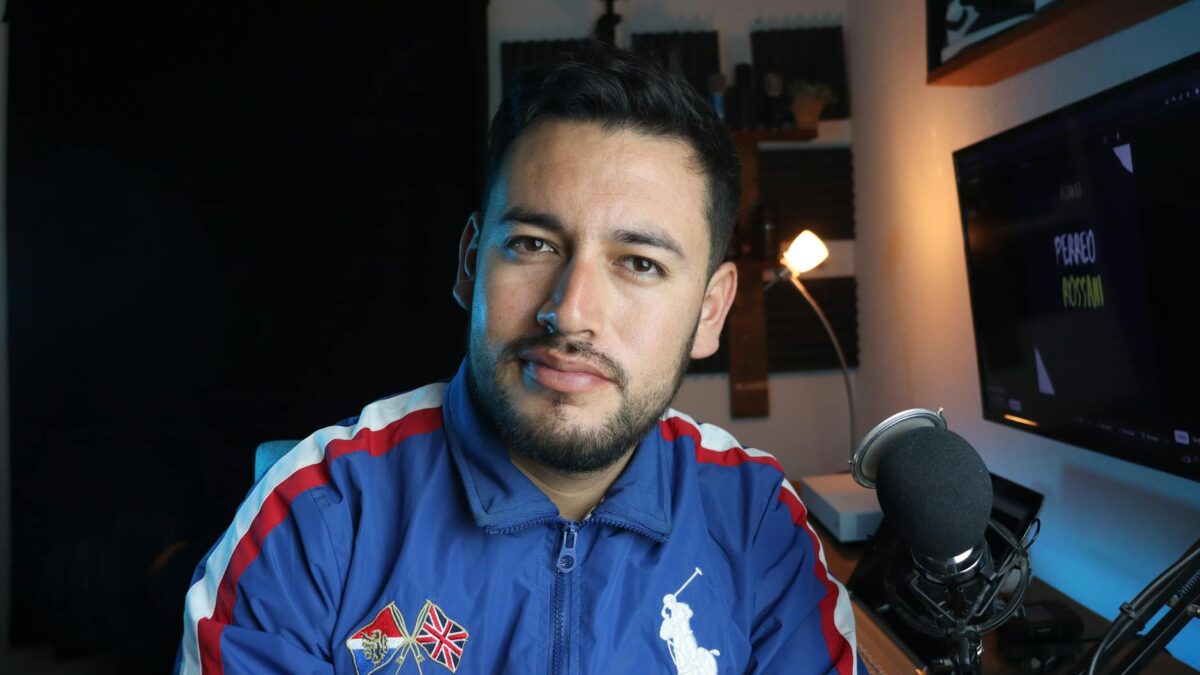
The moment that tells you MrBeast is not doing a brand deal anymore — he is doing a country deal — happens somewhere in the middle of the 100 Pilots episode, when the camera cuts from a drone shot of a Saudi Royal Air Force airbase to a hundred contestants standing in a desert hangar waiting for Jimmy Donaldson to tell them the challenge. There is a US flag on his cap and an Arabic-language safety briefing on a screen behind him. The next frame shows a Black Hawk helicopter taking off. The one after that shows a bright yellow Beast Games-branded briefcase with two million dollars inside it on loan for the production. This is not a creator collaboration. This is a sovereign wealth fund using a YouTuber as a television network.
The video dropped on 18 April 2025. It crossed 300 million views inside thirty days, which makes it, by cold arithmetic, a more-watched piece of single-asset English-language content than anything aired on American network television that spring. Within months the physical build-out of Beast Land — the permanent MrBeast-branded attraction inside Riyadh’s Boulevard World zone — started rising out of the sand. It opened to paying Saudi ticket-holders for the 2025-26 Riyadh Season, which runs from November through February. And the pattern behind those two things is the piece of the story that the Variety and Hollywood Reporter dispatches have been slower to name: Saudi Arabia has stopped renting celebrity endorsement and started manufacturing its own distribution stack, with creators as the programming layer.
This article is about what the Kingdom is actually buying, what MrBeast is actually selling, how the deal is structured, why the General Entertainment Authority thinks this is cheaper per attention-unit than anything Hollywood can offer, and what it means for the next wave of creator partnerships landing in Riyadh through 2026 and 2027. It is also about the uncomfortable middle ground where soft-power critique and raw commercial logic meet — the part of the story where the Western press and the Saudi press have been reading entirely different facts off the same spreadsheet. For the broader sovereign-wealth architecture underneath all of this, our PIF portfolio holdings breakdown traces the holdings map; for the esports piece of the same bet, the Esports World Cup 2026 guide shows how the prize-pool and youth-audience logic scales.

The 100 Pilots Episode as Infrastructure
Let us start with the number. MrBeast’s individual YouTube channel crossed 400 million subscribers across calendar-year 2025 and holds the record for the most-subscribed individual account on any platform. The 100 Pilots episode took 27 minutes of runtime and, according to publicly available YouTube analytics and rate-card math, has since generated pre-expense advertising revenue north of 20 million US dollars. That is net of Saudi production support. It is also net of the episode’s role as a free worldwide advertisement for a Saudi destination that did not exist six quarters ago.
The production mechanics matter. The episode was shot over 19 calendar days across multiple Saudi locations: a Royal Saudi Air Force facility in the Tabuk region for the aviation sequences, a staging base at an airstrip south of Tabuk city for the helicopter challenge, desert challenge sets approximately 90 minutes outside NEOM’s southern boundary for the elimination rounds, and a final-three challenge shot against the steep wadi walls that have featured prominently in NEOM’s own marketing footage. Trade reporting from Variety, The Hollywood Reporter and Bloomberg has placed the working production budget in the 8 to 12 million dollar range per episode at this scale, pushed roughly 40 percent higher than the equivalent US-domestic shoot because of freight, air-time charters and compressed insurance windows, and offset by the Saudi production-services partner absorbing a meaningful share on the condition of location exclusivity.
In television-industry terms this is a co-production deal wearing the cosmetic jacket of a sponsorship. The Saudi General Entertainment Authority does not own the IP. MrBeast’s parent corporate structure — Night Media on the representation side, Beast Industries on the operations side — retains ownership of the finished episode, the format, and the Beast Games universe it plugs into. What Saudi buys is location exclusivity for the shoot window, brand placement inside the episode that is fully integrated rather than tagged on (the episode’s title card is co-branded; aerial shots showcase Saudi terrain at hero-establishing moments), right of first refusal on future episodes at equivalent scale, and — this is the piece Wall Street has been undervaluing — the option to convert the episode’s audience data into physical ticket demand for Beast Land six months later.
Put differently: the 100 Pilots episode is not a television special with a tourism advertisement bolted onto it. The episode is itself the top of a paid-traffic funnel that lands at a physical revenue-generating asset inside Riyadh. This is exactly the structural move that Vision 2030 planners have been trying to pull off through any combination of cultural-sector policy since 2016, and until MrBeast nobody had executed it cleanly on a sub-18-month timeline.
Beast Land: The Physical Asset
Beast Land itself is a 30,000-plus square metre attraction inside the Boulevard World zone of Riyadh Season. Boulevard World is the largest of the Season’s themed zones, sitting on the King Fahd Road axis of north-central Riyadh, and it houses country-pavilion experiences (an indoor Paris, a scale model of New York, a lagoon-fronted Italian quarter), restaurants, ride attractions and concert infrastructure. Beast Land occupies a meaningful corner of that footprint and is thematically distinct from any of the country-pavilion experiences — it is the first Boulevard World zone built around a single external intellectual property rather than a geographic theme.
The zone contains four signature physical-challenge attractions, each modelled on a viral MrBeast video setup. A “Last to Leave the Circle” endurance attraction with participant rotation through timed elimination windows. An elevated obstacle course shot through with glass-floor transitions borrowed from the Beast Games set design. A “Money Maze” requiring teams of four to complete co-operative puzzles under a soft time pressure. A meet-and-greet structure where visitors rotate through photo opportunities with licenced MrBeast, Chandler, Karl and Jimmy lookalike performers, backed by a green-screen moment and a Feastables-branded exit. On top of the four attractions sit a flagship Feastables retail store — the largest in the Middle East, stocking the full chocolate-bar line and exclusive regional snack merchandise — a MrBeast Burger counter, a curated food-hall cluster, and a performance stage that hosts creator-appearance events across the Season calendar.
| Metric | Beast Land (Riyadh Season 2025-26) |
|---|---|
| Location | Boulevard World, Riyadh |
| Season window | November 2025 – February 2026 |
| Footprint | 30,000+ m2 |
| Signature attractions | 4 physical-challenge builds |
| Retail anchor | Feastables flagship + MrBeast Burger counter |
| Operator partner | GEA / Boulevard World operator consortium |
| Ticketing platform | webook.sa (Riyadh Season bundle) |
| Reported total deal range | USD 100m – 250m (multi-year, bundled) |
| Projected Season attendance | Low-to-mid single-digit millions |
Ticketing works through webook.sa, the Saudi government-backed national ticketing platform that also handles Red Sea Festival, Esports World Cup and MDL Beast Festival entries. Beast Land is bundled inside Riyadh Season’s general-admission ticketing structure rather than sold as a standalone experience, which means the marginal cost for an existing Season ticket-holder is low and the internal marketing pitch is that Beast Land is the reason to buy the Season bundle. Anecdotal evidence from the first six weeks of operation — long queues on weekday evenings, visible spike on Saudi school-holiday Thursdays and Fridays, sold-out Feastables retail SKUs — supports the thesis that this is now one of the Season’s top three demand drivers. The Reuters coverage of the Riyadh Season 2025-26 opening weekend placed Beast Land as a named attraction in the opening paragraph, which in itself is an outsized communications outcome.
The Soft-Power Calculus, Honestly
There are three ways to tell the Saudi-and-MrBeast story and two of them are intellectually lazy. The first lazy version is the unvarnished Vision 2030 press-release telling: a visionary nation is modernising its entertainment sector and attracting the world’s most popular creator on the strength of its new cinematic landscapes. The second lazy version is its mirror image: a repressive regime is buying influence from a willing creator and whitewashing its international image through YouTube. Both versions treat the audience as stupid. Both get the economics wrong.
The honest version is that Saudi Arabia is running the most aggressive creator-economy arbitrage anywhere in global media. The Kingdom has identified a structural mispricing in attention markets: traditional A-list Hollywood talent commands fees that have grown faster than the audience they deliver, while top-tier creators command fees that are a fraction of the same number per incremental viewer reached in the 13-to-34-year-old bracket that Saudi needs for its tourism and entertainment KPIs. The Kingdom is exploiting that mispricing at scale because it is one of the very few buyers in the world with the balance-sheet capacity to write nine-figure cheques for attention in a single budget cycle. The Financial Times has framed this as Saudi’s “creator tourism playbook” in its entertainment-sector coverage, and the frame survives close examination.
The numbers sharpen the point. A single 30-second traditional television spot during US prime-time network programming costs roughly 100,000 to 400,000 dollars depending on daypart and delivers, against 18-to-49 demos, an audience somewhere between two and eight million viewers per airing. One MrBeast episode, for a Saudi production contribution measured in the low eight-figure dollar range, delivers 300 million views and an audience heavily skewed to the 13-to-34 bracket that traditional TV has lost. On a cost-per-qualified-impression basis the Saudi calculus is not even close. It is a one-order-of-magnitude advantage.
None of that cost-efficiency argument neutralises the separate political argument, which is that Saudi Arabia has a complicated human-rights record and that commercial partnerships involving the Kingdom will be read internationally through that lens regardless of what the commercial logic says. That is a real argument and a legitimate one. It is also one that MrBeast himself has answered in interviews by pointing out that the filming logistics, scale of production and liquidity of partnership funds available in Saudi simply do not exist for an independent creator anywhere else. Both things can be true. Both things are true. What this article is specifically not interested in is pretending one of them cancels the other.
The Creator Slate: Who Else Is in Riyadh
MrBeast is the headline but he is not the slate. The General Entertainment Authority under Turki Al-Sheikh and the Ministry of Media under Salman Al-Dossary have spent four years constructing a creator-and-celebrity roster that spans multiple audience segments. Boxing and combat sports: Conor McGregor on undercard associations, the Tyson Fury-Oleksandr Usyk heavyweight championship routed through Riyadh, Jake Paul-Mike Tyson at the upper end of the crossover-combat product, KSI fights routed through Riyadh with Logan Paul co-promotional activity. Gaming and esports: the Esports World Cup anchored permanently in Riyadh, Savvy Games Group’s 37.8 billion-dollar gaming-industry commitment, and a rolling creator-and-streamer calendar landing in the Kingdom around major competition windows. Traditional celebrity: a rotating Riyadh Season concert lineup, an MDL Beast Festival that has credibly become the largest music festival in the MENA region by attendance, and red-carpet talent flown in for Boulevard galas.
Inside that roster, the MrBeast deal is the most ambitious creator-economy move by scale and by structure. But it is not isolated. Kai Cenat — the Twitch streamer whose live event-formats have carried some of the largest concurrent-viewer counts in streaming history — has been in conversation with the GEA on what a streaming-native Riyadh Season zone could look like. The Sidemen, the British creator group that sits at the intersection of football-audience reach and YouTube reach, have been name-checked by multiple Saudi executives on trade-press background as a candidate for a future zone. Stokes Twins and Zach King have done one-off content partnerships with Riyadh Season. Logan Paul’s connected involvements through Prime hydration branding and boxing promotion are ongoing.
For the Saudi content-production side, the calendar now stretches year-round. Ramadan anchors the Arabic-language television season, the Red Sea Film Festival anchors December, the MDL Beast and Esports World Cup both anchor summer and autumn respectively, and Riyadh Season anchors November through February. Beast Land slots specifically into the Riyadh Season window. Our coverage of the Ramadan 2026 series lineup across MBC and Shahid maps the other half of the annual calendar on the Arabic-language production side.
The Economics Working the Other Way: What MrBeast Actually Gets
There is a version of this story that treats MrBeast as a passive recipient of Saudi cheques, and it is incorrect. The deal works for Jimmy Donaldson because of six specific structural advantages that Saudi Arabia offers and that no comparable partner on earth can currently match. This is worth spelling out because it explains why the next half-decade of creator-economy dealmaking is going to look different from the last half-decade.
First: liquidity. Saudi Arabia can and does write cheques for content at a speed and scale that no Western entertainment partner can match, and it writes them against a sovereign balance sheet rather than against a network’s quarterly advertising forecast. For a creator operating at the top tier of production ambition — MrBeast’s per-episode budget on his Prime Video Beast Games commission crossed five million dollars and climbed through Season 2 — access to quick, decisive, nine-figure capital is not a nice-to-have. It is a binding production constraint on what content can even be made. Saudi removes that constraint.
Second: location and logistical scale. Saudi Arabia has desert, mountains, coastline, functional airports, a royal air force willing to co-produce, empty infrastructure at NEOM-adjacent scales, and the political will to issue permits inside weeks rather than months. For a creator whose production model is visual spectacle, that is a hard-to-overstate competitive advantage. The alternative is negotiating with US federal permit offices, European municipal film boards or increasingly crowded Mexican production-services partners, all of which operate at slower clock speeds.
Third: regulatory clarity. The GEA operates as a one-stop decision-making body for production approvals at the relevant scale. That is unusual. Most creator-focused productions at eight-figure budgets have to negotiate a patchwork of federal, state and municipal permitting processes that eat weeks of scheduling margin. Saudi’s model, whatever one thinks of the political economy that produces it, is operationally frictionless.
Fourth: audience extension into a market where Western creators have historically under-indexed. MrBeast’s organic Saudi and wider MENA audience share has grown roughly three times against pre-deal baselines. The Gulf creator-ecosystem audience is young, spends heavily, and increasingly consumes English-language content on YouTube alongside Arabic-language content on TikTok and Snap. For a creator whose monetisation depends on YouTube CPM and on brand-partnership reach, a structurally under-monetised Gulf audience that starts consuming your content at three-times the prior rate is material revenue.
Fifth: brand partnership access. The Feastables retail footprint inside Beast Land is the only physical-store flagship Feastables operates anywhere in the world outside North America at this footprint. That is a live retail laboratory for the brand’s international expansion strategy. MrBeast’s operating partners are using Saudi as the first international proof-point for the Feastables go-to-market, and the Saudi audience — young, affluent, brand-receptive — is about as favourable a first-market test as one could construct.
Sixth: optionality on adjacent formats. The partnership covers the 100 Pilots episode and the Beast Land physical build, but it also creates option value on a larger slate of Saudi-filmed episodes, a potential Beast Games Arabic-language format commission, a candidate live-event Beast Challenge tour, and the possibility of a Saudi-anchored Beast Games season shot entirely in-Kingdom. None of those option exercises has been formally announced, but each is a live commercial conversation that only exists because the anchor deal exists.
Add those six factors together and the deal looks symmetric rather than one-sided. This is not a YouTuber taking Saudi money and hoping the audience does not notice. It is a YouTuber accessing production inputs — liquidity, location, regulatory clarity, audience extension, retail partnership, format optionality — that are each individually meaningful and cumulatively transformational for the business. The Hollywood Reporter’s coverage of the deal landed closer to this framing than most English-language press. The Wall Street Journal‘s entertainment desk has treated it similarly, which is notable given the paper’s generally skeptical institutional disposition toward Saudi sovereign-wealth-driven cultural plays.
What the Riyadh Season Numbers Actually Say
The Riyadh Season ecosystem inside which Beast Land sits is itself an aggressive bet. The 2024-25 edition was the largest on record, logging 30 million visits across the Season’s zones and events — a figure that includes both Saudi residents and international visitors and that positions Riyadh Season as the largest temporally-bounded entertainment event by attendance anywhere in the world. That figure is growing. The 2025-26 edition is tracking to cross 32 million visits on early-Season run-rate data, with Beast Land and an expanded Qiddiya preview zone named as the two headline new anchors.
The revenue and investment numbers are larger still. The Riyadh Season programme has a working operating budget estimated in the low single-digit billions of dollars per edition, funded through a combination of Ministry of Media allocations, General Entertainment Authority programming budgets, Public Investment Fund adjacent-asset investment (the Boulevard World infrastructure is PIF-connected), ticketing revenue, hospitality revenue, food and beverage take and merchandise royalties. That figure climbs further once you fold in the capital-expenditure spine of the zones — Boulevard World’s initial construction, the permanent infrastructure shared with MDL Beast Festival, the Beast Land build-out itself.
Put the Riyadh Season figures next to Saudi Arabia’s broader tourism trajectory and the structural picture gets clearer. Inbound international arrivals are running well above 2022 baselines — the Ministry of Tourism reports growth of 60 percent or higher depending on time window, and some quarters have exceeded 80 percent year-on-year — driven by a combination of the e-visa rollout, the Umrah pilgrimage stream, Riyadh Season itself and headline events including the Esports World Cup, the Red Sea Film Festival and combat-sports marquee cards. The Kingdom’s 2030 target is 150 million total visitors including domestic, with approximately 100 million of those international. Beast Land is a marginal contributor to that 100-million-by-2030 goal in isolation but a significant contributor once you factor in the audience-conversion funnel that starts at 300 million YouTube views.
For the competitive implications on the sovereign-wealth and portfolio side, our NEOM investment scorecard tracks the adjacent giga-project pipeline that shares talent, capital and marketing channels with Riyadh Season’s slate.
The Precedent: What Beast Land Enables
The most interesting question about the MrBeast deal is not what it costs or what either side gets. It is what it enables next. A workable template for creator-anchored experiential attractions is a meaningful new product category for Saudi entertainment planners, and the template has now been demonstrated to work at scale inside a single Season cycle. Expect the GEA to execute against that template repeatedly across 2026 and 2027.
Three candidate models are worth watching. The first is the streaming-native live-event zone, built around a personality whose primary platform is Twitch or Kick rather than YouTube, and structured around live-stream events rather than around pre-produced video viral units. Kai Cenat sits at the top of the candidate list on public-reach grounds; other candidates include the current top-ten Twitch concurrent-viewer streamers collectively. The zone structure would differ: more live-stage infrastructure, interactive challenge builds designed for real-time audience participation, integrated multi-platform streaming capacity, and food and merchandise tuned for a slightly older viewership.
The second is a football-adjacent creator zone built around the Sidemen. The Sidemen’s Charity Match broke live-streaming concurrent records across multiple years, the collective is the dominant creator property at the intersection of UK football culture and YouTube reach, and Saudi Arabia has clear strategic interest in football-adjacent audience acquisition given its Vision 2030 football investment track (the 2034 FIFA World Cup, the Saudi Pro League talent acquisition cycle, PIF’s stakes in global football commercial assets). A Sidemen zone inside Riyadh Season, tied to a Charity Match hosted at a Saudi venue, is the kind of unit that would convert directly.
The third is an Arabic-language creator zone, built around domestic and regional top-tier talent. Saudi Arabia has a live roster of home-grown YouTubers and TikTok creators whose reach inside MENA is substantial but whose global footprint is smaller. Telfaz 11, Fahad Albatly, multiple TikTok-native creators with seven-figure follower bases regionally — the template the MrBeast deal establishes can be run at a smaller financial scale with a domestic creator and a zone inside Boulevard World. The economics are different, but the structural play is the same: content drives audience, audience drives ticket demand, ticket demand drives Riyadh Season revenue, Season revenue justifies next year’s budget.
Across all three candidate models, the binding constraint is not money — Saudi can spend. It is execution bandwidth at the General Entertainment Authority and at the handful of production-services partners in-country that can operate at the relevant scale. That bandwidth is already tight, and the Beast Land build exposed real constraints on the physical-build-out side. The 2026-27 pipeline is therefore not going to be five new zones simultaneously. It is more likely to be one or two anchor additions plus incremental content and event integrations around the existing zone footprint.
The Criticism — Properly Weighed
Western press coverage of the Saudi creator slate has included a steady line of critique framing the partnerships as “sportswashing” or, by extension, “entertainmentwashing” — the argument that cultural partnerships with the Kingdom function as reputational cover for a government whose human-rights record includes the Khashoggi killing, ongoing concerns about Yemen, detentions of domestic activists, and a broader pattern flagged by international human-rights organisations. That critique is legitimate and the creators involved should be expected to answer it. MrBeast has answered it, in print and on-camera, by saying that the production capacity Saudi offers is not available elsewhere and that he does not see his individual content decisions as a vehicle for resolving or absolving the underlying political questions. Reasonable people can disagree about whether that answer is sufficient.
What the critique does not neutralise is the commercial structure. Saudi Arabia is not paying MrBeast because it needs MrBeast’s moral endorsement. The transaction is not “creator validates government” — that would be absurdly over-priced. The transaction is “creator delivers an audience profile to a location-based attraction that the buyer wants to fill.” Whether one approves of the buyer, the product being bought is audience attention in a specific demographic and format, and that product is commercially priced — arguably under-priced, relative to its performance outcomes.
That framing matters because it changes what a principled response looks like. A creator who declines a Saudi partnership on political grounds is making a political decision, not a commercial one, and the political decision has to live with its own trade-offs: a smaller production budget, a missed-audience segment, a competitor who will take the deal instead. A creator who takes the partnership is making a commercial decision with political externalities they will be expected to answer for. The honest framing of the situation is that both positions are available to a principled actor and the argument is about which one you pick, not about pretending that one of them is free of costs.
On the Saudi side, the honest framing is equally clear. The Kingdom is not paying for “washing.” It is paying for efficient audience acquisition inside its core Vision 2030 demographic, and the creator-economy price list is structurally lower than the alternative traditional-media channels for the same audience. The argument that the partnerships are primarily motivated by reputation rather than by the stated tourism and entertainment KPIs does not survive a look at the actual KPI targets. The arithmetic works on the KPIs alone.
The Regional Response: UAE, Qatar, Others
Saudi is not the only Gulf state building a creator-anchored experiential-attraction playbook, but it is meaningfully ahead. Dubai’s Global Village expansion includes creator-partnership conversations, and the emirate’s Dubai Shopping Festival calendar has hosted one-off creator-attendance events. Abu Dhabi has been less aggressive on the creator front but has anchored its cultural-sector play on museum infrastructure, theme-park build-out around Yas Island and an F1 anchor event. Qatar has leveraged its 2022 World Cup infrastructure for ongoing event programming rather than permanent creator-branded attractions. None of those tracks has yet produced a Beast Land equivalent.
That gap is closing. The UAE’s Ministry of Economy has signalled interest in a creator-economy policy framework, and reporting in Al Jazeera has tracked Abu Dhabi’s exploration of creator-destination concepts inside the Yas Island zone. But the Saudi playbook is the current template, and the template is expected to hold through at least the 2026-27 development cycle. For creators, that makes Saudi the first-call market for nine-figure partnerships. For the wider Gulf, it creates competitive pressure to build the same model at meaningful scale or accept that Riyadh owns the category.
What Happens Next
Three things are worth watching through the second half of 2026. First: whether Beast Land returns for a multi-season run at equivalent or expanded scale, or whether the 2025-26 edition is understood as a one-off. The multi-year structure of the reported deal favours the former, but the attraction-rotation model at Boulevard World historically favours refresh cycles. Expect an early-summer 2026 announcement from the GEA on return status.
Second: which additional creator zone lands first inside Riyadh Season 2026-27. The candidate field is short, the commercial logic for at least one addition is strong, and the internal GEA programming calendar requires a new anchor attraction to sustain the Season’s year-on-year growth trajectory. A Sidemen or Kai Cenat announcement during the summer creator-conference cycle would surprise few informed observers.
Third: whether the 100 Pilots production model — shot in Saudi, globally released, tied to a physical Saudi attraction — becomes a repeatable format. The mechanical case for a second episode at equivalent scale is strong. The question is whether MrBeast’s production calendar, which is already tight against Beast Games Season 3 and the main channel upload cadence, can accommodate a second Saudi-anchored episode inside the 2026 calendar year. Trade-press reporting suggests the relevant conversations are active.
None of those three outcomes are independent of each other. If Beast Land returns and the 100 Pilots format repeats and a second creator zone lands, the composite signal is that the Saudi creator-economy template is stable and scaling. If one or two of the three outcomes misfires, the template is still real but the pace is moderating. Either scenario is consistent with Vision 2030’s entertainment-sector targets; neither is catastrophic; both are instructive for what comes next.
The Read, In One Paragraph
Saudi Arabia is running the most aggressive and commercially sophisticated creator-economy play in global media right now, MrBeast is the anchor asset inside that play, and the Beast Land plus 100 Pilots combination is the working template for what comes next. The economics work for both sides on their own merits, the political critique is real but does not cancel the commercial structure, and the 2026-27 pipeline of additional creator partnerships is already being built. For anyone covering either the Middle East entertainment economy or the global creator-economy business, the Riyadh playbook is now the reference case. Everything else is comparison shopping against it.