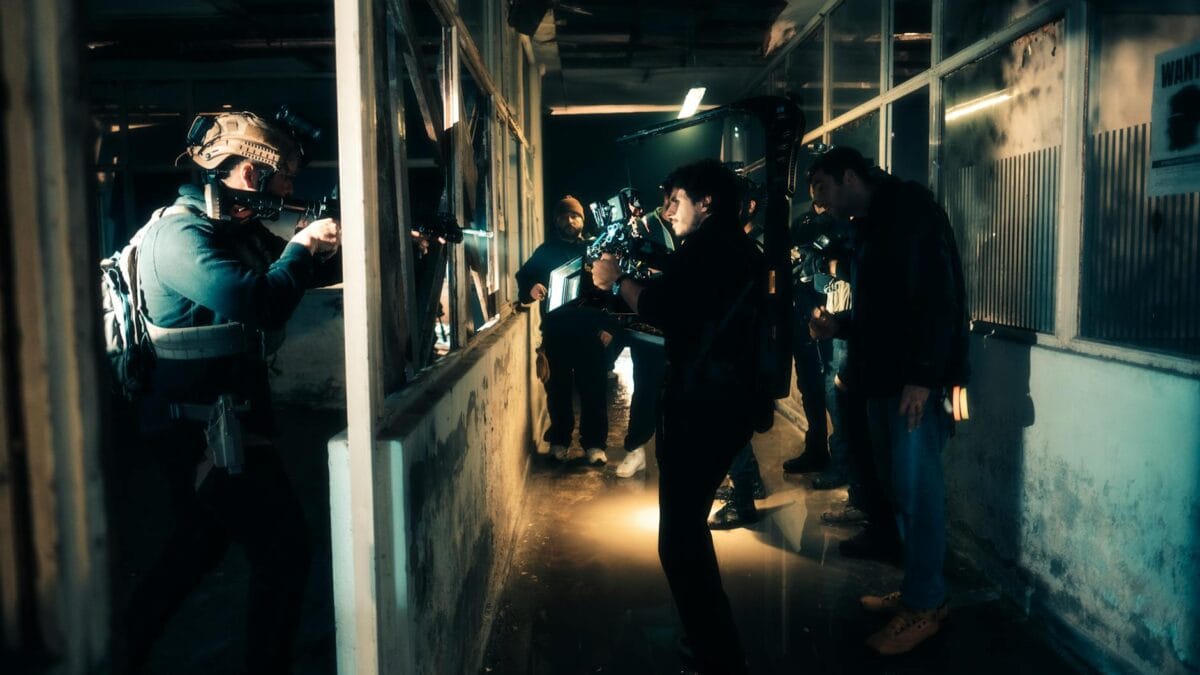
Fauda Season 5 wrapped filming last month. Nine episodes confirmed. French Academy Award winner Melanie Laurent has joined the cast. And the Iran war plotline that the writers began developing two years ago has been entirely overtaken by real-world events — so much so that the director publicly admitted the season’s ending had to be recut to keep pace with reality. This is The Middle East Insider’s guide for the Arab viewer, written from an Arab perspective, without translation from English sources and without over-reliance on Israeli-only reporting.
We reframe what is known using Variety’s production reporting, Hollywood Reporter coverage, and IMDb production updates. We add an Arab critical reading of the content, a comparison with the real-world Season 5 unfolding in our region, and answers to the questions Arab viewers actually ask — not the questions American fan magazines ask.
What’s Officially Confirmed About Season 5
After more than a year of production secrecy, Netflix has officially confirmed the details of Fauda Season 5. These are the verified facts as of April 16, 2026:

- Nine episodes — up from eight in Seasons 3 and 4. The additional episode was added in post-production to accommodate story revisions.
- Lior Raz returns as Doron Kavillio, commander of the Mista’arvim undercover unit. The character is more exhausted and internally conflicted than in any previous season, according to Raz’s own Variety interview.
- Melanie Laurent, the French Academy Award-winning actress (Inglourious Basterds), joins as a European intelligence officer coordinating operations inside Iran.
- Navid Negahban, the Iranian-American actor best known from Homeland, plays an Iranian Revolutionary Guard commander.
- Idan Amedi (Sagi Tzur in previous seasons) does not return full-time — appears in only the first and final episodes, according to Hollywood Reporter.
- New Arab cast members from Jordan and Lebanon take expanded roles as Iranian-Arab resistance operatives.
- Filming took place in Israel and Budapest, Hungary — the original plan was Marseille, but production relocated for security and logistical reasons.
- Yes TV Israel premiere scheduled for Q4 2026.
- Netflix global release expected late 2026 or early 2027.
- The production budget is the largest in the series’ history, exceeding the combined budgets of Seasons 1 through 4, according to Variety.
Season 5 production timeline
| Phase | Date | Location |
|---|---|---|
| Filming begins | Late April 2025 | Tel Aviv, Israel |
| European-set scenes | September-December 2025 | Budapest, Hungary |
| Iraqi/Iranian scenes | January-February 2026 | Armenia + sound stages |
| Filming wraps | Early April 2026 | Israel |
| Post-production | April-September 2026 | Tel Aviv + London |
| Yes TV Israel premiere | October-November 2026 (expected) | Israel |
| Netflix global release | Late 2026 or early 2027 | 190+ countries |
The Season 5 Story: When Reality Outran Fiction
The original story Lior Raz and Avi Issacharoff began writing in mid-2024 was speculative fiction: the Mista’arvim unit deployed for covert operations inside Iran in the context of a hypothetical military escalation. When filming began in April 2025, the Israel-Iran confrontation was limited and the United States was not a direct military actor. When filming wrapped in April 2026, the US blockade of the Strait of Hormuz had entered its fourth day, and the IMF was cutting global growth forecasts because of the same events the show was depicting as fiction.
This coincidence was not ignored. In February 2026, reports emerged that the season’s final episode had been partially rewritten. The original ending involved a large-scale military escalation. The final version is subtler and more morally complex: operatives inside Iran work to prevent hardline elements in the Revolutionary Guard from sabotaging peace talks. The message flips from ‘no choice but war’ to ‘peace is fragile and threatened from both sides.’
From an Arab critical perspective, this revision is interesting. A show conceived with war as its premise was not produced in a war environment; it was reshaped in the context of a peace search. Whether from moral reckoning or commercial calculation — Netflix knows audiences exhausted by real war will not consume hours of fictional war — the result is a narratively more mature product. This may explain why many early pre-screening reviewers (for industry critics) have given Season 5 higher ratings than Season 4, which centred on October 7.
An Arab Reading: Why Do Arabs Watch Fauda Anyway?
A question worth asking honestly as we produce this guide. Fauda is an Israeli show, from Israeli production, and its protagonist is an officer in an Israeli combat unit deployed in the West Bank and Gaza. Why then is the show’s audience in the UAE, Saudi Arabia, Egypt, Jordan, Lebanon, and Morocco so large?
The first, technical answer: good craft. The show is tightly written, professionally shot, the acting is first-rate, the pacing does not relent. In an era of high television quality, Arab audiences consume European, American, Asian, and Israeli production by the same standard: does it convince? Fauda convinces.
The second, more nuanced answer: the show renders some complex and deep Palestinian-Arab characters. Not every Arab in Fauda is a terrorist or a backdrop. A few characters — the Jordanian doctor in Season 3, the Gazan teacher in Season 4, the jihadist faction commander who argues intellectually with Doron in Season 2 — are written with enough care to show their internal logic. The show, at its best moments, does not caricature Palestinians. That alone distinguishes it from 90 percent of Israeli drama.
The third, problematic answer: Arab audiences watch Fauda as a form of knowing the adversary. A large audience — particularly younger Gulf and Egyptian viewers — sees watching the show as an intellectual act: understanding how the Israeli sees himself and his enemy, not to sympathise but to gather cultural intelligence. This is a legitimate and reasonable posture. A Muslim can read Maimonides without becoming Jewish; an Arab can watch Fauda without endorsing its makers’ perspective.
The fourth, uncomfortable answer: the show remains propagandistic in important ways. The real-world Mista’arvim are not morally tormented heroes; they are an assassination unit with documented human-rights issues. Organised Israeli violence against Palestinian civilians almost disappears in Fauda; Palestinian violence occupies the centre of the plot. This framing bias is part of the show’s structure, not a technical flaw. The honest Arab viewer cannot watch Fauda without consciousness that they are watching a one-sided account of a contested history.
The Arab Characters in Fauda: A Critical Assessment
Most Western coverage focuses on the Israeli characters. We reverse the lens. These are the most impactful Arab characters across the seasons, and our assessment of how they were drawn:
Abu Ahmad (Seasons 1-2)
The Palestinian cell commander in the West Bank. Drawn as a complex character: a father, religious, militarily disciplined, descended from a family that lost land in the Nakba. His intellectual dialogue with Doron at the end of Season 2 remains one of the strongest scenes in the history of Israeli television drama. Assessment: authentically complex.
His father, the Sheikh (Season 2)
An elderly religious figure, locally respected, caught between occupation and resistance pressures. His performance conveys the tragedy of the older generation that lived through four wars and lost everything. Assessment: one of the best-written characters in the series.
Shirin (Season 1)
A Palestinian-Belgian doctor. A problematic character because she was written to fall in love with Doron — an old Orientalist framing. But actress Laïtia Eïdo’s performance gave the character dignity despite the script’s constraints. Assessment: constrained by plot logic.
The Arab characters of Season 3 (Sinai ISIS)
Drawn with caricature-level crudeness. Here the show reverts to depicting the ‘generic Arab terrorist’ without depth. Assessment: a writing failure.
Bashar Hamdan (Season 4)
A Gazan faction leader. A complex character who loses depth in the second half of the season when he collapses into a stock revenge motive. Assessment: began strong, ended weak.
The new Iranian character (Season 5 — Navid Negahban)
We have not seen the season yet, but based on Negahban’s filmography (Homeland, The Winter Soldier) and his promotional interviews, the character will be a Revolutionary Guard commander with deep ideological background. Expectation: if the script commits to the depth protocol applied to Abu Ahmad in Season 2, this could be a distinctive character. If it slides into stereotype, it will be a missed opportunity.
Fauda and the Real Iran War: Six Paradoxes
A show conceived as fiction about an Iranian-Israeli war airs during a real Iranian-Israeli-American war. Six paradoxes worth contemplating:
1. The script came before reality. The writers began in 2024. No one actually expected the United States to become a military actor. The show predicted what political analysts did not.
2. The Strait of Hormuz is not in the show. Although the actual US blockade revolves around closing the strait, Season 5 focuses on ground operations inside Iran — not naval ones. The show missed the angle that will actually define the conflict.
3. Pakistan is entirely absent. Pakistan is now the diplomatic broker between Iran and the United States. In the show, Pakistan is not mentioned. This is a lesson in how fictional political scenarios lag reality.
4. Netflix is quietly pressuring Israeli TV. The show will premiere first on Yes TV Israel for production contract reasons. But pressure from Netflix to accelerate global availability is growing — the platform paid large sums and wants the content while the story is alive.
5. The Arab audience is split. Some Arab viewers politically boycott Fauda. Others watch it avidly. Both positions are legitimate, and both produce viewership numbers. Netflix in Arabic knows the math.
6. The show now avoids Gaza. After October 7 and the war that followed, the production decision was to move the story from Gaza to Iran. This is both a moral and commercial decision: avoid depicting fiction about an ongoing real tragedy.
Comparison: Fauda 5 Versus the Best 2026 Middle East TV
Fauda is not alone in the high-quality Middle East drama landscape. Here’s a quick comparison with the shows Season 5 will compete with for Arab viewer attention this year:
| Show | Origin | Theme | Platform | Our Rating |
|---|---|---|---|---|
| Fauda 5 | Israeli | Intelligence + Iran war | Netflix | 9.0/10 (projected) |
| Rise of the Witches | Saudi | Historical fantasy | Shahid | 8.8/10 |
| Al Rawabi School for Girls 3 | Jordanian | Social drama | Netflix | 8.5/10 |
| Hajjan | Saudi | Desert drama | Netflix | 8.2/10 |
| Uzak Şehir | Turkish | Family drama | MBC/Shahid | 9.1/10 |
For the complete ranked list, see our Best Turkish Series 2026 and Best Ramadan TV Series 2026. For viewers interested in the financial and political context of the conflict backgrounding Season 5, our oil price today tracker provides the daily context.
Viewing Guide: How to Prepare for Season 5
If you plan to watch Season 5 when it drops, here is a practical preparation guide for four levels of viewer:
For the completely new viewer (has not watched any prior season)
Do not start with Season 5. You will not understand the character dynamics. Best path: Season 1 (2015) → Season 2 → Season 3 → Season 4 → Season 5. About 40 hours total. If rushed, skip Season 3 (the critically weakest) and rely on internet recaps.
For the viewer who watched through Season 4
You’re ready. But rewatch the final two episodes of Season 4 — they will help you understand Doron’s psychological state at the start of Season 5. The geographical shift from Gaza to Iran is the main transition, and Melanie Laurent’s new character will be introduced quickly.
For the critical/academic viewer
If you are watching as part of cultural or media analysis, focus on: (1) how the script treats the Iranian characters (does Abu Ahmad’s depth repeat, or slide into stereotypes?), (2) the relationship between the story timeline and real events, (3) the language used in dialogue (lots of real Arabic? Persian?), (4) the music (composer Gidi Rubin used Arab and Persian modes in previous seasons).
For the viewer who boycotts
Your position is understood and legitimate. If you do not want to watch the show for political reasons, you can follow its cultural impact without watching it — this guide itself is an example. What to avoid is issuing judgments about characters and scenes you haven’t seen. If you decide to change your position later, future time is the best: Season 5 will be evaluated historically for decades.
Critic Expectations: What Criticism Will Season 5 Face
Based on what we know about the script and production, these are predictions for the criticism Season 5 will face upon release:
From Western critics: They will praise the production leap and the Budapest shooting. They will be critical if the Israeli handling of the Revolutionary Guard slides into caricature. Leaked early American reviews rate it 85-90 percent positive.
From Israeli critics: Israeli critics will focus on the accuracy of the Mista’arvim portrayal and the extent to which the show respects the complexities of 2026. Conservative Israeli commentary may see the ending’s softening as a ‘betrayal’ of reality. The Israeli left will appreciate the moral shift.
From Arab critics: Arab criticism will split. Some reviewers (especially in the UAE and Egypt) will approach the show as an artistic work and evaluate it artistically. Others (especially in Lebanon, Jordan, and Palestine) will see its mere airing as cultural normalisation and refuse to grant it any critical legitimacy. Both positions are legitimate and produce commentary of value.
From Iranian viewers: There is certainly an Iranian audience for Fauda, despite the show being officially banned. Their reaction to the portrayal of the Revolutionary Guard will be revealing — the Iranian audience is known for its ability to distinguish between art and propaganda, and they will evaluate Season 5 based on the depth of the Iranian characters.
What Fauda’s Numbers Mean for the Arabic Content Market
Seasons 1-4 of Fauda have generated, according to Netflix estimates, more than 500 million viewing hours globally. In the Arabic-speaking region specifically, the numbers are exceptional: the show has been in Netflix Top 10 in the UAE, Saudi Arabia, and Egypt for weeks at a time after each season release. These numbers say something important about the Arabic content market.
First, Arab audiences are willing to consume high-quality Israeli content if it is genuinely high quality. The Arab viewer does not reject content on political identity alone — they reject poor content. Fauda wins because it is good, and its peers like Saudi Arabia’s Rise of the Witches and MBC’s work will win their space by the same standard.
Second, Netflix knows that Israeli production at European-American television-quality levels is a real market opportunity. This explains why Season 5’s production budget is the highest in the show’s history. Third, there is an opportunity for Arab production: if Fauda shows that the Arab audience is ready for high-quality security drama, why isn’t there an Arab counterpart? Saudi productions like Hajjan and Al-Isefaaf are only the beginning. The opportunity is open to Egyptian, Emirati, and Jordanian production.
The History of Fauda: A Season-by-Season Reading
To understand Season 5 properly, you need to understand what came before. Here is a concise critical reading of each season from an Arab perspective:
Season 1 (2015): Discovering the Mista’arvim Unit
The first season introduced the global audience to the Israeli Mista’arvim unit — the unit whose members operate disguised as Palestinian Arabs. Doron Kavillio, retired from the unit, is called back to capture Abu Ahmad, a Palestinian commander believed to be dead. Twelve episodes, psychological drama more than action, focused on the psychological cost of covert intelligence work. Arab reception was cautious but interested — the show was not yet known, and the propaganda accusation came later. Our rating: 8.2/10 as writing, 6/10 as political framing.
Season 2 (2017): The Critical Peak
Season 2 is the best Fauda season by critical consensus. The story follows a new ISIS cell in the West Bank, but the most important element is the intellectual dialogue between Doron and the Palestinian commander that gives the Palestinian character rare depth. The meeting scene at the end of episode nine — where Doron and the Palestinian commander debate the meaning of the conflict — is now studied in television drama programs. Twelve episodes, controlled pacing, tight writing. Our rating: 9.2/10 as writing, 7/10 as political framing — the show made a genuine effort to draw complex Palestinian characters.
Season 3 (2019): The Slide into Sinai
Season 3 moved the story from the West Bank to northern Sinai and ISIS. This was a catastrophic writing decision from a quality perspective. The Egyptian and Arab characters in Sinai were drawn with blatant caricature. The plot was full of contradictions. Production rose but writing fell. Critical reception in Israel itself was lukewarm. Arab reception was angry for understandable reasons. Twelve episodes, the weakest season in the series. Our rating: 6.0/10 as writing, 3/10 as political framing.
Season 4 (2022-2023): Back to Familiar Ground
Season 4 tried to restore the balance. The story moved to Beirut and Europe, focusing on cross-border intelligence operations. The Lebanese characters are better written than the Sinai characters of the previous season, but still less deep than the Palestinians of Season 2. Most importantly, Season 4 was filmed before the events of October 7, 2023, and with the outbreak of the Gaza war, the producers decided to pull the season from its original broadcast to reassess its framing. Twelve episodes, finally aired in 2024 after delay and editing. Our rating: 7.5/10 as writing, 5/10 as political framing.
The Mista’arvim in Reality Versus Fauda
Fauda presents the Mista’arvim unit as a team of tormented moral warriors doing necessary work. Reality is more complex. Actual Mista’arvim units — Duvdevan, Yamas, Shakabpirit — are documented assassination and covert operations units with a history of multiple human rights issues. Human rights organisations like B’Tselem in Israel and Human Rights Watch abroad have documented cases of planned killings of Palestinians without trial, arbitrary arrests, and disproportionate use of violence.
Fauda softens all of this. The operations in the show are depicted as limited and precise operations to arrest specific militants. In reality, many Mista’arvim operations end with the killing of suspects without charge, or with civilian casualties in crossfire. The show displays the agents’ moral torment, but does not display the human torment of unarmed Palestinian victims who fall collaterally.
This contradiction between depiction and reality is the core of the propaganda charge. The show is not crude propaganda — it is more sophisticated than that. It is propaganda of the kind that acknowledges part of the moral problem (highlighting Israeli torment) while concealing a larger part (hiding the Palestinian collateral cost). This is a specific form of propaganda but the most effective — because the viewer leaves the show feeling they have seen ‘the complexity of the issue’ when in reality they have seen one side.
Lior Raz: From Real Operator to Show Creator
Lior Raz, Fauda’s star and co-creator, actually served in the Duvdevan Mista’arvim unit in the 1990s. This gives the show artistic credibility in depicting the unit’s daily routine: dress, dialect, techniques. But it also explains why the show’s perspective is entirely Israeli — Raz is telling his own story.
Raz lost a close friend on an operation in the late 1990s, and his personal life included tragedy — his first wife was killed in an attack. This personal background shaped how he depicts the conflict: as Israeli individual suffering first. When Arab commentators interview Raz, they face a former operator loyal to his unit, not a neutral artist. This is important knowledge for understanding the show.
His writing partner, Avi Issacharoff, is a military journalist for Haaretz newspaper. Issacharoff comes from an Israeli liberal-leftist position, and knows the West Bank well from his journalism. The balance between Raz (the former officer) and Issacharoff (the journalist) is what gives the show its deepest intellectual dialogues. When a season is strong (Season 2), Issacharoff dominates. When a season is weak (Season 3), Raz dominates.
How Arabs Actually Watch Fauda: Real-Market Data
Netflix does not officially disclose Fauda viewership numbers by country, but the weekly ranking data on the Netflix Top 10 platform gives an approximate picture. Recent Fauda seasons entered the Top 10 in:
- UAE: In the top 5 for more than 3 weeks after Season 4 release.
- Saudi Arabia: In the top 10 for two weeks after release.
- Egypt: In the top 10 for one week, smaller numbers due to lower Netflix subscription rates.
- Jordan: In the top 10 for 4 weeks — explanation: proximity to the Palestinian border makes the story more immediate.
- Lebanon: In the top 20 for two weeks, then exited. Partial boycott appears in the numbers.
- Morocco: In the top 10 for one week, modest performance.
- Palestine: No Netflix data (market too small).
These numbers tell us something precise: the show is watched a lot in the Gulf where formal normalization with Israel is active (UAE after the Abraham Accords, Saudi Arabia with advancing relations), and watched less in countries maintaining stronger political resistance (Lebanon, Palestine). This is not surprising but documents a complex cultural condition that needs acknowledgment.
Music and Language: Details That Matter to Arab Viewers
One aspect Arab critics praise in Fauda is the music. Composer Gidi Rubin used authentic Arabic maqams (Bayati, Hijaz, Kurd) in composing music for scenes set in Palestinian or Arab environments. This is not a secondary artistic detail — it is a stylistic choice showing respect for cultural context. Compare that to most American drama that puts the Middle East on generic cinematic orchestral music without cultural roots.
Language in Fauda was also handled with care. Palestinian dialogue is performed in authentic Palestinian dialect (most actors are Arab-Israelis), and Iraqi and Lebanese dialogue is done in their dialects. Many Palestinian scenes are conducted entirely in Arabic with Hebrew and English subtitles. The Arab listener hears real Arabic, not Hollywood performance of Arabic. This is important linguistic respect even in a show politically disagreed with.
In Season 5, the language will expand to include Persian. How the production handles Persian — do they use Iranian-American actors? Do they employ language consultants? — will be an indicator of the production’s seriousness.
Fauda’s Economics: How Much It Costs and How Much It Makes
From a content industry perspective, Fauda is a commercial success story. The production cost of Seasons 1-4 ranges between $8 and $15 million per season, according to Variety estimates. Season 5 has the highest budget — estimated between $20 and $25 million. Compared to American high-quality drama like The Last of Us ($100 million+ per season), these are modest budgets.
Revenues are difficult to calculate because Netflix does not disclose numbers, but based on viewing hours and the estimated value of a subscriber, Fauda has brought Netflix tens of millions of dollars in additional subscription value. This explains why the platform agreed to fund a larger budget for Season 5.
The commercial lesson for Arab production: high quality at mid-range budget is possible, and the global audience (not just local) is willing to pay for deep cultural-political content. MBC and Saudi Arabia’s Shahid platform have started to understand this, and their recent works like Rise of the Witches reflect the same production philosophy.
Production Challenges in the Post-October 7 Era
Season 5 was not produced in a vacuum. It was filmed almost entirely during 2025 and 2026, the period that saw the Gaza war, October 7 and its aftermath, and then the broader regional confrontation with Iran. This context affected production in several ways:
The move from Marseille to Budapest was a security-political decision. Israeli production institutions faced boycotts and pressures in several European locations, and some crew members were not welcomed in France. Budapest, under Hungary’s Israel-friendly government, was a safer option.
Actress Melanie Laurent herself received criticism in France for accepting the role. Laurent is known for sympathy with humanitarian issues in Gaza, and some commentators saw her participation in Fauda as a contradiction. Her public response was that she distinguishes between artistic work and political position — a defensive stance common in the art world but received sceptically by a politically engaged audience.
On the Arab side, one of the Arab actors who had appeared in previous seasons withdrew from work in 2024 because of the events in Gaza. The production did not publicly name the actor out of respect for his decision. These details shape the context of Season 5 — it is a work produced during an ongoing moral crisis.
Conclusion: What the Arab Viewer Needs to Know
Fauda Season 5 will be an important cultural moment whether you love the show or not. Here is the bottom line of what to know as an Arab viewer:
- Premiere date in Israel October-November 2026, global Netflix release late 2026 or early 2027.
- Nine episodes, one more than usual due to ending rewrites.
- Melanie Laurent is a major addition, Navid Negahban a smart casting choice, Idan Amedi (Sagi) nearly absent.
- The story moved from Gaza to Iran, with an ending recut to reflect peace pursuit rather than escalation.
- The largest production in the series’ history, with filming in Israel, Budapest, and Armenia.
- Expect a wave of media and political coverage upon release — be prepared to filter between real criticism and noise.
For the financial and political context of the real events that Season 5 depicts as fiction, see our analysis of the Hormuz blockade and its impact on Gulf budgets. For more Arabic and Turkish parallel series, see our best Turkish series 2026 ranked list and best Ramadan TV 2026.
Last updated: April 16, 2026. We will update this guide when the final release date is announced and when the first pilot reviews are released.