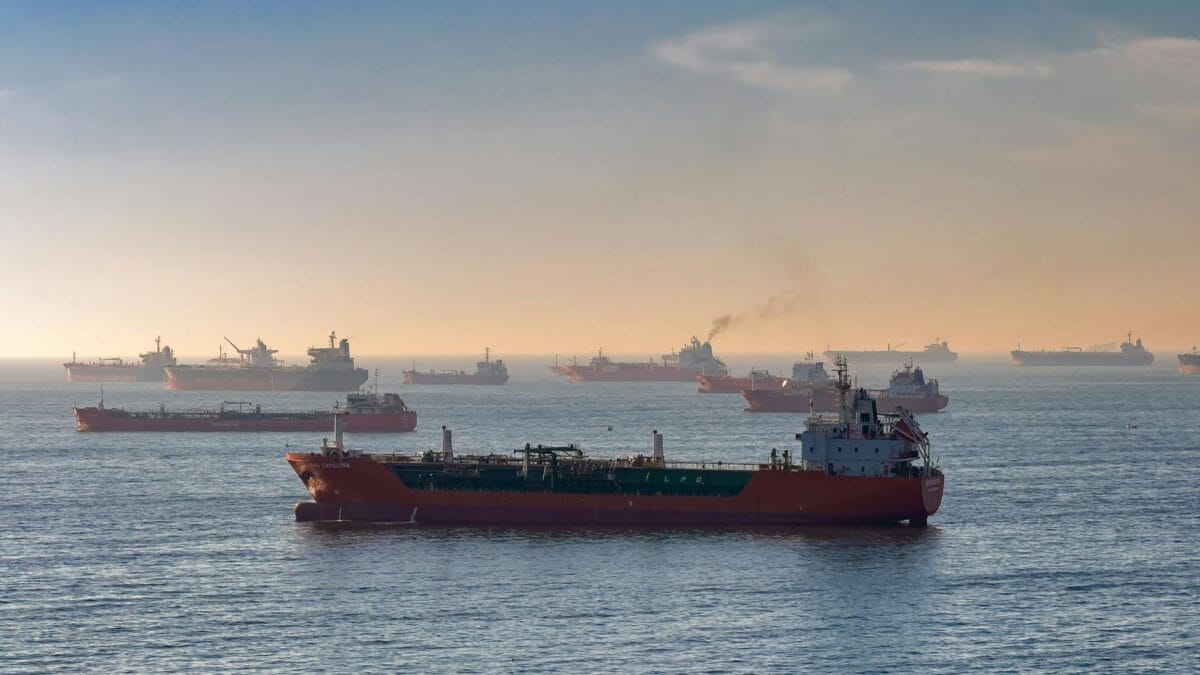
The US blockade of the Strait of Hormuz is now in its fourth day. Saudi Arabia, the country that ought to benefit most from rising oil, just quietly raised another multi-billion dollar tranche of sovereign debt. That contradiction — windfall revenues in the headlines, tightening budgets on the balance sheet — is the story Wall Street models miss when they print a $200-per-barrel scenario chart.
This analysis lays out what has actually changed since April 10, why the Gulf fiscal math does not work the way the commodity desks in New York say it does, and what Egypt, Saudi Arabia, the UAE, Kuwait, and Iraq are each doing this week to protect their 2026 budgets. We use primary data from the IMF Regional Economic Outlook for the Middle East and Central Asia released today, the IEA Oil Market Report for April 2026, and reporting from Bloomberg’s Hormuz oil shock tracker, CNBC’s blockade coverage, and Al Jazeera’s IMF downgrade reporting.
The Blockade Is Now Real: What Day 47 Actually Looks Like
On April 15, 2026, US Central Command declared the blockade of Iranian ports on the Strait of Hormuz ‘fully implemented.’ Ten Iranian vessels have been intercepted since the naval cordon began. The US Treasury added 24 entities — shipping companies, front firms, and individual captains — to the Specially Designated Nationals list on April 16, targeting the grey-market chain that had kept Iranian crude flowing to Chinese and Pakistani refiners.

The numbers beneath the headlines are stark. Iran’s oil export revenue has collapsed by an estimated $435 million per day. Roughly 80 percent of Iran’s export earnings flow through Hormuz, and the blockade has now removed most of that flow from the market. Iran’s National Petrochemical Company announced on April 13 that it was suspending petrochemical exports ‘until further notice’ to prioritise domestic supply — a euphemism for collapsing logistics.
The spillover hit third countries first. India — the world’s third-largest oil importer and historically a major buyer of discounted Iranian and Russian crude — has lost approximately 3 million barrels per day of Hormuz-routed supply. Indian refiners are scrambling for Russian Urals and West African grades, paying insurance premiums that have tripled since March. Pakistan, Turkey, and Egypt are all absorbing secondary shocks through diesel and jet fuel prices.
The market reaction has been surprisingly measured. Brent crude is sitting at roughly $96.31 per barrel, up about 8 percent since the blockade was declared, but well below the panic prices priced in futures strips for June and July. Traders are telling us two things at once: the market believes a diplomatic off-ramp exists, and the market is under-hedged if that off-ramp fails.
Day 47 in numbers
| Metric | Value | Source |
|---|---|---|
| Iranian daily revenue loss | $435 million | US Treasury estimates |
| Indian barrels displaced per day | 3 million | CNBC/Reuters composite |
| Iranian vessels intercepted | 10 | US CENTCOM |
| Treasury SDN additions April 16 | 24 entities | US Treasury |
| Brent crude price | $96.31/barrel | Live market data |
| WTI crude price | $89.40/barrel | Live market data |
| Gold per gram | $155.27 (8,045 EGP) | MEI price engine |
Track the daily number on our canonical oil price today tracker, updated every hour.
Why Wall Street’s $200/Barrel Scenario Is No Longer a Joke
Three weeks ago the idea of Brent at $200 per barrel was a research-desk thought experiment. This week it has moved into baseline risk models at JPMorgan, Goldman Sachs, Citi, and Standard Chartered. Two things changed.
First, the blockade is now bilateral. The US is intercepting Iranian vessels and Iran has signalled it will retaliate by targeting Gulf shipping lanes. Any single successful Iranian strike on a Saudi or Emirati export facility — the Ras Tanura terminal, the Jebel Ali port, the Fujairah storage complex — would immediately take a multiple of Iranian output off the market and send insurance rates into uncharted territory. War-risk insurance on Gulf tankers is already up 400 percent since early March.
Second, the spare-capacity cushion that OPEC+ historically used to cap price spikes is narrower than the cartel admits. Saudi Aramco can deliver perhaps 2 million additional barrels per day within 30 days. The UAE can add another 500,000. Iraq, Kuwait, and Nigeria are effectively capped at current output. That total — roughly 2.5 to 3 million barrels per day — is less than what has already been lost via Hormuz friction and Iranian sanctions enforcement.
The asymmetry is what drives the $200 tail. Below a certain threshold the price rises gradually as traders arbitrage substitute grades. Above that threshold — probably around $130 in our base case — the replacement barrels are simply not there, and the price function becomes step-shaped. A single incident in the Gulf could therefore push Brent from $120 to $180 inside a trading day.
The three Brent scenarios we are tracking
| Scenario | Brent Range | Trigger | Probability (MEI) |
|---|---|---|---|
| Base | $95–$115 | Blockade continues, no Gulf infrastructure hit, Pakistan-brokered ceasefire partial | 55% |
| Escalation | $120–$160 | Blockade tightens, Iran strikes shipping, OPEC+ cannot replace fast enough | 30% |
| Break | $75–$85 | Pakistan-brokered ceasefire holds, Iranian supply returns to market | 10% |
| Black swan | $180–$220 | Saudi or Emirati export infrastructure directly damaged | 5% |
Bloomberg’s own scenario tree, published this week, assigns a roughly 25 percent probability to a full Hormuz closure lasting more than 30 days, a case in which their model produces sustained Brent above $150. We are slightly less bearish because we believe the Pakistani diplomatic track has real substance — but the tail is fat either way.
Gulf Fiscal Breakevens at $200: The Math Wall Street Skips
The reflexive Wall Street narrative is that any Gulf oil producer benefits linearly from higher prices. This is wrong, and it has been wrong since 2015 when the region quietly re-anchored its sovereign finances around spending commitments that require ever-higher oil.
The IMF’s April 2026 Regional Economic Outlook, released this morning, puts MENAP growth at 3.7 percent for 2026 and projects Iran contracting by 6.1 percent (a 7.2-point downward revision from the January 2026 outlook). More importantly for our fiscal discussion, the Fund revised fiscal breakeven estimates upward for every major GCC producer.
2026 fiscal breakeven oil prices (IMF estimate + MEI analysis)
| Country | Fiscal breakeven $/bbl | Current fiscal position | Net reaction to $200 |
|---|---|---|---|
| Saudi Arabia | $94–$96 | Deficit at $96 Brent | Windfall on revenue, offset by Vision 2030 capex overruns |
| UAE | $55–$60 | Comfortable surplus | Strong net positive, but non-oil GDP slows |
| Kuwait | $68–$72 | Modest surplus | Positive, but structural salary bill rises |
| Iraq | $78–$82 | Near breakeven | Mixed — depends on export infrastructure |
| Qatar | $45–$48 | Strong surplus (LNG) | Net positive via LNG spot |
| Oman | $82–$85 | Fragile | Positive, but debt profile matters |
| Bahrain | $118–$122 | Deficit | Still deficit even at $200 |
The counterintuitive headline: Saudi Arabia, Bahrain, and Oman run deficits even at current Brent. Bahrain keeps deficits at any oil price below $118 because its production is small and its spending commitments are large. Saudi Arabia’s breakeven has drifted higher because the Kingdom front-loaded NEOM, Qiddiya, and the Diriyah Gate investments at a time when it expected a multi-year $100+ price environment. When prices failed to cooperate in 2024 and 2025, Riyadh chose to borrow rather than cut — and that borrowing cost is now compounded by higher US Treasury yields.
The flip side is that the UAE, Qatar, and Kuwait genuinely do benefit from higher oil. Emirates NBD’s research desk estimates that sustained Brent above $110 would add roughly 1.5 percentage points to UAE GDP growth in 2026 and push the federal surplus above 5 percent of GDP. For our detailed analysis of how these Gulf fiscal dynamics interact with currency reserves and sovereign wealth flows, see our gold price today tracker, which follows the central-bank buying that tends to accelerate in parallel.
The Egypt Equation: Why $200 Oil Is a Two-Sided Blade
Egypt sits in a peculiar position in the Middle East oil economy. The country is a net importer of refined products, a net exporter of natural gas (though shipments have been erratic since 2024), and a major beneficiary of Suez Canal traffic and Gulf remittances. Each of these flows responds differently to a higher oil price.
The subsidy bill is the immediate pain point. Egypt’s fuel subsidy programme covers diesel, LPG, and partially petrol. Every $10 increase in Brent adds roughly $1.8 billion to $2.2 billion to the annual subsidy bill at current consumption volumes. At $200 Brent that additional cost would blow through the IMF programme’s primary surplus target and force either a devaluation, a subsidy overhaul, or a return to the central bank for monetary financing. None of those options is politically painless.
On the other side of the ledger, Suez Canal revenue spikes when Gulf tanker routes become uncertain. Oil tankers that would normally transit the canal head-on are being rerouted around the Cape of Good Hope, adding 10–14 days and roughly $2 million per voyage. Canal transits have dropped 22 percent year-over-year, but transit fees per vessel have risen, partially offsetting the volume loss.
Remittances from Gulf expatriate Egyptians — roughly $31 billion in the prior fiscal year — tend to rise when Gulf economies run hot. Early 2026 data suggests remittance growth is accelerating, giving the Egyptian current account a quiet but meaningful cushion.
The Egyptian crossover point
Our internal model suggests Egypt is net-positive on oil up to roughly $115–$120 per barrel Brent. Above that level, the subsidy bill and the EGP depreciation pressure begin to outweigh the Canal and remittance upside. The Central Bank of Egypt’s reserve position — just under $48 billion in March 2026 — is comfortable but not infinite, and it would erode quickly at sustained $150+ oil.
The gold and dollar signal for Egyptian savers is clear. At $155.27 per gram ($8,045 EGP/gram) for 24-karat and $135.86 per gram ($7,039 EGP/gram) for 21-karat — the karat Egyptian households actually buy — gold remains the hedge of choice against both dollar strength and oil-driven EGP pressure. The dollar sits at 51.81 EGP. Our USD to EGP tracker is updating hourly, and our gold price today page carries the full karat-by-karat breakdown.
Who Wins, Who Loses, and Who Pays the Bill
Step back from the country-level math and the picture clarifies. The winners of $150+ oil are a narrow group: Qatar (LNG), the UAE (low breakeven + diversified revenue), Kuwait (cushion), Norway (non-OPEC hedge), and — surprisingly — Russia, whose discounted crude has become the default Plan B for Asian importers that can no longer source Iranian barrels.
The losers are most of the world. The IMF cut its 2026 global growth forecast to 3.1 percent, down from 3.3 percent in the January Update, directly citing the Hormuz situation. Germany, Japan, and South Korea — all heavily energy-import-dependent manufacturing economies — face renewed recession risk. Emerging markets without oil endowments (Turkey, Pakistan, Egypt, Morocco, Bangladesh) face the dual blow of higher oil prices and stronger dollar financing conditions.
The hidden cost is distributed through the insurance and shipping chain. War-risk premiums on vessels transiting the Gulf have risen from roughly 0.125 percent of hull value in January to 0.9 percent today. Those premiums are passed through to cargo prices, which are passed through to end consumers, which shows up as inflation six to nine weeks later. This is how the Gulf conflict will appear on a European grocery receipt in June.
OPEC+ at the Crossroads: The Decision Three Weeks Away
The next OPEC+ Joint Ministerial Monitoring Committee meeting is expected in the first week of May 2026. Three decisions are on the table, and the rest of the market is reading every Gulf statement for signals.
The first option is to hold production steady. This is the default if Saudi Arabia believes the blockade is resolving — either via Pakistani diplomacy or because the US runs out of patience. Holding keeps the risk premium intact, keeps Saudi revenue elevated, and lets the Kingdom continue its quiet debt issuance programme.
The second option is a modest, token output increase of perhaps 500,000 to 800,000 barrels per day. This is our base case. It lets the cartel claim price-stabilisation credit, appeases Washington enough to maintain the strategic relationship with Riyadh, and still leaves significant spare capacity in the locker. Saudi and UAE messaging this week has been conspicuously market-friendly, hinting at willingness to add barrels.
The third option is a coordinated spare-capacity release of 1.5 to 2 million barrels per day. This only happens if Brent pushes decisively above $130 and stays there. In that case the cartel’s priority shifts from revenue maximisation to avoiding a global recession that would crater long-term demand. The memory of 2015 and the lost decade of stranded high-cost investments is still fresh in Riyadh.
Our view is that option two is the most likely outcome, but option three is the one markets should actually be hedging. An announcement of a 1.5 million bpd release could take $20 off Brent inside 48 hours — a violent move in either direction depending on how it is priced going into the meeting.
What Gulf Finance Ministries Are Doing This Week
Public statements are diplomatic; balance-sheet actions are revealing. In the last ten days we have tracked the following moves from Gulf sovereign finance operations:
- Saudi Arabia tapped the international dollar bond market for a reported $12 billion tranche, oversubscribed 3.5x. The capital raise was framed as Vision 2030 funding but looks more like fiscal cushion-building.
- UAE accelerated its ADQ-backed sovereign investment programme, with two large acquisitions announced in Egypt and Turkey that will lock in long-term non-oil revenue streams.
- Kuwait saw its parliament finally approve the long-delayed public debt law, unlocking a $30 billion borrowing envelope that Treasury had been lobbying for since 2023.
- Qatar used its LNG spot-price bonanza to fund the Ras Laffan capacity expansion — a pure hedge against a post-conflict oil price collapse.
- Oman saw its sovereign rating affirmed at BBB- by Fitch, citing fiscal discipline. But the country’s bond curve widened 40 basis points this week on Hormuz risk.
- Bahrain quietly restructured a $2 billion syndicated facility coming due in Q3 2026 — the first real stress signal from the smaller GCC members.
The pattern is consistent. Gulf sovereigns are treating the current price as a one-time windfall, not a permanent condition, and positioning their balance sheets accordingly. They do not believe $200 is sustainable, and they do not want to be caught over-committed when the price eventually normalises.
The Investor Playbook: Six Assets That React First
For readers positioning portfolios this week, the signal chain from a Hormuz escalation is predictable in order, less so in magnitude. The first-mover assets are the ones to watch for early warning.
- Brent–WTI spread. At $7/barrel today. A sudden widening to $12+ is the first sign that a Gulf-specific event is being priced. Monitor our oil price tracker.
- Gold in USD per gram. Central-bank buying is a lagging indicator, but retail EGP gold demand in Egypt is a leading one. Any break above $160/gram in USD terms is the ‘risk is spreading’ signal. Our gold price today page shows the live number.
- USD/EGP. Egypt is the first emerging market to break when oil-driven dollar demand spikes. A move from 51.8 to 54+ would indicate the CBE is letting the currency absorb the shock. Track at USD to EGP today.
- EGX 30. The Egyptian stock market has underperformed MSCI EM by 9 points YTD. A break below 34,000 would signal local capital is exiting. See EGX stocks today.
- Saudi Tadawul and UAE DFM. Both indices have held up surprisingly well. A sudden underperformance versus Brent-correlated equities elsewhere would indicate that Gulf retail is repositioning defensively.
- BDI and Baltic Dirty Tanker Index. The freight indices are where the blockade cost is priced first. Both are already up 35 percent versus March; a doubling from here would be the canary.
Expert Perspectives
Reuters quoted a senior OPEC+ delegate this week as saying ‘the market is testing us, not Iran’ — a reference to the asymmetric pressure on the cartel to either absorb the supply loss or accept higher prices that invite recession. The Financial Times editorial board wrote on April 14 that ‘the blockade will end only when either Iran capitulates or the US recession probability crosses 50 percent.’ That framing — that the blockade is itself a financial instrument whose price is recession risk — is the clearest analytical frame we have seen.
Gulf-based analysts are more sanguine. Emirates NBD’s chief economist, in a note to clients circulated Tuesday, argued that the region is better positioned than in 1973 or 1990 to absorb a supply disruption, pointing to diversified export bases, sovereign wealth fund reserves over $3 trillion, and domestic demand resilience in the UAE and Saudi Arabia. The counter-argument — which we find more persuasive — is that the 1973 analogue is not the right one. 1973 was a supply-side shock into a demand-healthy global economy. 2026 is a supply-side shock into a global economy already dealing with central-bank tightening lags, fragile Chinese property finance, and an AI capex bubble that has not yet deflated.
What to Watch in the Next 72 Hours
Three events will define the trajectory into next week:
- Pakistani mediation outcome — any concrete ceasefire framework emerging from the Islamabad talks removes $15–$25 from Brent inside two trading days.
- Iranian retaliation signalling — any successful or near-miss attack on a Gulf asset pushes the escalation scenario from 30 to 55 percent probability and moves Brent to $130+.
- Saudi Arabia’s official fiscal comment — the Finance Ministry is expected to update its 2026 budget assumptions later this month. Any revision above $95 breakeven oil formalises the borrowing posture.
For live coverage, our oil price today page is updating hourly, and our gold price tracker carries the parallel safe-haven move. Entertainment readers following the parallel Fauda storyline will find our Fauda Season 5 release hub — the show’s Iran war plot arc was rewritten in post-production specifically because the real conflict outpaced the fictional one.
The Historical Analogues That Actually Fit
Every oil-shock analysis begins with 1973, 1979, and 1990. The comparisons are useful, but they are also misleading because each of those episodes had a specific supply and demand configuration that does not match 2026. Drawing the wrong analogue leads to the wrong hedge.
The 1973 embargo by Arab members of OPEC was a producer-led action in response to Western support for Israel during the Yom Kippur War. It removed roughly 4 million barrels per day from the market at a time when spare capacity outside OPEC was negligible. Brent-equivalent prices quadrupled, from about $3 to $12, inside six months. The demand side was not ready — the US had no strategic petroleum reserve, Japan was entirely import-dependent, and Europe had no coordinated energy policy. The 2026 situation has most of those cushions in place: the US SPR, the IEA’s coordinated-release mechanism, ample floating storage in the Atlantic Basin, and meaningful demand-side flexibility from EVs and industrial substitution.
The 1979 Iranian Revolution shock is closer to today’s configuration but still imperfect. Iran’s exports collapsed by roughly 5 million barrels per day as the Shah fell and production infrastructure was damaged. Saudi Arabia increased output, but the market price still doubled because Iran’s outage coincided with the second shock of Iraq invading Iran the following year. The 2026 analogue is sharper: Iran’s exports are already impaired by sanctions before the blockade; the additional lost volume is perhaps 1.5 million barrels per day, not 5 million. But the fat-tail risk — that Saudi or Emirati infrastructure is compromised — would convert 2026 into an even more severe 1979-plus-1980 scenario.
The 1990 Iraqi invasion of Kuwait is the most useful analogue for the current moment. Iraq and Kuwait together produced roughly 4 million barrels per day in the pre-war months. The invasion removed nearly all of it. Brent doubled from $15 to $30 inside 90 days, then collapsed as Saudi Arabia brought spare capacity online and the coalition liberated Kuwait. The key lesson: markets respond to volume impairment, but they re-price rapidly when the impairment proves bounded. The 2026 Hormuz blockade is, so far, a demonstrably bounded event — US officials have described it as ‘targeted at Iran, not the region.’ That framing is the single most important reason Brent has not broken above $110.
The Sector Impact Map: Who Is Feeling This First
Oil price shocks do not hit economies uniformly. They hit specific sectors first, propagate through supply chains over six to twelve weeks, and eventually show up in aggregate numbers. For investors and business operators, knowing the propagation order is what separates genuine tactical positioning from noise.
Airlines and aviation
The global airline sector is the first real-economy sector to feel a jet fuel price spike. Jet kerosene is tracking at roughly $115 per barrel equivalent, up 18 percent in three weeks. Emirates, Qatar Airways, Saudia, EgyptAir, and Etihad have all raised their internal fuel-hedge assumptions for the second quarter. The International Air Transport Association has warned that sustained Brent above $100 would cut the industry’s 2026 profit forecast by 35 percent. Ticket price increases of 8 to 12 percent on intercontinental routes are now being modelled for summer.
Manufacturing and petrochemicals
Manufacturing in the Gulf, Egypt, and Turkey faces a double hit. Input costs for plastics, fertilisers, and refined chemicals rise directly with oil. Simultaneously, the weak currencies in Turkey and Egypt amplify the local-currency impact. Egyptian industrial production growth was tracking at 4.1 percent in March; our model suggests it falls to 1.8 percent by July if Brent averages $110. Saudi SABIC and Emirates Global Aluminium have signalled rising input costs in their Q1 outlook calls.
Shipping and logistics
Container shipping rates on the Asia-to-Europe route are up 42 percent since February as vessels reroute around the Cape. The Baltic Dirty Tanker Index has risen even more sharply. Insurance premium inflation is already being passed through to freight rates, which will show up as higher consumer goods prices in Europe and the Gulf by early summer.
Agriculture and food security
The indirect food-price channel is often underappreciated. Fertiliser prices — particularly urea and ammonia — track natural gas and oil. Egypt, which imports roughly 60 percent of its wheat, is exposed to both direct shipping cost inflation and indirect fertiliser input cost pressure. The government’s subsidised bread programme is vulnerable if oil averages above $110 for two consecutive quarters.
Real estate and construction
The Gulf real-estate cycle is surprisingly resilient to oil-price shocks of short duration. Historical analysis suggests that Dubai and Riyadh property prices track 12 to 18 months behind oil, meaning any 2026 shock would not show up in real-estate headlines until mid-2027. The more immediate impact is on construction input costs — steel, cement, aluminium all rise with the petrochemical complex. Vision 2030 projects and NEOM specifically could see 8 to 14 percent capex inflation in 2026 that was not in the January plans.
Central Bank Responses: The MENA Monetary Picture
The conventional playbook says oil-importing countries cut rates to support growth and oil-exporting countries hold or raise to control inflation. The 2026 configuration is messier because of the global backdrop: the Fed is expected to cut in June, the ECB is mid-cycle, and the dollar is ambiguous. MENA central banks are therefore making idiosyncratic choices.
The Central Bank of Egypt has held the policy rate at 27.25 percent since February, delaying the cuts it had telegraphed for Q1. Governor Hassan Abdalla’s public messaging has shifted from ‘gradual easing path’ to ‘conditional easing subject to external stability’ — code for ‘oil and the EGP determine the next move.’ If Brent averages above $110 in Q2, the CBE will likely delay any cut until September. That is a significant change from the January base case, which had 150 basis points of cuts by June.
The Saudi Central Bank, SAMA, moves in lockstep with the Fed because of the riyal-dollar peg. The Kingdom’s liquidity conditions therefore depend on US rate decisions, not regional circumstances. The UAE Central Bank operates similarly. What is new in 2026 is that both central banks have quietly accelerated their gold reserve accumulation — the Gulf share of global central-bank gold purchases rose from 9 percent in 2024 to 14 percent in 2025, and the April 2026 numbers are tracking even higher.
The Central Bank of Iraq is in a uniquely difficult position. Iraqi oil exports are geographically exposed — the Basra terminal accounts for the majority of outbound flow, and any generalised Gulf tanker insurance spike hits Iraq disproportionately. Baghdad has also been dealing with persistent USD supply friction since US sanctions enforcement on Iranian-linked Iraqi banks tightened in late 2025. The dinar’s peg has held, but gray-market rates have drifted.
The Central Bank of Turkey, though not a Gulf institution, is critical to the regional picture because Turkey is a major refined products importer and transit country for Iraqi crude. Lira stress indicators are once again elevated, and the TCMB’s interest-rate-as-stability tool has a narrow operating band before political constraints re-engage.
Sovereign Wealth and the Quiet Gold Story
Gulf sovereign wealth funds collectively manage more than $3.5 trillion across PIF, ADIA, Mubadala, KIA, QIA, and the smaller vehicles. The sector has been quietly rebalancing since 2024 — reducing exposure to Western equities, increasing exposure to emerging-market infrastructure, and accelerating gold accumulation. The April 2026 allocation picture, based on filings and credible sourcing, shows three trends:
- Hard assets over financial assets. Real infrastructure, logistics, ports, and data centres are in; high-multiple US tech is being trimmed.
- Regional allocation rising. Gulf-to-Gulf and Gulf-to-Egypt investment flow is accelerating — ADQ’s Egypt announcements this week are the latest marker.
- Gold as strategic reserve, not just tactical. Physical gold purchases by Gulf central banks and sovereign vehicles are on pace for a record year in 2026.
The gold story is the most important one for retail investors to understand. When Gulf sovereign balance sheets accumulate gold, the physical price floor rises. Retail Egyptian gold demand responds about 60 to 90 days after Gulf central-bank purchases accelerate, which is exactly the pattern showing up in Cairo and Alexandria bullion markets right now. Expect 21-karat EGP prices to push above 7,300 by mid-May if current trends continue. Track our gold price today page for the daily karat-by-karat breakdown.
The Diplomatic Track: Pakistan’s Unexpected Central Role
Six months ago, no Gulf analyst would have listed Islamabad as the most important diplomatic capital for resolving an Iran-US confrontation. In April 2026, Pakistan has quietly become exactly that. Iran’s foreign minister visited Islamabad on April 12 to meet Pakistan’s military chief, General Asim Munir. The readouts from that meeting — carefully choreographed through Pakistani state media — indicated Iran was ‘committed to a peace track’ and that Pakistan had ‘offered to host a second round of US-Iran talks in a mutually acceptable neutral venue.’
Pakistan’s suitability as a mediator is not ideological — it is structural. Pakistan shares a long land border with Iran, has deep religious and cultural ties to both Shia and Sunni Iranian populations, maintains a functional security dialogue with both Washington and Tehran, and crucially, is not a party to the Gulf rivalry that has complicated past GCC-led mediation attempts. Pakistan’s diplomatic bandwidth is also one of the few currencies the country has that the Gulf states want. If Islamabad delivers a ceasefire framework, Pakistan’s debt-restructuring negotiations with Gulf creditors become immediately easier.
The probability of a near-term ceasefire announcement, in our assessment, has risen from roughly 20 percent a week ago to 35 percent today. The markets are priced for about 15 to 20 percent. That differential is where some of the best asymmetric trades sit right now — long Egyptian pound, long Turkish lira, long regional equities, short Brent June futures — all paying off on a credible ceasefire announcement.
The MEI Take
The US Hormuz blockade is the most consequential supply-side event in oil markets since 1973, but the narrative that Gulf producers are linear beneficiaries is wrong. Saudi Arabia is issuing debt because its 2026 fiscal breakeven is roughly equal to today’s Brent price. Egypt is quietly losing fiscal space to the subsidy bill. The UAE and Qatar are the real winners, positioned for diversified revenue capture no matter how the conflict ends.
Our base case — Brent $95–$115 through Q2, Pakistan-brokered partial ceasefire by late May, OPEC+ token output increase at the early-May meeting — is by some distance the consensus view, but it is the scenario markets are most comfortable with and therefore the one with the smallest residual alpha. The real trade is positioning for the 5 percent tail: a direct Gulf infrastructure hit or a Saudi production incident that takes Brent past $180 inside a week.
For Egyptian savers, the playbook is straightforward: 21-karat gold remains the hedge of choice, hard-currency deposits remain attractive at current EGP levels, and any exposure to Gulf-listed equities should be weighted toward UAE and Qatar rather than Saudi Arabia until the fiscal picture clarifies. For Gulf operators, the trade of the week is ‘sell the headline, not the structure’ — the risk premium is real but the region’s long-term capital flow thesis is intact.
Last updated: April 16, 2026, 09:00 Cairo Time. We will refresh this analysis as events develop.