Some matches are played. Others are proclaimed. The women’s final of the El Gouna International 2026 was the second kind — a match where Hania El Hammamy did not just defend the world number one ranking but wrote, in plain view of the glass court and the home crowd and the champion on the other side of the glass, a sentence that had been building all tournament: the next decade belongs to her.
One by one, across five days of play, she had put every opponent in her place. A top-twenty breakthrough silenced in the first round. A top-ten challenger managed in four games. A European top-eight quarter-finalist pushed into a rhythm she could not recover from. Amina Orfi, the 18-year-old heir apparent of the Egyptian pipeline, neutralised in a semi-final that left both players visibly wounded. And then, under the Red Sea lights, Nour El Sherbini — the seven-time world champion, the woman who had ruled this sport through an entire generation and who could reclaim world number one with one more victory — was looked squarely in the eye and told, with a fourth-game closing sequence that will be replayed for years: the reign has changed hands. A new sheriff is in town. And she does not intend to leave.
This article unpacks what actually happened at El Gouna, why this particular final carried weight that earlier wins did not, and what it means for the rest of the 2026 PSA calendar, the LA28 Olympic cycle, and the longer arc of Egyptian women’s squash dominance.

The Final: The Stakes Were Clear Before the First Serve
Stepping onto the glass court at El Gouna for the final, Hania El Hammamy was not playing for a trophy alone. The ranking calculation was well-known to both players and to anyone tracking the PSA points structure closely: a Nour El Sherbini victory would have returned the world #1 ranking to the seven-time world champion. A Hania El Hammamy victory would hold it.
That mathematical reality sharpened the competitive edge of a match that would have been significant anyway. Hania and Nour had met multiple times across 2025 and early 2026, with results trading back and forth. Nothing previously had carried the clean binary of this match — either the current #1 defends, or the former #1 reclaims.
The home crowd in El Gouna leaned toward both players. Both are Egyptian. Both are products of the Cairo squash system. Both carry the hopes of a national programme that has defined global squash for a generation. What the crowd could not do was make the ranking implication go away. When Hania took her position at the serving line, she was playing to keep the top of the sport.
Game One: Setting the Tone, Barely
The opening game of the final tracked closer than either player’s strategy likely called for. Hania opened tight, trying to control the T and dictate length. Nour countered with the pace and variety that have defined her entire career — sudden short drops, punishing crosscourts, the discipline to never give Hania clean rallies on her preferred terms.
The exchange went back and forth to 8-8. Hania earned the game ball at 10-9 on a cross-court nick that Nour could not retrieve. The finish was disciplined but not comfortable. Walking back to the box for game two, Hania’s body language betrayed that she knew this was going to be the harder match of her career so far.
Game Two: Nour Answers
Any player entering a PSA Platinum final against a seven-time world champion should expect the second game to be the hardest to manage. El Sherbini’s pedigree is largely built on her capacity to turn a close loss into a cold, clinical recovery. She did it in game two.
Hania made unforced tactical errors — trying too hard to finish rallies, rushing the kill shots she had held back successfully in game one. Nour capitalised with clean length and the kind of timing that only a champion who has played thousands of elite matches can bring. 11-6 to El Sherbini. The match was level at one game apiece, and the momentum was visibly tilting.
Game Three: The Shift
The third game of the final was the single most important ten minutes of Hania El Hammamy’s career to date. Down the ranking implications, facing the most accomplished player of the previous generation, with a home crowd that had grown tense, she had to impose herself or concede the narrative.
She imposed. The tactical adjustment was visible: tighter length, fewer low-percentage attacking shots, patience in the rally construction. The emotional adjustment was equally important — she stopped looking like a defending player and started looking like an attacking one. She took game three 11-7, and from that point forward the final was a different match.
Game Four: The Close
Nour El Sherbini did not collapse. She did not go away at 2-1. She rebuilt through the first half of game four with the resilience that has defined her career. But Hania had found her level. The fourth game was tight through the middle stages, split on unforced pressure at 7-7, then pulled away by Hania as she extended rallies that Nour could no longer consistently win.
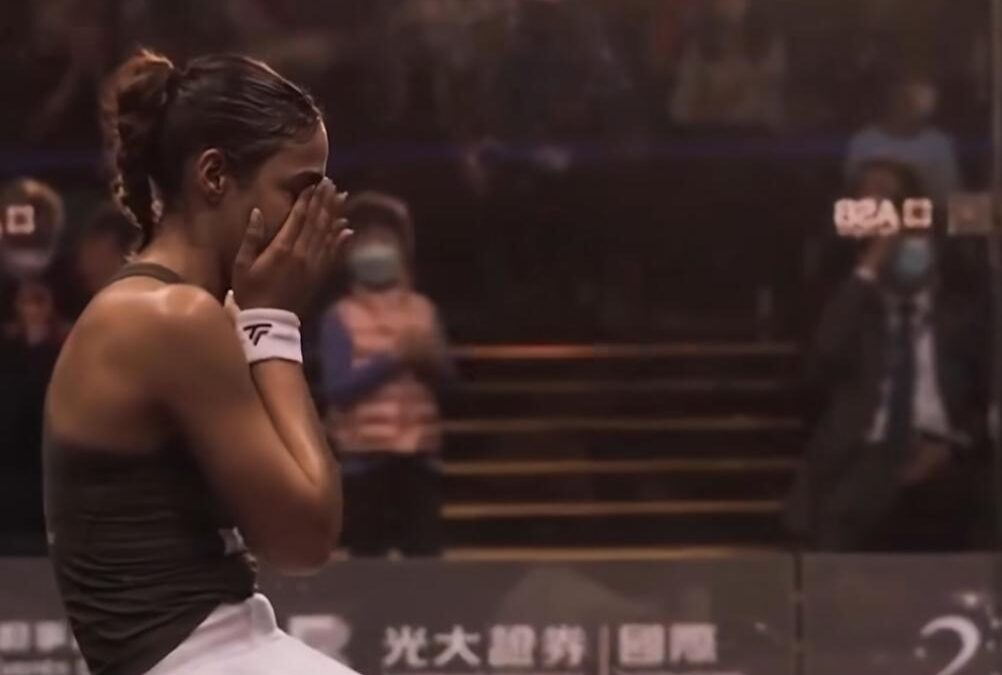
Championship point at 10-8. Hania hit a boasted drop that died on the front wall, and the match was over. She dropped to her knees on the glass court, clenched her fist, and held it for a moment before standing. The ranking was safe. The title was hers. What was visible to anyone watching closely — and what the post-match speech would confirm — was that she knew exactly what she had just defended.
The Post-Match Speech: Tension Beneath the Victory
El Gouna’s trophy ceremony is a well-established ritual of the PSA Tour. A microphone is handed to the winner. Remarks are made. The ritual carries on. Hania El Hammamy’s remarks were brief, tight, visibly controlled. She thanked her team. She thanked the home crowd. She paused longer than she usually does between phrases. Her voice caught once.
This was not a speech of a player who had just won any tournament. It was a speech of a player who had just closed out the most consequential match of her career under the full weight of the ranking and the rivalry, and who had only now allowed herself to feel the stakes she had been carrying through the entire week. The tension read clearly. Fans who watched the speech on the PSA stream immediately commented on how different this victory felt from her previous title celebrations — less relief, more catharsis.
She also complimented Nour El Sherbini with specific grace. The comment about “the champion who showed us all how to play this game” was not a throwaway line. It recognised the generational hand-over without diminishing either side. In a sport where the transition between eras is often ugly, Hania chose to make this one something different.
Why This Specific Match Matters: The Ranking Math
The PSA World Tour rankings operate on a rolling points system. Every major tournament generates ranking points for the top finishers. Points are valid for 52 weeks; older points drop off as new tournaments replace them. This means the top of the rankings is constantly defended.
Hania El Hammamy claimed world #1 in November 2025 after a sustained run of consistent finals and semi-finals. The ranking was narrow — within a small window of Nour El Sherbini’s points total. El Gouna 2026 was the first Platinum-level event where the points differential between the two was close enough that a direct head-to-head outcome would swing the top of the rankings.
If Nour had won, she would have returned to world #1 within days of the El Gouna result being processed. Hania would have been back at #2. The new era, declared in November 2025, would have been called into question less than six months later.
By winning, Hania held #1 through April 2026 and extended her ranking points buffer by a meaningful margin. More importantly, she sent the message that this ranking is not a fluke or a favourable-schedule artefact. She can defend it on glass against the most accomplished player of the prior generation. That is what breaking point means — the moment the new order stops being provisional.
The Semi-Final: Hania vs Amina Orfi — Aggression and Tension
Before the Sherbini final, Hania El Hammamy had to navigate one of the most intense semi-finals of her career against Amina Orfi, the 18-year-old Egyptian prodigy whose rise has been the most watched narrative in women’s squash outside the top two.
The match was always going to be combative. Amina Orfi is not a player who concedes space. She is not a player who respects reputation. Her whole style — built around aggressive intercepts, early volleys, refusal to let the opponent set the pace — is designed to disrupt senior players and make them play uncomfortable squash.
Hania responded to that approach with aggression of her own that went beyond what her normal match behaviour has looked like. On court, there were visible moments of confrontation — body contact during rallies that drew the referee’s attention, disputed lets, one moment where Hania held her position on the T longer than necessary and Amina had to break her own line to go around. None of this was outside the rules. All of it was outside the normal tone between two Egyptian team-mates.
The atmosphere was noticeably more tense than a typical semi-final. The crowd felt it. Commentary on the PSA stream remarked on it. The match went four games, with Hania eventually pulling away, but the final score did not reflect how uncomfortable the squash actually was.
Off-Court Escalation: The Unspoken Rivalry
What happened off court after the semi-final has been less widely reported but was visible to anyone in the venue. The customary handshake at the court door was brief. The customary photograph opportunity was declined or cut short. The customary press conference — where both players would normally field questions side by side — was rearranged so the players did not overlap.
None of this was dramatic in isolation. All of it, taken together, confirmed what PSA watchers have been reading in body language for months: there is a real friction between Hania and Amina that neither player has publicly addressed. The semi-final in El Gouna did not create the tension. It exposed it.
The background is generational in nature. Amina Orfi, born in 2007, is fifteen years younger than Nour El Sherbini and seven years younger than Hania. She has climbed faster than anyone in the women’s tour, already a top-10 player at an age when most elite squash players are still finishing junior competition. For Hania, that climb is not just a professional curiosity. It is the future challenger to the ranking she has just claimed.
Whether the friction becomes a long-term rivalry narrative or an episode that cools over subsequent tournaments remains to be seen. What is clear from El Gouna is that the Hania-Amina dynamic is now a second front on top of the Hania-Nour story, and both will shape the 2026 tour narrative.
Hania’s Full Path Through the Tournament
Too often the final is discussed as if it existed in isolation. The week at El Gouna was a full tournament arc with specific moments that shaped the final outcome.
Round one. A straightforward 3-0 win against a player who qualified through. Clean match, no surprises. Hania used it to calibrate her length on a glass court that plays slightly quicker than some PSA surfaces.
Round two. A 3-1 against a top-20 opponent who took a single game through pace variation. Hania adjusted mid-match, controlled the back half, closed cleanly.
Quarter-final. Four games against a European top-8 seed. The match was tighter than the scoreline suggested. Hania was tested on her second-front retrieval and found she was physically sharper than she expected at that stage of the tournament.
Semi-final. The Amina Orfi match described above. Four games, uncomfortable, ultimately decisive.
Final. The Nour El Sherbini match. Four games. Breaking point.
The full arc matters because tournament tennis and tournament squash are cumulative games. Players do not arrive at the final fresh. Hania’s physical and emotional readiness for the Sherbini match was the product of the week — the pacing of her earlier rounds, the adjustment made during and after the Orfi semi-final, the recovery she gave herself between the Saturday night semi and the Sunday afternoon final. All of it added up.
Training, Coaching, Preparation
Hania’s preparation for El Gouna 2026 was reportedly the most intensive of her career. Her coaching team — built around her long-time coach with supplementary conditioning and mental-performance specialists added over the past 18 months — had designed the full tournament approach with the ranking implications in mind.
The training base was split between her Cairo home facility and a pre-tournament camp in El Gouna itself to acclimatise to the specific glass court conditions. Conditioning work focused on the fifth-game capacity that elite finals can demand. Tactical work focused specifically on the range of styles Amina Orfi and Nour El Sherbini can bring, with video analysis sessions dedicated to both players.
This is the level of preparation that used to be exceptional in squash and is now standard for anyone operating at the absolute top of the women’s tour. It is also expensive and support-intensive. Hania’s sponsor base, Egyptian Squash Federation backing, and PSA Tour prize money collectively fund the operation at a level that would have been unthinkable for a squash player a decade ago.
Career Statistics and the Record So Far
Hania El Hammamy’s career ledger as of April 2026 includes:
- World #1 ranking — held since November 2025
- Multiple PSA World Tour titles across Platinum, Gold, and Silver levels
- World Championship finalist in multiple editions
- Commonwealth Games medals in individual and team events
- World Team Squash Championship winner (multiple editions, Egypt)
- Head-to-head record against Nour El Sherbini now stands at approximately 7-10 across their PSA Tour meetings
- Head-to-head record against Nouran Gohar approximately 9-6
- Head-to-head record against Amina Orfi approximately 4-1 with the friction building across the most recent matches
These numbers will update as the 2026 tour continues, and the head-to-head against Orfi in particular will be closely watched. The long-term career target — for any player — is building a record that future generations will measure themselves against. Hania’s record is now securely in the top 10 women’s squash careers of the PSA era, and potentially rising.
Why This Is a Breaking Point, Not a One-Season Moment
Sports narratives often inflate individual wins into transitions that do not actually hold up. A player wins a major, is declared the future of the sport, loses their next three finals, and the narrative unwinds. This is a risk attached to any “breaking point” claim.
The argument that El Gouna 2026 is different, and not a one-season wonder, rests on several structural observations.
First, the ranking math. Hania is not world #1 on a flukey points advantage. The gap has been earned across multiple tournaments and is sized to survive normal tournament variance.
Second, the head-to-head pattern. She has beaten every top-5 player on tour multiple times. She has won on glass, on panel courts, on different tournament formats. Her game travels.
Third, the physical profile. She is 25. She is in peak physical years. Her specific injury history is limited. The next three to five years are where elite women’s squash players typically do their most consistent work.
Fourth, the mental profile. The El Gouna final demonstrated that she can win the high-pressure match against the most accomplished peer challenger available. That is not a skill that disappears.
Fifth, the support structure. Egyptian squash coaching, national federation, sponsor base, and peer group are all aligned in ways that reinforce her continued top-level performance. This is not an individual athlete fighting alone; it is an institutional programme that has backed her.
Any one of these could fail. Injury could intervene. A new generation player (Amina Orfi, or someone younger not yet visible) could reshape the competitive landscape faster than expected. Burnout, off-court life changes, or motivation shifts can move any elite athlete’s trajectory. But the baseline case — that Hania El Hammamy holds world #1 through 2026 and remains in the top two through the LA28 Olympic cycle — is backed by structural factors, not just one tournament result.
That is what makes El Gouna a breaking point rather than a peak. A peak implies downward travel after it. A breaking point marks the transition from one stable state to another. The reading of this match, both by Hania’s team and by objective observers of the women’s tour, is the latter.
The Bottom Line
Hania El Hammamy won the El Gouna International 2026 women’s singles title on April 19, 2026, defeating Nour El Sherbini in four games in the final. The match held her at world #1 in the PSA rankings at a moment when a loss would have returned the top spot to the seven-time world champion. The victory came after a semi-final against Amina Orfi that exposed unusual tension between the two Egyptian players on and off court.
The post-match speech showed a player who understood exactly what she had just defended. The win is the clearest signal yet that the generational transition at the top of women’s squash is not a narrative concoction but a structural reality. Hania El Hammamy is not a one-tournament flash or a single-season top of the rankings. She is the new stable top of the sport, and El Gouna 2026 is where that became undeniable.
For anyone following Egyptian women’s squash, the broader MENA sports scene, or the runway to the LA28 Olympic Games, this is the match to remember. The ranking defended here, the tension managed in the semi-final, the grace shown in the speech, and the specific tactical execution on the fourth-game closing sequence all combine into one of the most complete career moments available to any current professional athlete. The next 30 months will test whether Hania can build on it. The honest expectation is that she will.
For readers interested in related coverage, our Gulf sports investment piece tracks how Saudi PIF is entering squash through broader sports commitments, and our entertainment section covers the broader regional profile of Egyptian athletes across multiple disciplines. The Al Jazeera sports coverage provides an independent English-language record of PSA events, and the Reuters sports wire carries the global news feed for ranking and tournament updates. El Gouna 2026 will be covered across all of these channels for the weeks ahead, but the defining interpretation of what it meant will be built in pieces like this one — carefully, from the specifics, without rushing past the actual human drama of the week that was.