DUBAI, April 28, 2026. The United Arab Emirates announced on Tuesday that it will leave both the Organization of the Petroleum Exporting Countries and the broader OPEC+ alliance effective Friday May 1, 2026, ending 51 years of membership and instantly resetting the political map of global oil. Energy Minister Suhail Mohamed Al-Mazrouei delivered the statement at a press briefing in Abu Dhabi, framing the exit as a defence of “national interests” after years of friction with the cartel’s quota system that he said had failed to recognise the country’s expanded production capacity.
The decision is the largest single rupture inside OPEC since the alliance’s founding in 1960 and lands in the middle of the deepest Middle East oil-supply crisis in a generation. Brent crude jumped 18 percent in the 48 hours surrounding the announcement, climbing from $99 per barrel before the news to $117 per barrel by Tuesday’s New York close, while Saudi Aramco shares fell 6 percent in after-hours trading on the Tadawul. The exit comes as the Strait of Hormuz, which carried roughly 20 million barrels per day of crude before the war between the United States, Israel, and Iran that began in March 2026, is currently moving only about 2 million barrels per day, a 90 percent collapse that has already forced rerouting through Egypt’s Suez Canal, the Bab el-Mandeb, and overland pipelines.
Reuters, Bloomberg, the Financial Times, and Al Jazeera all confirmed the announcement within an hour of the Abu Dhabi briefing. The Wall Street Journal and CNBC reported that Saudi Arabia and several other OPEC member states had been blindsided, with senior officials in Riyadh learning of the move only in the final hours before the press conference. The Saudi energy ministry said it would issue a formal response on Wednesday morning.

The Statement: What Al-Mazrouei Actually Said
The Abu Dhabi briefing lasted 22 minutes. The opening lines were direct: “Effective Friday, May 1, 2026, the United Arab Emirates will end its membership in the Organization of the Petroleum Exporting Countries and in the OPEC+ Declaration of Cooperation. This decision is taken in the long-term interest of the United Arab Emirates and its people. The Government remains committed to a stable, well-supplied global oil market.”
Al-Mazrouei was specific about the grievance. The OPEC+ quota system, he said, “has not adequately reflected the substantial investment our country has made in productive capacity over the past decade.” He cited the more than $150 billion ADNOC has invested in upstream expansion since 2017, the build-out toward 5 million barrels per day of installed capacity, and the gap between that capacity and the roughly 3.5 million barrel per day quota the UAE has carried under successive OPEC+ agreements. The minister did not name Saudi Arabia. He did not have to.
The statement also contained what oil traders interpreted as a clear price signal. Al-Mazrouei said the UAE intended to “produce in line with market conditions and our installed capacity,” language that traders read as a signal that volumes will move toward 4.8 million barrels per day rather than remain at quota-restricted levels. The minister declined to give a specific production target.
How Big Is the UAE Inside OPEC?
The UAE produced an average of 3.45 million barrels per day in March 2026 according to OPEC’s Monthly Oil Market Report, making it the cartel’s third largest producer behind Saudi Arabia (around 9 million b/d) and Iraq (4.1 million b/d) and ahead of Kuwait, Iran, and Nigeria. Total sustainable capacity sits at 4.8 million b/d as of April 2026, with ADNOC publicly targeting 5 million b/d by the end of 2027 through expansion of the Upper Zakum, Lower Zakum, and Bu Hasa fields plus integration of newer offshore blocks.
The headline volume understates the UAE’s strategic importance. Murban, the flagship Abu Dhabi grade, has been the marker grade on the ICE Murban futures contract since 2021 and serves as the principal benchmark for light, sour, low-sulphur crude flowing east of Suez. Loss of UAE quota discipline matters more for marginal pricing of Asian-bound crude than the absolute volume suggests. ADNOC’s offtake to refiners in India, Japan, South Korea, and China is the backbone of UAE’s export book and has been growing at 4 percent compound annually since 2020.
By comparison, the only previous OPEC departures that came close to this scale were Indonesia’s 2016 suspension (when its production had fallen to 700,000 b/d and it had become a net importer), Qatar’s 2019 exit (around 600,000 b/d, focused on LNG), and Angola’s 2023 departure (around 1.1 million b/d in a quota dispute). UAE at 4.8 million b/d of capacity is roughly four times Angola’s 2023 production and eight times Qatar’s 2019 output. There is no historical precedent for a producer of this size leaving the cartel.
The Hormuz Context: Oil Flows from 20 to 2 mb/d
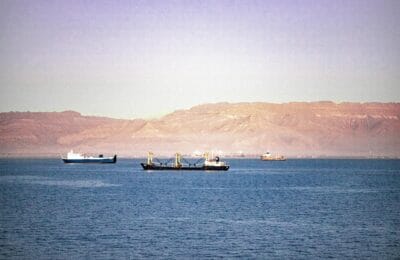
The exit cannot be read in isolation from the Iran war and the collapse of Strait of Hormuz shipping. Roughly 20 million barrels per day of crude oil and condensate moved through the Strait before the war, the largest single chokepoint in global energy according to the U.S. Energy Information Administration. As of mid-April 2026, satellite-tracking firms including Kpler and Vortexa estimate Hormuz flow at approximately 2 million barrels per day. Tankers are queuing at Fujairah on the Indian Ocean side of the Strait, waiting for security clearance that has been intermittent at best.
The 90 percent flow collapse has already forced operational rerouting that runs through UAE infrastructure. The Habshan-Fujairah pipeline, which bypasses the Strait of Hormuz entirely by moving Abu Dhabi crude overland to the Gulf of Oman, has been near-capacity since early April. Saudi Arabia’s East-West pipeline to Yanbu on the Red Sea has been similarly stretched. Egyptian Suez transit is constrained by Bab el-Mandeb security risks. The bypass infrastructure that exists is geographically anchored to UAE and Saudi territory, which gives Abu Dhabi disproportionate negotiating leverage during the current crisis. Our recent analysis of OPEC’s spare capacity walks through the geometry of these alternative routes in detail.
Some traders and policymakers have privately argued that the timing of the UAE exit reflects a calculated read of the leverage moment: with Hormuz closed and OPEC’s marginal supply value at a multi-decade peak, an independent UAE production policy can extract maximum strategic and commercial value from the country’s bypass routes and capacity. The minister did not address that interpretation in the press conference.
Brent Reaction: $99 to $117 in 48 Hours
The Brent crude price reaction was immediate and severe. Brent for June 2026 delivery closed at $99.20 per barrel on Monday April 27. By Tuesday’s New York close, after the Abu Dhabi briefing, the front contract settled at $117.40, an 18 percent move in a single session. WTI for June moved from $94.10 to $112.30 over the same window. The Brent-WTI spread widened modestly, reflecting the larger international exposure to OPEC+ disruption.
Gold rallied 4 percent on the day in classic safe-haven flow, taking the metal back above $3,420 per ounce. The dollar index gained 0.6 percent against a basket of major currencies. Saudi Aramco shares fell 6 percent in after-hours Tadawul trading. ADNOC-linked equities including TAQA and Aldar Properties rose between 2 and 4 percent on the assumption that an unconstrained UAE production regime would benefit firms tied to the country’s industrial and real-estate complex.
Goldman Sachs, in a flash note circulated Tuesday evening, raised its near-term Brent target to $125 per barrel and flagged a 30 percent probability of a $140 spike if Saudi Arabia retaliates with a coordinated quota-discipline failure of its own. JPMorgan kept its base case at $115 but raised the upside scenario to $135. Our Q2 2026 Brent forecast from earlier this month had a base case of $102 and a high case of $118; both numbers will be revised in coming days.
Saudi Arabia’s Position: Caught Off-Guard
Saudi Arabia has been the public face and effective architect of OPEC+ since the alliance’s formation in 2016. The Kingdom carries the largest single quota cut (1 million b/d of the 2.2 million b/d voluntary cuts), holds roughly 3 million b/d of spare capacity, and has been the dominant voice in setting alliance policy through Energy Minister Prince Abdulaziz bin Salman. The UAE exit is the first time in a decade that a major member has departed without prior coordination with Riyadh.
Reuters reported, citing two senior Saudi officials, that the energy ministry in Riyadh learned of the announcement only “in the final hours” before the Abu Dhabi briefing. The official Saudi response is expected Wednesday morning. Three plausible Saudi paths are under discussion in Riyadh:
Path one: Hold the line. Saudi Arabia maintains its 1 million b/d voluntary cut, calls the UAE exit a “national choice that does not affect the strategic mission of OPEC,” and works to keep Iraq, Kuwait, and Algeria inside the alliance. This preserves OPEC’s institutional credibility but cedes market share to the UAE.
Path two: Match the move. Saudi Arabia ends its voluntary cut and adds roughly 1 million b/d to the market within 60 days. This would crash Brent back toward $80 and punish UAE financially for the exit, but would also crash Saudi fiscal projections that depend on $85+ Brent. The political signal would be unambiguous: Riyadh will not allow Abu Dhabi to free-ride on Saudi production discipline.
Path three: Restructure the alliance. Saudi Arabia works behind the scenes for a smaller, tighter OPEC core that explicitly recognises UAE as outside the framework, with Iraq, Kuwait, and Russia carrying somewhat heavier voluntary contributions. This is the most institutionally constructive path but also the slowest.
The base case in the trader consensus is path one in the immediate aftermath, with path two as a credible threat in the second half of 2026 if UAE production additions exceed market expectations. Our broader Aramco-versus-ExxonMobil comparison details the Saudi fiscal pressures that constrain how aggressively Riyadh can move on quota policy.
The Riyadh-Abu Dhabi Rift: A Decade in the Making
The public alliance between Saudi Arabia and the UAE dates to the founding of the UAE in 1971 and has been the central spine of Gulf security cooperation for half a century. The private tensions are more recent. Three flashpoints stand out.
2021 quota fight. The UAE publicly objected to a Saudi-brokered OPEC+ deal that would have extended cuts through 2022 without revising the UAE’s reference baseline. The dispute briefly delayed an OPEC+ meeting and ended in a compromise that lifted the UAE baseline modestly. The episode was the first public daylight between Riyadh and Abu Dhabi inside the alliance.
2023 strategic divergence. The UAE’s Vision 2031 diversification programme accelerated investment in non-oil sectors including artificial intelligence (G42, Microsoft partnership), financial services (ADGM), tourism, and esports. Where Saudi Vision 2030 also targets diversification, the UAE programme is further along and less dependent on continued high oil prices. This widened the gap in fiscal sensitivity to Brent.
2025 commercial competition. Both countries began competing directly in artificial intelligence chip access, financial-services regulation, sovereign-wealth deal-flow, and regional sports investment. The Saudi-UAE relationship moved from quiet alliance to active strategic competition while remaining publicly cordial.
The April 2026 OPEC exit publicly fractures the alliance for the first time. The bilateral relationship is not ending. The framing of “two close partners taking different paths on energy policy” is the language both governments will likely adopt in coming weeks. But the alignment that defined Gulf oil policy for fifty years is over.
What It Means for OPEC and the Cartel’s Future
OPEC’s effective market power depends on three things: the share of global production held by member states, the discipline of quota compliance, and the credibility of the threat to enforce that discipline through coordinated action. The UAE exit damages all three.
OPEC’s share of global production drops from roughly 32 percent to 28 percent overnight. Combined OPEC+ moves from 52 percent to 48 percent. These are still meaningful market shares but the marginal influence on price-setting weakens at the edges. With UAE outside the framework, the cartel must extract more discipline from a smaller base to achieve the same price effect.
Spare capacity within the alliance falls sharply. Saudi Arabia retains roughly 3 million b/d of spare capacity. UAE’s 1.3 million b/d of unused-capacity headroom moves outside the cartel and becomes available to flood or restrict at Abu Dhabi’s commercial discretion. The combined OPEC+ optionality on global supply effectively halves at the margin. The cartel can still act on a shock; it can no longer act with the same authority on small price moves.
The follow-on risk is the more dangerous question. If Algeria, Iraq, or Nigeria conclude that exit is now a viable option, the alliance could fragment further. None of those producers has the financial independence to free-ride the way the UAE can; all of them have specific quota grievances; all of them watched the UAE exit announcement and the market response on Tuesday. The May 2026 OPEC+ meeting, which our May meeting preview covered last week, was already going to be one of the most consequential of the decade. It is now a defining moment for whether OPEC survives in recognisable form.
Investor Implications: Sectors and Names
The first-order trade is long Brent and long oil-leveraged equities. Goldman’s $125 Brent target implies roughly 7 percent additional upside from Tuesday’s close. Energy-sector ETFs and integrated oil majors should benefit disproportionately if the price move holds.
The second-order trade is long ADNOC-adjacent and Abu Dhabi exposure. Aldar Properties, TAQA, IHC, and ADNOC Drilling all benefit from a UAE that produces near full capacity rather than at quota. Most of these names rallied 2-4 percent on Tuesday and have further upside if production additions match the minister’s signal.
The third-order trade is short Saudi Aramco relative to a basket of integrated oil majors. The stock’s 6 percent after-hours decline reflects two real concerns: lost cartel pricing power and the credibility risk of a Saudi production response that crashes Brent. Aramco’s dividend cover gets harder at $80 Brent and easier at $115. The valuation impact is asymmetric and probably not yet fully priced in.
The fourth-order trade is long US shale producers and US oil-services firms. Higher Brent at $115-125 makes US tight-oil economics extremely strong, supports completion activity in the Permian and Bakken, and benefits oil-service names disproportionately. Iran-sanctions impact on global supply is also raising the strategic value of US production; our Iran sanctions analysis covers the specific volume math on dark-fleet displacement.
Currency, gold, and rates trades are secondary but real. Gold’s safe-haven response is likely to extend if the Saudi response is hawkish. The dollar index direction depends on Federal Reserve language about inflation pass-through from energy prices.
Foreign Policy: US, Iran, Russia
The UAE exit comes during the most active US-Israel-Iran military period in two decades. The Trump administration’s strategic alignment with both Israel and the UAE has been visible throughout the crisis, and senior US officials have expressed support for UAE energy independence in private discussions over the past 12 months. Whether the White House had advance notice of Tuesday’s announcement is unconfirmed.
Iran’s response has been muted so far. Tehran has limited capacity to influence OPEC dynamics directly given sanctions and reduced production. The strategic implication for Iran is mixed: a fragmented OPEC with weaker pricing discipline reduces Tehran’s leverage in any future sanctions-relief negotiation but also raises the price floor for Iranian crude moving through grey-market channels.
Russia has been a constructive OPEC+ partner since 2016 despite its own production constraints from sanctions. The UAE exit weakens the alliance Moscow has invested in but does not affect Russian production directly given the existing capacity ceiling on Russian output. Deputy Prime Minister Alexander Novak has not publicly commented as of Tuesday evening.
What We Are Watching Wednesday and Thursday
Three signals matter most over the next 48 hours. First, the Saudi response: any indication of a quota-discipline failure or coordinated production additions will reshape the Brent price path. Second, ADNOC commentary on production guidance: any explicit production target above 4 million b/d will be read as confirmation of the maximum-output interpretation of the minister’s statement. Third, Iraq, Kuwait, and Algeria positioning: any signal of solidarity with the Saudi line will stabilise the alliance; any equivocation will accelerate the fragmentation narrative.
The May 1, 2026 effective date is also the first OPEC+ Joint Ministerial Monitoring Committee window of the new framework. The committee was expected to discuss the 2.2 million b/d voluntary cut framework. That meeting is now operating under entirely different assumptions and the agenda will need to be rewritten.
Bottom Line
The UAE has left OPEC. The third-largest producer in the cartel, the second-largest spare-capacity holder, and the country that built the principal Hormuz bypass infrastructure is now operating on its own production policy effective Friday. Brent is up 18 percent in 48 hours. Saudi Arabia has been blindsided. The Iran war has redrawn the political map of Gulf oil and the UAE exit has redrawn the institutional map of global oil supply. Both happened in the space of six weeks. The May ministerial meeting will set the next chapter and we will be covering each ministerial cable from the moment it lands.
Reporting by The Middle East Insider editorial desk. Sources: Reuters, Bloomberg, Wall Street Journal, Financial Times, Al Jazeera, CNBC, U.S. Energy Information Administration. Brent and WTI prices from ICE and CME settlement data. Updated April 28, 2026 22:30 GST.