What Happened to NEOM and The Line? The 2026 Reality Check
NEOM’s The Line — Saudi Arabia’s $500 billion futuristic city — had construction suspended in September 2025 after completing only 2.4 kilometers of foundation. The population target was slashed from 1.5 million to under 300,000. The most ambitious construction project in human history has collided with the realities of engineering, economics, and geopolitics. This is the complete 2026 status report.
This article provides a detailed, honest assessment of every NEOM component — The Line, Sindalah, Trojena, Oxagon, and NEOM Bay — as well as a broader Vision 2030 scorecard examining what Saudi Arabia has achieved and where it has fallen short.
The Line: What Was Promised vs. What Was Built
The Original Vision
When Crown Prince Mohammed bin Salman unveiled The Line in January 2021, the vision was breathtaking:

- Length: 170 kilometers (106 miles) — a straight line cutting across the desert from the Gulf of Aqaba coast inland
- Height: 500 meters (1,640 feet) tall — higher than the Empire State Building
- Width: 200 meters (656 feet)
- Population: 9 million residents (later revised to 1.5 million by 2030)
- Concept: Two parallel mirrored skyscrapers running the entire 170 km length, with all services, transportation, and amenities enclosed within the structure
- Transportation: High-speed rail running the full length, with end-to-end transit time of 20 minutes
- Zero cars, zero streets, zero carbon emissions
- Budget: Estimated at $500 billion, later reported as potentially $1 trillion+
What Actually Got Built (As of April 2026)
| Component | Planned | Completed | % Complete |
|---|---|---|---|
| Foundation length | 170 km | 2.4 km | 1.4% |
| Excavation depth (max) | 500 meters | ~200 meters in test sections | 40% depth achieved |
| Mirror facade | 170 km x 500m | 0 km completed | 0% |
| High-speed rail | 170 km tunnel | Not started | 0% |
| Residential units | Millions | 0 habitable units | 0% |
| Population housed | 1.5 million (2030 target) | 0 | 0% |
| Supporting infrastructure | Roads, utilities, camps | Substantial | ~30-40% of Phase 1 needs |
| Worker camps | Required for 100,000+ workers | Built for ~50,000 | Partially complete |
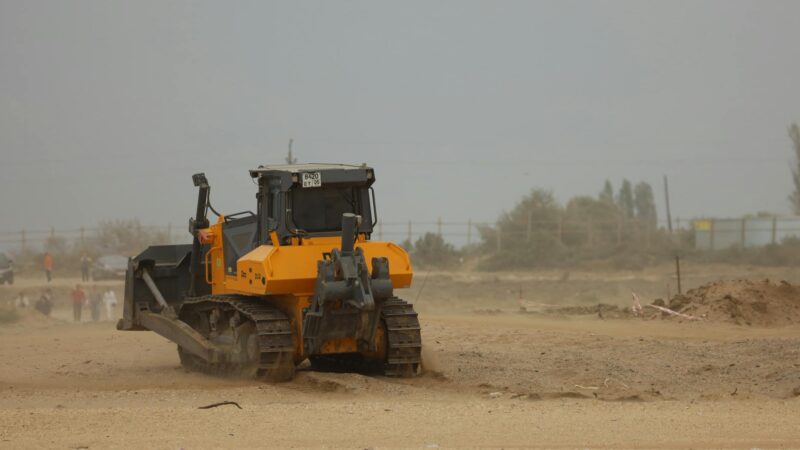
The 2.4 kilometers of foundation work that does exist represents a massive engineering achievement in its own right — enormous trenches cut into desert rock, with reinforced concrete foundations capable of supporting 500-meter-tall structures. But it is a tiny fraction of the original vision, and the September 2025 suspension means no new construction is happening on The Line itself.
Why Construction Was Suspended
Multiple factors converged to force the suspension:
1. Budget Reality: The original $500 billion estimate proved dramatically low. Independent engineering assessments suggested the full 170 km Line would cost $1-2 trillion — more than Saudi Arabia’s entire annual GDP. Even with the world’s largest sovereign wealth fund (Public Investment Fund, approximately $930 billion), the project was financially unsustainable at its original scale.
2. Oil Price Pressure: Saudi Arabia’s fiscal break-even oil price (the price needed to balance the government budget) rose above $90 per barrel as mega-project spending increased. When oil prices dipped below $80 in mid-2025 (before the Iran conflict pushed them back up), the government faced difficult spending choices. NEOM’s The Line was the highest-profile project to be scaled back.
3. Engineering Challenges: Building two parallel 500-meter-tall structures across 170 km of desert — including mountainous terrain, sand dunes, and areas with challenging geology — presented engineering problems that no existing construction methodology could solve at the required pace and cost. The “mirror city” concept required novel structural engineering, and solutions that worked in 2.4 km test sections did not necessarily scale to 170 km.
4. Labor and Human Rights Concerns: Reports from international media and human rights organizations documented difficult working conditions at the NEOM construction site, including heat-related injuries during Saudi Arabia’s extreme summer months. Worker recruitment became more difficult, and international construction firms began demanding higher risk premiums.
5. Iran Conflict Fiscal Impact: The February 2026 Iran war and March Hormuz closure created additional fiscal pressure. While higher oil prices benefited Saudi revenue temporarily, the broader regional instability and defense spending increases competed with mega-project budgets for government attention and funding.
6. Population Target Reality: Attracting 1.5 million residents to live inside a linear megastructure in the remote desert was always the project’s most questionable assumption. Market research and early interest surveys reportedly showed far lower demand than projected, leading to the downward revision to under 300,000.
The Revised Plan: What The Line Looks Like Now
The current plan, as understood from official statements and industry sources:
- Phase 1 (revised): Complete the 2.4 km foundation section as a self-contained community for up to 300,000 residents
- Timeline: No official completion date announced; unofficial estimates suggest 2030-2035 for Phase 1 habitation
- Height: Reduced from 500 meters to approximately 200-300 meters for Phase 1
- Concept: Mixed-use community with residential, commercial, entertainment, and green spaces — still car-free and vertically integrated, but at a much smaller scale
- Future phases: Extensions beyond 2.4 km are “subject to market demand and economic conditions” — essentially indefinitely postponed
NEOM’s Other Components: Status Report
While The Line has dominated headlines, NEOM consists of several other major components, some of which are progressing more successfully:
Sindalah Island: The Closest to Completion
| Feature | Status (April 2026) |
|---|---|
| Concept | Luxury island resort in the Red Sea, targeting ultra-high-net-worth visitors |
| Location | Island off NEOM coast, Red Sea |
| Construction progress | ~75-80% complete |
| Expected opening | Late 2026 or early 2027 |
| Hotels planned | 3 luxury hotels (EDITION, Marriott, Aman brands rumored) |
| Marina | 86-yacht berth marina, substantially complete |
| Golf course | Championship course, under construction |
| Target market | Ultra-luxury tourism, yacht visitors from Mediterranean and Gulf |
Sindalah is NEOM’s near-term success story. As a relatively self-contained island resort, it avoids the massive engineering challenges of The Line and serves as a proof-of-concept for NEOM’s tourism ambitions. Its Red Sea location positions it to capture yacht traffic from the Mediterranean that has been avoiding the region due to Houthi attacks on Red Sea shipping — once the security situation normalizes, demand should be strong.
Trojena: The Mountain Resort and Ski Area
| Feature | Status (April 2026) |
|---|---|
| Concept | Mountain tourism destination with outdoor ski resort using artificial snow |
| Location | Hejaz Mountains within NEOM zone, elevation 1,500-2,600m |
| Construction progress | ~35-40% complete |
| Expected opening | Targeting 2028-2029 (for Asian Winter Games 2029) |
| Ski facilities | Outdoor slopes with year-round artificial snow capability |
| Hotels planned | Multiple resort hotels, luxury lodges |
| Key event | Selected to host 2029 Asian Winter Games |
| Challenge | Sustainability of snow-making in desert mountain climate questioned |
Trojena’s selection to host the 2029 Asian Winter Games gives it a hard deadline that forces continued investment. The mountain location provides natural advantages (cooler temperatures at 2,600m elevation) but the reliance on artificial snow in a water-scarce region has drawn environmental criticism. If delivered on time, it would be a remarkable engineering and hospitality achievement.
Oxagon: The Floating Industrial City
| Feature | Status (April 2026) |
|---|---|
| Concept | Octagonal floating industrial and port city for advanced manufacturing |
| Location | NEOM coast, Gulf of Aqaba |
| Construction progress | ~15-20% (significantly scaled back from original plans) |
| Original vision | World’s largest floating structure, covering 7 km diameter |
| Current plan | Significantly reduced; focusing on port facilities and initial industrial zones |
| Tenants/partners | Several manufacturing firms signed MOUs, few have committed to construction |
| Green hydrogen | Green hydrogen production facility (partnership with Air Products and ACWA Power) still planned |
Oxagon has been quietly scaled back even more dramatically than The Line. The original concept of a massive floating octagonal city has been reduced to a more conventional coastal industrial zone with port facilities. The most promising element is the green hydrogen production project, which aligns with genuine global demand for clean energy and has major international partners committed.
NEOM Bay and Airport
NEOM Bay Airport is operational for construction flights and private aviation, with commercial service planned once sufficient tourism and residential demand materializes. The bay area is intended to serve as NEOM’s “gateway” and has seen the most conventional construction progress — roads, utilities, and initial commercial buildings.
The Budget Question: Where Did the Money Go?
NEOM’s total spending through early 2026 is estimated at $40-60 billion — a massive sum, but far less than the $500 billion+ originally allocated. Here is where the money has gone:
| Category | Estimated Spending ($B) | Notes |
|---|---|---|
| The Line (excavation, foundation) | $15-20 | Massive earth-moving and concrete work for 2.4 km |
| Sindalah Island | $3-5 | Most advanced component |
| Trojena | $3-5 | Mountain infrastructure, road construction |
| Oxagon (initial works) | $2-3 | Port facilities, initial site preparation |
| NEOM Bay/Airport | $2-3 | Airport, roads, utilities |
| Worker housing/camps | $3-5 | Housing for ~50,000 construction workers |
| Planning, design, consulting | $5-8 | Architecture, engineering, management fees |
| Land clearing, security, admin | $3-5 | Relocation of Howeitat tribe, security perimeter |
| Total Estimated | $40-60 |
The gap between the $40-60 billion spent and the $500 billion+ budget is not “savings” — it represents work that was planned but not executed. The question for Saudi Arabia is whether the money already spent can be leveraged into viable, revenue-generating projects (Sindalah, Trojena, reduced Line), or whether a significant portion represents sunk costs that will never generate returns.
Official Explanations vs. Reality
What Saudi Officials Say
The Saudi government has been careful to frame The Line’s downsizing as strategic flexibility rather than failure:
- “NEOM is adopting a phased approach that allows us to deliver world-class experiences while adapting to market conditions” — Official NEOM spokesperson
- “The Line remains the most ambitious urban development in history. The revised timeline reflects our commitment to quality over speed” — Government sources
- “We are prioritizing components that serve near-term tourism and industrial goals” — Vision 2030 officials
What Industry Insiders Say
Off-the-record conversations with contractors, consultants, and engineers who worked on NEOM tell a different story:
- “The 170 km Line was never feasible at the proposed timeline or budget. Everyone in the engineering community knew this, but no one could say it publicly” — Former NEOM consultant
- “The 2.4 km that was built is an incredible piece of engineering, but extrapolating it to 170 km was like building one house and claiming you could build a million identical houses at the same pace and cost” — Construction industry source
- “The real value of NEOM will be in the tourism components — Sindalah and Trojena — which are achievable and marketable. The Line was always more of a marketing concept than an engineering plan” — Regional real estate analyst
Vision 2030 Scorecard: Hits and Misses
NEOM is just one component of Saudi Arabia’s broader Vision 2030 transformation. To fairly assess NEOM’s struggles, we need to look at the full picture:
Vision 2030 Targets: Achieved vs. Missed
| Target | 2030 Goal | Status (April 2026) | Assessment |
|---|---|---|---|
| Tourism visitors | 100 million/year | Achieved in 2025 (~105M) | Exceeded ahead of schedule |
| Female workforce participation | 30% | 35.5% (2025) | Exceeded significantly |
| Unemployment rate | 7% | ~11% (2025) | Behind target |
| Non-oil revenue share of GDP | Target confidential, but “majority” | ~45-50% | Improving but oil still dominant |
| PIF assets under management | $2 trillion | ~$930 billion | Significantly behind |
| Entertainment sector | Create new sector | Cinemas, concerts, sports events — operational | Achieved (from zero) |
| Home ownership | 70% | ~63% | Progressing well |
| Small business GDP share | 35% | ~28% | Behind target |
| NEOM Phase 1 | Functional by 2025 | Largely incomplete | Significantly behind |
| The Red Sea tourism | Operational luxury tourism | Phase 1 opening underway | Delayed but progressing |
| Diriyah Gate | Cultural tourism destination | Phase 1 partially open | Largely on track |
| FIFA 2034 World Cup | Host bid | Awarded to Saudi Arabia | Major achievement |
Where Vision 2030 Has Genuinely Succeeded
Tourism: This is Vision 2030’s clearest success story. Saudi Arabia welcomed over 105 million visitors in 2025, smashing the 2030 target of 100 million five years early. The combination of new tourist visas, entertainment options, religious tourism (Hajj and Umrah), and business travel has transformed Saudi Arabia from a country most people never considered visiting to a genuine tourism destination. The awarding of FIFA 2034 further validates this trajectory.
Female workforce participation: From approximately 17% in 2016 to 35.5% in 2025, the increase in Saudi women’s economic participation is one of the most rapid social transformations in modern history. The lifting of the driving ban (2018), entertainment sector opening, and active government employment programs have driven this change. This is not just a social achievement — it represents genuine economic diversification as a larger labor pool contributes to GDP growth.
Entertainment and cultural sector: Saudi Arabia had essentially zero entertainment industry before Vision 2030. Today it has cinemas, concert venues hosting international artists, major sporting events (Formula 1, boxing, golf, football), and a growing domestic content creation industry. This cultural transformation has made Saudi Arabia more attractive to young talent and international businesses.
Stock market development: The Tadawul has grown from a relatively isolated market to an MSCI Emerging Market component attracting significant foreign investment. Saudi Aramco’s IPO in 2019 was the world’s largest, and the exchange has seen dozens of new listings in sectors from healthcare to entertainment.
Where Vision 2030 Has Fallen Short
Mega-project execution: NEOM/The Line is the highest-profile shortfall, but other giga-projects have also experienced delays. The Red Sea tourism project is behind its original timeline. Jeddah Tower (formerly Kingdom Tower, aimed to be the world’s tallest building at 1,000+ meters) remains incomplete after construction paused in 2017. The pattern suggests that Saudi Arabia’s ambition in individual mega-projects consistently exceeds execution capacity.
Economic diversification from oil: While progress has been made, oil revenue still constitutes approximately 50-55% of government revenue and a dominant share of export earnings. The target of making non-oil revenue the majority has proven more difficult than anticipated, particularly when oil prices are high (which paradoxically reduces the urgency to diversify).
Unemployment: Saudi unemployment, particularly among youth and women entering the workforce for the first time, remains higher than the 7% target. The private sector has not created jobs fast enough to absorb the growing workforce, partly because many private sector positions are still filled by lower-cost foreign workers despite Saudization policies.
PIF asset growth: The Public Investment Fund’s target of $2 trillion in assets under management by 2030 appears very unlikely to be met. At approximately $930 billion in 2026, the PIF would need to more than double in four years, which would require either massive new government transfers (difficult with current spending levels) or exceptional investment returns.
What Went Wrong: Structural Analysis
Several structural issues explain why mega-projects like The Line have struggled:
1. The Scale Problem
The Line was conceived as a project with no historical parallel. The world’s largest buildings — the Burj Khalifa (828m), the Three Gorges Dam, even the International Space Station — are engineering marvels that took years or decades. The Line proposed something orders of magnitude larger, on a compressed timeline, in extreme environmental conditions. History consistently shows that first-of-their-kind mega-projects exceed budgets by 200-400% and timelines by 50-200%. The Line appears to follow this pattern.
2. Top-Down Planning Without Market Validation
The Line’s design was driven by architectural vision and political ambition rather than market demand analysis. The fundamental question — “Who would want to live in a 170-kilometer-long mirrored structure in the desert?” — was not adequately answered before construction began. The downward revision from 1.5 million to 300,000 residents reflects this market reality gap.
3. Contractor and Talent Constraints
There are simply not enough construction companies in the world with the capability and capacity to build a project of The Line’s scale. Saudi Arabia was simultaneously launching multiple giga-projects (The Line, Trojena, Sindalah, The Red Sea, Diriyah Gate, Jeddah Central, KAFD completion) while every other Gulf state was also building aggressively. This created a regional shortage of construction talent, equipment, and materials that drove costs up and timelines out.
4. The Opportunity Cost Realization
As The Line consumed tens of billions of dollars with no visible return, Saudi decision-makers appear to have reassessed whether the same money could generate better outcomes through other investments. The pivot toward achievable tourism projects (Sindalah, Trojena, Red Sea), industrial diversification, and defense spending during the Iran conflict reflects this opportunity cost calculation.
Comparison with Other Mega-Projects: Is NEOM Unique?
NEOM/The Line’s struggles are dramatic but not unique in the history of mega-projects:
| Project | Original Plan | Reality | Outcome |
|---|---|---|---|
| The Line (NEOM) | 170 km, 1.5M residents, $500B | 2.4 km, 300K target, $40-60B spent | Significantly scaled back |
| Dubai’s The World Islands | 300 artificial islands, global resort | Most islands undeveloped 15+ years later | Partial failure, slowly improving |
| Masdar City (Abu Dhabi) | Carbon-neutral city for 50,000 | ~2,000 residents after 15 years | Scaled back, rebranded as tech hub |
| Songdo City (South Korea) | International business district for 300,000 | ~170,000 residents after 20 years | Partial success, below target |
| Forest City (Malaysia) | 700,000 residents, $100B investment | ~9,000 residents after 8 years | Near-total failure |
| Burj Khalifa (Dubai) | World’s tallest building | Completed, but original developer went bankrupt | Engineering success, financial stress |
The pattern across these projects is consistent: planned mega-cities and mega-structures routinely attract far fewer residents and cost far more than projected. The most successful cases (Songdo, Masdar) involve significant downward revision of targets and reimagining of the project’s purpose. NEOM appears to be following this same trajectory.
What Happens Next: The Future of NEOM
Most Likely Scenario (2026-2035)
- Sindalah opens in late 2026 or 2027 as a luxury island resort, becoming NEOM’s first revenue-generating component
- Trojena is completed in time for the 2029 Asian Winter Games, establishing NEOM as a unique mountain tourism destination
- The Line Phase 1 (2.4 km) is completed by 2032-2035 as a mixed-use community, housing far fewer than 300,000 residents initially but growing over time
- Oxagon evolves into a more conventional industrial port zone, with the green hydrogen project as its anchor tenant
- The 170 km vision is quietly abandoned, though it may remain in official documents as a “long-term aspiration”
What NEOM’s Story Tells Us About Vision 2030
NEOM’s reality check does not mean Vision 2030 has failed. It means that the most extreme manifestations of Saudi ambition — projects that no country on Earth could realistically deliver on the proposed timeline — have been brought into closer alignment with what is achievable. The more grounded aspects of Vision 2030 (tourism development, social reform, economic diversification, stock market opening, entertainment sector) have largely succeeded and continue to transform Saudi Arabia at an impressive pace.
The lesson is not that Saudi Arabia was wrong to dream big — it is that the difference between transformational ambition and successful execution requires acknowledging engineering, economic, and market constraints. The revised NEOM, if executed well, could still be a remarkable development. It simply will not be the linear megastructure that once dominated architectural renders and social media feeds.
Investment Implications
For investors in Saudi Arabia, the NEOM/Line reassessment has several implications:
- Construction sector: Reduced NEOM spending means less demand for construction services than originally projected. However, other mega-projects (FIFA 2034 stadiums, Diriyah Gate, Red Sea tourism, Riyadh metro expansion) maintain substantial construction demand
- Tourism stocks: NEOM’s tourism components (Sindalah, Trojena) remain on track and could drive tourism sector growth. Saudi tourism stocks remain a strong Vision 2030 play
- Banking sector: Banks that made large loans for NEOM-related construction may face slower-than-expected loan disbursement. However, overall lending growth from other mega-projects and housing demand remains positive
- Avoid: Companies whose valuations are primarily based on expected NEOM contracts that may now be delayed or cancelled
- Opportunity: Companies benefiting from achievable Vision 2030 goals — tourism, entertainment, healthcare, education — rather than speculative mega-project construction
The Human Side: Workers and Communities
Behind the financial numbers and engineering statistics, NEOM story involves real human consequences that are often overlooked in investment-focused analysis.
The Construction Workforce
At peak construction activity in mid-2025, NEOM employed approximately 50,000 workers predominantly from South Asia including India, Pakistan, Bangladesh, and Nepal as well as Southeast Asia including the Philippines and Indonesia. These workers lived in purpose-built camps in the desert and worked in extreme conditions with summer temperatures regularly exceeding 45 degrees Celsius at the construction site. Saudi labor law requires work stoppages during peak afternoon heat from June to September but enforcement has been questioned by worker advocacy groups. The NEOM site is hundreds of kilometers from the nearest major city of Tabuk meaning workers are essentially isolated and dependent on employer-provided housing food and medical care. Some workers reported discrepancies between wages promised during recruitment in their home countries and actual wages received. When The Line construction was suspended in September 2025 thousands of workers were laid off or reassigned and those on short-term contracts faced sudden unemployment far from home.
The Howeitat Tribe Displacement
One of NEOM most controversial aspects has been the displacement of the Howeitat tribe whose members had lived in the NEOM zone for generations. Several tribal members who resisted relocation were arrested. In 2022 one tribal member was sentenced to death for refusing to vacate his land though the sentence was later commuted after international outcry. The forced displacement of indigenous communities for mega-projects is not unique to NEOM as it has occurred with large dam projects mining operations and urban development worldwide but it remains a significant ethical concern that investors should be aware of.
International Reaction and Media Coverage
Early Phase 2021-2023: Excitement and Hype
When The Line was announced it captured global imagination. Architecture and technology media covered it extensively as a potentially revolutionary urban concept. The dramatic renders of twin mirrored structures cutting across the desert went viral on social media. International architecture firms competed for design contracts and major consulting firms including McKinsey BCG and Bain deployed large teams to NEOM.
Middle Phase 2023-2024: Growing Skepticism
As construction progressed slowly and costs escalated media coverage shifted toward skepticism. Investigative reports from outlets like the Wall Street Journal Bloomberg and The Guardian highlighted engineering challenges budget overruns and worker conditions. The phrase too ambitious became a recurring theme in analysis pieces. Engineering experts increasingly questioned whether the 500-meter-tall 170-kilometer-long structure was physically buildable within any reasonable timeframe or budget.
Current Phase 2025-2026: Reality Acceptance
The suspension of Line construction and downward revisions have shifted coverage to a more nuanced assessment. Most international media now acknowledge both NEOM shortcomings specifically The Line and its achievable components like Sindalah and Trojena. The narrative has evolved from will it work to what parts of it will work which is a more productive framing for investors and observers.
Lessons for Future Mega-Projects
NEOM experience offers several valuable lessons that apply beyond Saudi Arabia to any country or entity considering mega-scale development projects:
1. Market Validation Before Construction
The Line most fundamental error was beginning construction on a 500 plus billion dollar project without adequately validating whether 1.5 million people would actually want to live in the proposed structure. Future mega-projects should demonstrate market demand through pre-sales letters of intent and detailed demographic analysis before committing construction capital. Sindalah and Trojena by contrast target known markets of luxury tourism and sports events with demonstrated demand.
2. Phased Development with Decision Gates
Rather than committing to the full 170 kilometer vision upfront NEOM should have planned from the beginning as a phased project with explicit decision gates. Build Phase 1 of 5-10 kilometers evaluate results then decide whether to proceed. This approach which is standard in software development and pharmaceutical research was not applied to The Line construction planning.
3. Engineering Prototype Before Scale
Building a full-height full-width prototype section even just 500 meters long before committing to 170 kilometers would have revealed engineering challenges cost realities and construction timelines much earlier. The 2.4 kilometers of foundation work essentially became this prototype but at enormous cost because it was built as part of a full-scale project rather than a deliberate test.
4. Independent Engineering Review
Mega-projects benefit from independent engineering review boards that can challenge assumptions identify risks and provide reality checks without the political pressure to validate the sponsor vision. NEOM engineering review process was reportedly too closely tied to the project political sponsors to provide genuinely independent assessment.
5. Diversified Funding Sources
NEOM was funded almost entirely by the Saudi government through the Public Investment Fund creating a single point of failure. When government budget priorities shifted the entire project was affected. Future mega-projects should seek diversified funding including private equity project finance and international institutional investors who bring not only capital but also financial discipline and independent governance.
Other Saudi Giga-Projects: How Are They Doing?
NEOM is the most prominent but not the only Saudi giga-project. Here is the status of other major Vision 2030 developments:
| Project | Description | Budget | Status April 2026 | Assessment |
|---|---|---|---|---|
| The Red Sea (AMAALA + Red Sea Global) | Luxury tourism resorts on Red Sea coast and islands | ~$20 billion | Phase 1 resorts opening Phase 2 under construction | Progressing well delayed by 12-18 months |
| Diriyah Gate | Heritage and cultural tourism destination near Riyadh | ~$20 billion | Phase 1 partially open Phase 2 under construction | Largely on track |
| Jeddah Central | Waterfront redevelopment of Jeddah historic port area | ~$20 billion | Early construction phase | On schedule but early stage |
| Jeddah Tower | World tallest building 1000+ meters | ~$1.4 billion | Construction paused since 2017 at ~60 floors | Uncertain future not resumed |
| King Salman Park | Massive urban park in Riyadh larger than Central Park | ~$23 billion | Under construction 40-50% complete | Progressing |
| Riyadh Metro | Six metro lines covering 176 km | ~$23 billion | Lines 1-3 operational Lines 4-6 in testing | Major success largely on track |
| Qiddiya Entertainment City | Entertainment destination near Riyadh with theme parks sports | ~$8 billion | Phase 1 under construction | Progressing Six Flags Qiddiya confirmed |
| FIFA 2034 Infrastructure | Stadiums and transport for World Cup | $40-50 billion est. | Planning and early construction | Hard deadline creates urgency |
The pattern that emerges is that achievable demand-driven projects like tourism resorts metro systems and entertainment venues are progressing reasonably well while unprecedented visionary mega-structures like The Line and Jeddah Tower have stalled. This suggests that Vision 2030 practical elements are working even if its most ambitious architectural dreams are not. The lesson for investors is to focus on companies and sectors that benefit from the achievable parts of Vision 2030 rather than speculating on the completion of unprecedented mega-projects.
Conclusion: Ambition Meets Reality
NEOM’s The Line represents the most dramatic collision between ambition and reality in modern construction history. A project conceived to house millions in a 170-kilometer mirrored megastructure has been reduced to a 2.4-kilometer foundation with uncertain completion timelines. The $500 billion vision has produced $40-60 billion in spending with modest physical results.
But the story is not simply one of failure. The broader Vision 2030 transformation — tourism, social reform, economic diversification, entertainment — has produced genuine, measurable results. Saudi Arabia in 2026 is unrecognizable compared to Saudi Arabia in 2016, and that transformation is real and ongoing.
The lesson of NEOM is that transformational ambition is valuable — it changes what a society believes is possible. But the gap between vision and execution must be managed honestly, with willingness to scale back when reality demands it. Saudi Arabia’s willingness to quietly reduce The Line’s scope, rather than continuing to pour hundreds of billions into an unachievable timeline, may ultimately be the wisest decision of the entire Vision 2030 era.
Current status as of April 10, 2026: The Line construction remains suspended. Sindalah island is approximately 75-80% complete and targeting late 2026 opening. Trojena is approximately 35-40% complete and targeting 2029 Asian Winter Games. NEOM total spending to date is estimated at $40-60 billion.