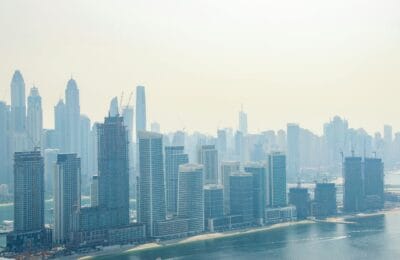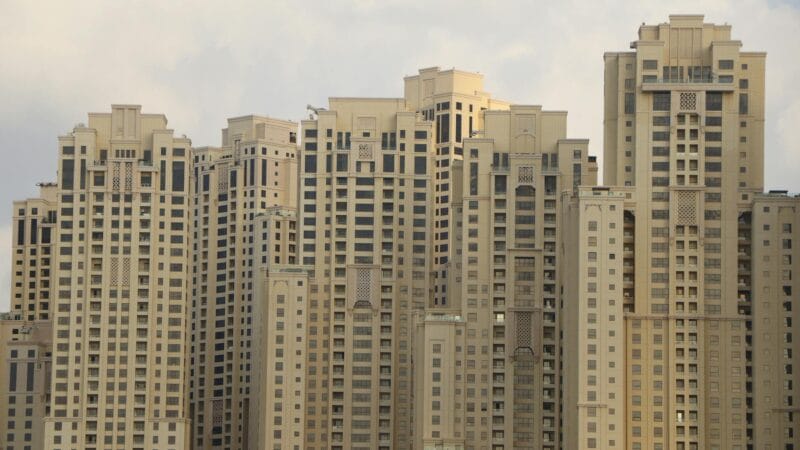
Dubai’s property market has absorbed a series of shocks in the first quarter of 2026 that would have triggered a full correction in any less liquid market. Six developer sukuk in distress. Transaction volumes down 25% quarter-on-quarter. A war 200 kilometers away that has spooked foreign buyers. And yet: gross rental yields of 6–8%, a villa segment that refuses to capitulate, and a landlord population so convinced of long-term value that 85% are declining sale requests at current prices.
The April 2026 outlook for Dubai real estate is not a binary between crash and boom. It is a market in bifurcation — where distress is real in specific segments and among specific developers, while structural demand drivers remain intact. Understanding which side of that divide you are on determines whether this moment is a risk or an opportunity.

- 6 developer sukuk currently in distress or restructuring (March 2026)
- Transaction volumes: -25% quarter-on-quarter
- 85% of landlords refusing to sell at current prices
- Moody’s forecasts a 10–15% price correction in mid-market by end-2026
- Villa segment: resilient, prices flat to +3% YTD
- Mid-market apartments: -3% YTD and declining
- Gross rental yields: 6–8% — among the highest in global prime markets
- 20% new housing stock increase expected from 2023–2025 pipeline deliveries
The Bond Crisis: What Actually Happened
The distressed sukuk story began in late 2025 when rising global interest rates collided with Dubai developers who had funded aggressive off-plan pipelines with short-duration Islamic bonds. As detailed in our earlier coverage of Dubai’s bond market stress and the more recent Binghatti and Omniyat sukuk situations, six developers are now navigating debt restructuring while simultaneously trying to complete projects and maintain buyer confidence.
The mechanism is classic: developers sold off-plan units at projected completion values, used sukuk proceeds to fund construction, and assumed continued price appreciation would give them refinancing headroom. When Brent hit $115 and the Iran war triggered a buyer hesitation premium in foreign demand, that model buckled. Completion delays followed. Sukuk covenants were breached. Restructuring conversations began.
This is not, however, a systemic banking crisis. UAE banks’ direct exposure to the six distressed developers is estimated at $2.1–3.4 billion — material but manageable against a banking system with $900+ billion in total assets and strong capital ratios mandated by the Central Bank of the UAE.
Transaction Volume Decline: Temporary Shock or Structural?
The 25% volume decline is real and significant. But decomposing it matters. The majority of the drop comes from two specific buyer categories: Russian and Eastern European cash buyers (disrupted by sanctions-related capital flow restrictions) and speculative flipper activity (which surged in 2024 and is now normalizing). End-user purchases and long-term investor acquisitions have declined by a more modest 10–12%.
The landlord refusal-to-sell dynamic is paradoxical but rational. Owners who bought at 2021–2023 prices have seen appreciation of 40–70% in villa segments and 20–35% in apartment segments. Selling at a 5–10% discount to peak to a hesitant buyer makes no economic sense when rental yields of 6–8% provide cash flow while waiting for conditions to normalize.
This supply-side rigidity is a structural feature of Dubai’s market. Unlike Hong Kong or Singapore, where stamp duties and holding costs force sales, Dubai imposes zero property tax, zero capital gains tax, and zero inheritance tax. Holding has no carrying cost beyond service charges. Sellers can wait indefinitely.
The Supply Overhang: 20% New Stock by Year-End
The genuine bear case for Dubai property in 2026 is supply. The 2023–2025 construction boom — which saw an estimated 85,000 new units break ground — is now delivering. By end-2026, Dubai’s housing stock will have increased by approximately 20% from 2022 levels. In a market where transaction volumes are already down 25%, absorbing that supply requires either a resumption of foreign demand or meaningful price concessions.
Moody’s base case — a 10–15% correction in mid-market apartment prices by Q4 2026 — is grounded in this supply math. The agency specifically exempts villa communities (Dubai Hills, Arabian Ranches, Jumeirah Golf Estates) from its correction forecast due to land scarcity and end-user buyer profiles. It is also bullish on prime waterfront (Palm Jumeirah, Bluewaters, Creek Harbour), where supply is structurally constrained.
The War Premium: How Much Is Iran Discounting Dubai Property?
The Iran conflict has introduced what analysts are calling a geopolitical risk premium of 5–8% in foreign buyer pricing expectations — meaning prospective international buyers are demanding prices 5–8% below where sellers are willing to transact. This bid-ask spread, more than any fundamental deterioration, explains much of the transaction volume decline.
The practical impact on tourism and transient demand — which influences short-term rental yields — has been documented in our analysis of Dubai’s tourism performance during the Iran war. Airbnb occupancy in tourist-facing districts fell 12–18% in February–March 2026. Investors in short-term rental properties have felt this directly.
However, the same war that is suppressing foreign buyer demand is accelerating Gulf national relocation to Dubai. Kuwaiti and Bahraini nationals — whose home countries are under direct attack — are purchasing UAE property as a safe-harbor asset at rates not seen since the 2011 Arab Spring. This intra-GCC demand is partially offsetting Western and South Asian buyer retreat.
Where the Opportunity Sits in April 2026
The market’s bifurcation creates a clear framework for analysis:
Avoid: Mid-market apartment towers in Jumeirah Village Circle, Dubai Silicon Oasis, and Dubai South with developer sukuk exposure. Supply overhang is heaviest here, yields are lowest (4–5.5%), and the buyer demographic most sensitive to market sentiment.
Watch: Distressed developer situations where Dubai’s government-linked entities (Dubai Holding, Emaar, DAMAC) may step in as acquirers. History suggests the UAE’s sovereign infrastructure acts as a buyer of last resort, preventing the outright collapse that a pure free-market correction would produce.
Buy: Villa communities with land scarcity, prime waterfront, and income-producing commercial assets where yields of 7–8%+ provide a margin of safety against further price erosion. The UAE’s structural advantages — zero income tax, world-class infrastructure, English-language business environment — continue to attract high-net-worth relocation demand.
Dubai property at 6–8% gross yields denominated in AED (pegged to USD at 3.67) offers a real yield premium of roughly 300–400 basis points over equivalent US residential real estate after accounting for cap rate compression in major US cities. The risk is not yield — it is capital value stability. US investors should size Dubai exposure as emerging market real estate (10–15% of real estate allocation), focus on income-producing assets over off-plan speculation, and monitor the Hormuz conflict resolution timeline as the single biggest catalyst for foreign buyer return.
The Medium-Term Case: Why Fundamentals Win
Dubai’s structural demand case — population growth, zero income tax, visa liberalization, regional safe-haven status — has not changed. The emirate’s population grew 4.2% in 2024 and is projected to reach 4.5 million by 2030. Each percentage point of population growth translates to roughly 8,000–10,000 new housing units of demand.
The 2026 correction, if it materializes, is more likely to be a 6–12 month repricing event in specific segments than a sustained multi-year downturn. The absence of mortgage leverage risk (most Dubai transactions are cash or low-leverage), the zero-tax holding environment, and sovereign backstop capacity distinguish this from a Western property cycle.
FAQ: Dubai Real Estate April 2026
Is Dubai real estate crashing in 2026?
Not across the board. Mid-market apartments face a 10–15% correction risk per Moody’s, driven by supply overhang. Villa communities and prime waterfront remain resilient. This is a segmented market stress, not a systemic collapse.
What are Dubai rental yields in April 2026?
Gross rental yields remain 6–8% across most asset classes — among the highest in global prime real estate markets. Net yields after service charges typically run 4.5–6.5%.
Are Dubai property prices falling in 2026?
Mid-market apartment prices are down approximately 3% year-to-date as of March 2026. Villa prices are flat to +3%. Prime waterfront is essentially unchanged. The correction is segment-specific, not market-wide.
Should US investors buy Dubai property in 2026?
Income-producing assets with 7–8%+ yields offer a compelling risk-adjusted return for investors who can tolerate emerging market capital value volatility. Off-plan speculation from distressed developers should be avoided. Size Dubai exposure as 10–15% of a real estate allocation.
What happens when the Iran war ends for Dubai real estate?
Foreign buyer demand — particularly from Europe, South Asia, and the US — is expected to rebound sharply on conflict resolution. The geopolitical risk premium of 5–8% that buyers are currently demanding would compress quickly, providing a catalyst for capital appreciation on top of current yield income.