Dubai’s real estate bond market is flashing its most serious distress signals in 17 years. As of March 28, 2026, six sukuk and dollar bonds issued by Dubai property developers are trading at spreads of 1,000 basis points or more over equivalent-maturity U.S. Treasuries — the threshold widely used by credit analysts to define distressed territory. The six instruments collectively represent approximately 15% of all Middle East dollar-denominated real estate bonds outstanding, and their deterioration is attracting attention from distressed debt funds in New York and London who see both opportunity and systemic risk.
Key Takeaways
- Six sukuk at 1,000+ bps — Binghatti, Sobha, Arada, and three others cross the distressed threshold, representing 15% of ME dollar real estate bonds.
- Binghatti 2027 most distressed — The developer’s near-term maturity note is the most stressed instrument in the cohort, reflecting refinancing risk.
- Sobha spread tripled — From 300 bps in early March to 800+ bps by March 28, a pace of deterioration that mirrors 2009-era stress.
- Arada spread doubled to 728 bps — Just below distressed threshold but deteriorating rapidly; likely to cross 1,000 bps absent stabilization.
- War risk premium driving selloff — Investors are discounting Iranian conflict contagion to UAE, reduced foreign buyer appetite, and refinancing risk in a high-rate environment.
The Six Distressed Instruments: A Closer Look
The most distressed instrument in the cohort is Binghatti Developers’ 2027 dollar sukuk, which has seen its spread widen to approximately 1,380 basis points as of March 28 — a level that implies a significant probability of restructuring in the eyes of the market. Binghatti, known for its high-velocity off-plan launch strategy, faces a challenging near-term maturity at a moment when its primary target market — upper-middle-income foreign investors, particularly from South Asia and Russia — has shown measurable retreat from new commitments amid war-related uncertainty.
Sobha Realty’s sukuk has been the month’s most dramatic widener in percentage terms, tripling from approximately 300 basis points at the start of March to over 800 basis points by March 28. Sobha’s trajectory is concerning because the company had been one of the sector’s more conservative operators — largely avoiding the excessive off-plan leverage that characterized some competitors — suggesting the spread widening is driven primarily by systemic risk reassessment rather than company-specific fundamentals.

Arada’s bond, with a spread of 728 basis points, sits just below the formal distressed threshold but has doubled in roughly three weeks — a pace that, if maintained for another 10–14 days, would place it firmly in distressed territory. Arada is primarily a Sharjah-focused developer with some Dubai exposure, meaning its stress may partly reflect contagion from Dubai rather than its own operating environment deteriorating.
Why Dubai Real Estate Bonds Are Under Pressure
The stress in Dubai’s real estate bond market stems from a confluence of factors that have accelerated sharply since the Iran-Israel conflict expanded in early March. The primary driver is a contraction in foreign buyer demand. Dubai’s off-plan property market — which accounts for roughly 70% of all transactions by volume — depends heavily on foreign purchasers, particularly from India, Pakistan, Russia, China, and the wider Middle East. War risk premiums have caused a measurable pause in new commitments, with several major developer IR teams reporting 30–40% declines in new booking inquiries in the first three weeks of March compared to January–February averages.
The second driver is refinancing risk in a persistently high interest rate environment. Several of the distressed instruments have maturities falling in 2026–2028. In a normal rate environment, rolling these into new instruments at modest spread premiums would be manageable. With base rates still elevated and credit spreads blowing out simultaneously, the all-in cost of refinancing for a stressed Dubai developer has increased by an estimated 350–450 basis points since early 2025.
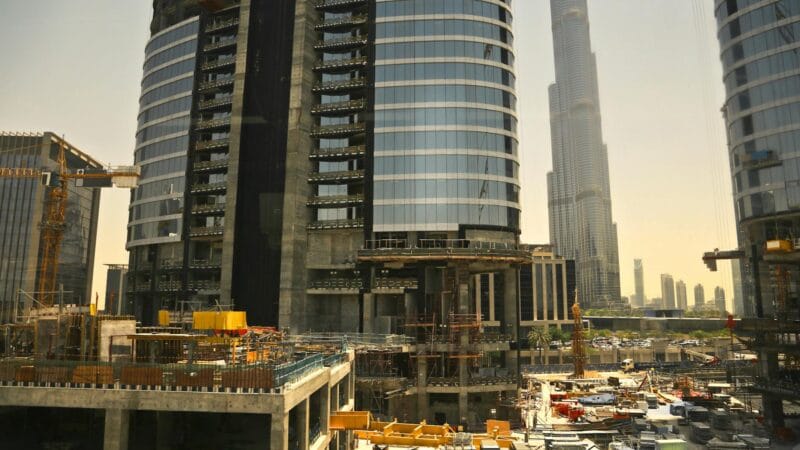
The third driver is specific to the current conflict: insurance and financing costs for construction materials and equipment have risen sharply. Several Gulf developers source steel, glass curtain wall systems, and mechanical equipment from suppliers who route through either the Red Sea or Hormuz. Supply chain delays are now being reported at multiple major construction sites in Dubai, with project completion timelines extending by an estimated two to four months on average.
The 2009 Parallel: How Far Could This Go?
The comparison to Dubai’s 2009 debt crisis is unavoidable — and instructive. In 2009, Dubai World’s $26 billion debt standstill triggered a systemic repricing of all Dubai real estate risk, with some developer bonds falling to 20–30 cents on the dollar. The current episode is structurally different in important ways: Dubai’s fiscal position is much stronger (Abu Dhabi sovereign support is more institutionalized), total developer leverage is lower relative to asset values, and the external demand shock is war-driven rather than being a fundamental structural oversupply.
However, the pace of spread widening in March 2026 is tracking at a rate comparable to the early stages of the 2009 crisis before intervention. If war-related demand destruction persists through Q2 2026 without diplomatic resolution, ratings agencies have indicated they are reviewing several Dubai developer ratings for potential downgrade — a move that would trigger forced selling by investment-grade-constrained institutional holders and could amplify the spread widening further.
Distressed Opportunity: What Bond Investors Are Watching
The selloff has begun attracting capital from specialist distressed debt funds, several of which have significant Middle East emerging market experience from the 2009 cycle. The recovery calculus depends primarily on Dubai government support mechanisms — specifically whether the Investment Corporation of Dubai (ICD) or Abu Dhabi’s ADQ would step in to backstop failing developers as occurred in 2009–2010. Several sources at regional sovereign wealth funds indicate informal conversations are already taking place, though no formal support announcement is imminent.
What This Means for US Investors
US investors with exposure to emerging market bond funds — particularly those benchmarked to the JPMorgan EMBI or CEMBI indices — likely have indirect exposure to Dubai developer sukuk, as several are included in these widely-tracked indices. Review fund prospectuses for UAE and GCC real estate exposure. For those actively managing credit risk, the current spread widening offers a potential distressed entry point on the most liquid names (Sobha, Binghatti) contingent on a sovereign backstop scenario — though the risk of restructuring is real and should be sized accordingly. Avoid direct investment in Dubai off-plan property as a financial instrument until Q2 transaction data clarifies the demand trajectory. The MENA high-yield ETF space (no direct US-listed pure play exists; GULF ETF has indirect exposure) warrants reduced weighting until diplomatic progress emerges.
Frequently Asked Questions
What does it mean for a bond to be “distressed”?
A bond is generally considered distressed when its yield spread over comparable U.S. Treasuries exceeds 1,000 basis points (10 percentage points). At this level, the market is pricing in a meaningful probability of default or restructuring. Distressed bonds typically trade at significant discounts to face value.
Why is Binghatti more distressed than other Dubai developers?
Binghatti has a near-term 2027 maturity creating immediate refinancing pressure, a high-velocity off-plan sales model that is acutely sensitive to foreign buyer demand pauses, and some questions about the sustainability of its rapid expansion. The combination of maturity pressure and demand headwinds makes it the market’s most stressed name.
Could Dubai face another 2009-style real estate crisis?
The structural parallels are real but the context is different. Dubai’s fiscal buffers are stronger, Abu Dhabi support mechanisms are more institutionalized, and developer leverage ratios are lower. A 2009-scale crisis would require a sustained multi-year demand collapse rather than a war-driven pause. However, if the Iran conflict extends into Q3 2026, downside scenarios become more probable.
How much of Middle East real estate debt is now distressed?
The six bonds identified represent approximately 15% of all Middle East dollar-denominated real estate bonds outstanding. A further 20–25% (including Arada, which is approaching distressed territory) is in the high-stress zone of 600–999 basis points, meaning distressed exposure could double relatively quickly absent market stabilization.