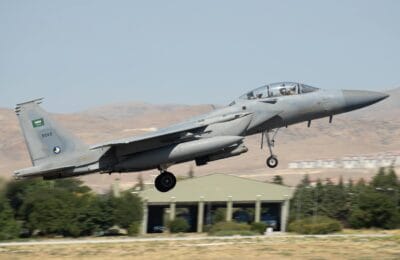
The week of March 8-14, 2026 will be remembered as one of the most turbulent in modern Middle Eastern history. As US-Israeli strikes on Iran entered their third consecutive week, the Strait of Hormuz choked down to just 5 ships per day — a 96% collapse from the pre-war average of 138. Brent crude surged past $100 per barrel, gold touched $5,032 per ounce, and stock markets bled from Seoul to Dubai. Yet amid the chaos, surprising signs of resilience emerged — from Saudi Arabia’s non-oil GDP crossing the 50% threshold for the first time ever, to Dubai’s real estate market posting a 75% surge in viewing activity even as its bond index cratered.
War & Geopolitics: A Third Week of Escalation
US-Israeli strikes on Iran entered their third week since launching on February 28, with a notable escalation in the pace of military operations. Iran’s IRGC declared unequivocally that “not one litre of oil will get through” the Strait of Hormuz, effectively transforming the world’s most critical maritime chokepoint into an active war zone. Shipping traffic plummeted to just 5 vessels per day — down 96% from the normal 138.
On the military front, the USS Gerald Ford carrier strike group was deployed to the region to bolster American naval presence. Diplomatically, Ali Larijani was dispatched on a regional diplomatic mission in an attempt to open negotiation channels, though no concrete outcomes materialized by week’s end.
The war’s impact on civilian life across the Gulf was severe. Over 4,000 daily flight cancellations were reported across Gulf states. DP World’s Jebel Ali port — the region’s largest — suspended operations after a drone strike ignited a fire. Bloomberg informed Gulf-based staff they could temporarily relocate, and evacuations were reported in parts of Doha, Qatar. For a comprehensive analysis of the economic fallout, see our detailed report on the war’s economic impact on Gulf states.
Oil & Energy: Brent Breaks $100
Brent crude surged past the $100-per-barrel mark, up approximately 40% since the war began. The rally reflects a simple reality: the Strait of Hormuz, through which roughly 20% of the world’s oil supply transits, is effectively shut down.
OPEC+ had agreed on March 1 to a modest 206,000 barrels-per-day production increase for April, but this increment appears woefully inadequate to offset the disruption caused by the strait’s near-closure.
Consumer-level costs are escalating rapidly. US gasoline hit $3.60 per gallon, up $0.35 in a single week. According to IMF estimates, every 10% rise in oil prices adds 0.4 percentage points to global inflation while shaving 0.15 percentage points off GDP growth. Maritime insurance costs have doubled, as detailed in our analysis of Hormuz shipping disruptions. For price trajectory projections, see our oil price forecast for April 2026.
Gold & Safe Havens: $5,032 Per Ounce
Gold continued its ascent to $5,032 per ounce on March 14, approaching the all-time record of $5,595 set on January 29. The surge reflects intensifying demand for safe-haven assets amid deepening geopolitical uncertainty.
However, not all that glitters is gold — literally. The Saudi Gold ETF plunged 9% amid extreme volatility, signaling that even safe-haven instruments are not immune to turbulence when market swings reach this magnitude. For deeper coverage, read our reporting on gold’s record-breaking rally and our gold price forecast for April 2026.
Dubai Real Estate: The Crash vs. Stability Paradox
Dubai’s property market painted a strikingly contradictory picture this week. On one hand, the DFM Real Estate Index plunged 21%, dropping from 16,700 to 13,353 points. Bloomberg labeled UAE corporate bonds the worst performers in emerging markets.
On the other hand, property viewing requests surged 75%, median prices held at AED 1,770 per square foot — up 14% year-over-year — and total transactions reached 36,831 since the start of 2026, running 7% ahead of 2025’s pace.
This divergence suggests that smart money sees the dip as a buying opportunity, not an exit signal. Paper markets are suffering, but the real market — where homes are built and contracts are signed — is showing “stability, not panic,” as analysts have noted. For deeper analysis, read Is Dubai’s Real Estate Dip a Buying Opportunity? and our Dubai Real Estate Stress Test Analysis.
Saudi Economy & TASI: Strategic Resilience
Saudi Arabia delivered a historic milestone this week: non-oil GDP surpassed 52% of the total economy for the first time ever — a watershed moment for Vision 2030. Overall GDP grew 4.5% in 2025, with 4.6% forecast for 2026.
On the market front, the TASI index hit an intra-week low of 10,214 before recovering to approximately 10,893, supported by a successful breakout in Aramco shares that anchored the broader index. On the consumer side, Ramadan spending was estimated at 65 billion SAR. For market movements, see our TASI analysis for March 12 and best dividend stocks on Tadawul for 2026.
Egypt & North Africa: Mounting Pressures
Egypt faces escalating pressures on multiple fronts. The Egyptian pound settled at 51.8 against the dollar, while Suez Canal revenues plunged 52% as shipping routes were diverted due to Red Sea disruptions and the broader regional war spillover.
The IMF’s $820 million tranche has been delayed, adding pressure to foreign reserves. In response, the government announced salary and pension increases in an effort to cushion citizens against rising living costs. For currency movements, see our Egyptian pound exchange rate analysis for March 2026.
GCC Markets Overview: Bonds and Credit Ratings Under Scrutiny
Gulf markets were not spared from the storm. UAE bonds were designated the worst performers among emerging markets, while GCC credit ratings came under review from major rating agencies amid heightened geopolitical risk.
In Qatar, evacuations were reported in parts of Doha, raising additional concerns about security stability across the region. Despite the war backdrop, Gulf airlines reported a strong Ramadan travel surge, reflecting the region’s capacity for adaptation even under the most challenging conditions. For an overview of GCC countries and their economies, see our comprehensive guide.
Global Ripple Effects: A Shockwave Beyond the Region
The Middle East crisis radiated well beyond the region’s borders. In South Korea, the KOSPI index crashed 12% in its worst weekly performance since the 2008 global financial crisis. Over 400,000 metric tons of Indian basmati rice remained stranded at ports due to soaring shipping and insurance costs.
CNN, the World Economic Forum, and the IMF all issued sequential economic impact assessments, each warning that a prolonged Hormuz closure could push the global economy toward stagflation. The worst-case scenario is not hypothetical: if the current situation persists for months, oil prices could return to levels not seen since the 1973 crisis.
What to Watch Next Week
The week ahead (March 15-21) carries several critical inflection points to monitor closely:
- Strait of Hormuz: Any change in shipping traffic — whether toward reopening or complete closure — will move markets instantaneously
- Diplomatic Mission: Outcomes from Larijani’s mission and any US-Israeli response to negotiation initiatives
- US Federal Reserve Meeting: The interest rate decision amid inflation pressures driven by surging oil prices
- Egypt IMF Tranche: Any progress on the $820 million disbursement negotiations
- Oil Prices: Whether Brent stabilizes above $100 or pushes past $110
- GCC Credit Ratings: Anticipated decisions from Fitch and S&P
- Ramadan & Markets: The impact of the holy month on trading patterns and consumer spending
Bottom Line: A Message for Investors
The Middle East is at a pivotal moment where the risks of war intersect with opportunities for structural transformation. Yes, the Strait of Hormuz is nearly shut, oil is above $100, and markets are bleeding — but beneath the surface, Saudi non-oil GDP has crossed the 50% threshold for the first time, Dubai real estate is showing resilient real demand despite index collapses, and gold is once again proving its role as the ultimate crisis hedge. The wise strategy is not to flee the region, but to understand where the risks lie and where the opportunities hide. Diversification, inflation hedging, and a focus on real assets — these are the tools for both survival and prosperity in a week like this. Caution is warranted, but panic is not an investment strategy.