Dubai’s real estate market faces what may be its toughest test since the 2009 crisis in March 2026. Three pressures are converging simultaneously: the fallout from the regional conflict tied to the war on Iran, a record residential supply exceeding 131,000 new units, and a clear shift in investor behavior from “fear of missing out” to “wait and watch.” But the actual data tells a more complex story than the headlines suggest.
The market recorded 15,756 residential sales transactions worth AED 55.18 billion in January 2026 alone — a 43.9% year-on-year increase. In February, transactions reached 16,959 deals valued at AED 60.6 billion. These figures point to a market that remains active — but one that is changing.
What Happened: From Record Momentum to Shock Testing
Dubai’s property market entered 2026 with historically unprecedented momentum. In 2025, the emirate recorded AED 917 billion (approximately $250 billion) in real estate transactions across more than 270,000 deals — the highest figure in its history. Average residential property values reached AED 1,689 per square foot by the end of 2025, a 19.8% year-on-year increase.

But beneath that glossy surface, warning signals were present. Fitch Ratings flagged Dubai as a market likely to undergo a price correction of up to 15%. UBS estimated that Dubai ranked fifth globally in real estate bubble risk, behind Zurich and Los Angeles.
Then came the military strikes.
The Geopolitical Context: When Conflict Reaches Real Estate
As the confrontation between Iran on one side and the United States and Israel on the other escalated, the UAE experienced direct consequences that no one anticipated would reach the region’s most attractive real estate market. The Fairmont The Palm hotel was struck by an explosion, debris from a downed Iranian drone set fire to the Burj Al Arab hotel, Dubai airport sustained damage from a missile strike, and the U.S. Consulate in Dubai was targeted by a suspected drone attack.
These events didn’t just cause physical damage to infrastructure — they struck at the very foundation of what made Dubai a global investment destination: its image as a safe and stable haven.
Analysis: A Market Split Into Three Tiers
What deeper analysis reveals is that Dubai’s real estate market is no longer a single market — it has become three distinct markets moving in different directions:
Ultra-Luxury Segment (Above AED 20 Million): Surprising Resilience
In a stark contrast to negative headlines, this segment recorded a historic transaction this week: an apartment sold for AED 422 million at Aman Residences Dubai. In January 2026 alone, 990 residential units priced above AED 10 million were sold.
Buyers in this segment — ultra-high-net-worth individuals — view Dubai as a long-term asset, not a speculative instrument. Headlines don’t shake them because they buy based on structural fundamentals: a favorable tax environment, strategic geographic location, and world-class infrastructure.
Mid-Market Segment (AED 1.5M — 4M): Under Maximum Pressure
This segment faces the greatest pressure, with buyers negotiating 3–7% discounts and extending due diligence periods. Many end-users are deferring purchase decisions by 4 to 8 weeks to assess the security situation.
This segment is most sensitive to news headlines because buyers here are predominantly residents seeking housing or investors with limited budgets — not professional speculators.
Off-Plan Market: Betting on the Future
The off-plan market accounted for more than 60% of total transactions in February 2026. Developers continue launching new projects with attractive payment plans across multiple communities.
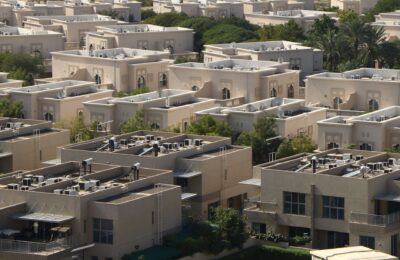
But here lies the greatest risk: with over 131,000 residential units expected for delivery in 2026 (81% apartments, 19% villas), any prolonged slowdown in demand could transform this record supply into a genuine oversupply.
Regional Impact: Dubai Is Not Alone
The repercussions extend beyond Dubai. Real estate markets in Abu Dhabi, Sharjah, and Ajman are also affected, albeit to varying degrees. Meanwhile, investors who were channeling capital toward the Gulf are reassessing their calculations:
Does the region remain a safe haven for real estate investment? Or have geopolitical risks become a structural factor that must be permanently priced in?
For other Gulf states such as Saudi Arabia, Qatar, and Bahrain, some capital that was flowing toward Dubai may be redirected to their markets — especially with the acceleration of Saudi Vision 2030 projects and preparations for the 2034 FIFA World Cup.
The Other Side of the Argument
In fairness, the full picture must be presented. Many experts and developers argue that what is happening is a “temporary shock” rather than a “structural shift.”
Mohammed Alabbar, founder of Emaar Properties, stated that he does not see a genuine market cooldown despite the tensions. Historical data indicates that Dubai recovered quickly from previous crises — from the 2009 financial crisis to the 2020 COVID pandemic.
The core argument: 86% of Dubai transactions are conducted in cash (according to Knight Frank estimates), meaning the market is less vulnerable to credit crises. Rental yields also remain globally competitive, ranging between 8% and 9.5% for apartments in mid-market areas.
What Comes Next: The Q2 2026 Roadmap
The market’s trajectory in the coming months depends on three critical factors:
**First: The duration and scope of the conflict.** If it becomes a prolonged confrontation with repeated strikes, investor confidence will erode gradually regardless of fundamentals. If it ends with a swift diplomatic resolution, recovery could be faster than many expect.
**Second: The market’s capacity to absorb supply.** With 131,000 new units, the market needs sustained demand from new residents and international investors. Any slowdown in migration or decline in foreign demand will pressure prices in specific areas.
**Third: Government response.** Dubai’s track record in crisis management is strong — from launching new visa programs to tax incentives. The policy and regulatory response will determine whether the current slowdown is temporary or the beginning of a deeper correction cycle.
The smart investor will neither flee the market nor rush into it blindly. They will wait for data, assess risks precisely, and seek opportunities in segments where competitors are retreating.