The final week of February and the start of March 2026 was no ordinary week for the Gulf. Between unprecedented military strikes, a historic shipping crisis, and oil decisions that seem contradictory, a new economic reality is taking shape — one that demands deeper reading than quick headlines provide.
In this weekly roundup, we don’t just list events — we uncover the angles most analysts overlooked, and the gaps that will define market direction in the weeks ahead.
1. The Hormuz Crisis: Not a Military Blockade — an Insurance Collapse
After Operation Epic Fury — the US-Israeli strikes against Iran on February 28 — Tehran retaliated with missile attacks on US military bases in the Gulf and Israeli targets. But the biggest impact wasn’t the missiles — it was the decision by maritime insurers.

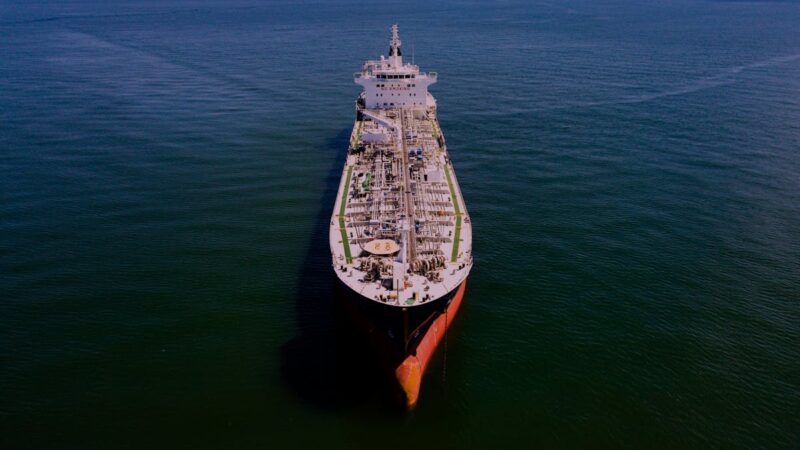
Major insurance companies cancelled war risk coverage for vessels transiting the Strait of Hormuz, effectively shutting the strait commercially without a formal military blockade. Tanker traffic dropped by approximately 70%, with over 150 ships anchoring outside the strait. Maersk, MSC, Hapag-Lloyd, and CMA CGM all suspended operations through the waterway.
Why this matters: 20-30% of global oil and gas supplies pass through Hormuz. When insurance coverage disappears, Iran doesn’t need to sink a single ship — the market shuts itself down. This angle was largely absent from media coverage focused on military operations.
2. Oil Jumps 13%: But What If It Crosses $100?
Brent crude surged up to 13% to reach an eight-month high, while gold climbed above $5,300 per ounce to hit new record highs.
Analysts distinguish between two scenarios:
- $80 scenario: Short-lived conflict, limited global economic impact
- $100+ scenario: A qualitative shift that hammers global growth and revives inflation fears
The paradox: Rising oil prices help Gulf producer budgets in the short term but damage vital non-oil sectors like tourism, aviation, and trade — the very sectors that Vision 2030 and Gulf diversification strategies are betting on.
3. The OPEC+ Paradox: Boosting Output at the Peak of Crisis
In seemingly contradictory timing, OPEC+ led by Saudi Arabia and Russia decided to add 206,000 barrels per day starting April, after freezing increases through Q1.
What analysts missed: The decision isn’t as contradictory as it appears. With Hormuz effectively closed, those additional barrels from Saudi Arabia, Iraq, and Kuwait may never actually reach markets. The decision is as much political as economic — a signal to markets that supply is theoretically available, even if shipping logistics say otherwise.
4. Saudi Budget Deficit: The Fiscal Sustainability Question
Q4 2025 data revealed a quarterly deficit of $25.3 billion, bringing the full-year deficit to $73.6 billion — equivalent to 5.5% of GDP and more than double 2024 levels.
Public debt rose to SAR 1.52 trillion from SAR 1.22 trillion a year earlier. The driver is clear: accelerated spending on Vision 2030 projects amid declining oil revenues.
The analytical gap: Most coverage reports the numbers without asking the essential question — is this pace sustainable? If we assume temporarily elevated oil prices from the Hormuz crisis, they may ease fiscal pressure in the short term. But relying on a geopolitical crisis to fund economic diversification is itself a paradox.
5. UAE Exit from Emerging Market Bond Index: What It Means for Investors
JPMorgan announced it will remove the UAE from its Emerging Market Bond Index (EMBI) in four phases between March 31 and June 30, after the UAE exceeded wealth measures for three consecutive years. The UAE represents 4.1% of the index.
What went unsaid: Hundreds of billions of dollars track this index. Passive funds and ETFs will be forced to gradually reduce UAE exposure. On the surface, this is an “upgrade” — the UAE has become too wealthy to be an emerging market. But in practice, it may mean temporary outflows and volatility in UAE bond markets.
Meanwhile, Saudi Arabia was added to the EMBI watchlist in September 2025 — signaling an entirely opposite trajectory.
6. JPMorgan Cuts GCC Non-Oil Growth Forecasts
The bank lowered its 2026 non-oil growth forecasts:
- Bahrain: -0.5 percentage points
- UAE: -0.4 percentage points
- Qatar: -0.3 percentage points
- Saudi Arabia & Kuwait: -0.2 percentage points
- Oman: unchanged
Bahrain is the hardest hit — logical, given it sustained direct attacks on the US naval facility in Juffair, forcing residential evacuations and causing damage to buildings and hotels.
7. TASI: Sharp Volatility, Index Down 12.8% Year-on-Year
The Saudi stock index closed at 10,489 points on Monday with a marginal 0.13% gain. But the bigger picture is grim: the index lost 7.3% over the past month and 12.8% year-on-year.
Notably, 189 out of 267 listed stocks declined, while only 74 advanced. The slight headline gain was driven entirely by Saudi Aramco, which alone represents 67.6% of total market capitalization — meaning the real market performance is far worse than the headline number suggests.
8. Global Markets: Panic Then Partial Recovery
On Monday, March 2, Wall Street opened sharply lower before partially recovering. The S&P 500 closed up 0.1% and Nasdaq up 0.5%, while Europe’s Stoxx 600 fell 1.6% and Japan’s Nikkei 225 dropped 1.35%.
US airline stocks plunged: American Airlines (-3.6%), Delta (-2.3%), United (-2.9%). Gold surpassed $5,300 per ounce, hitting new record highs as a safe haven.
Bottom Line: A New Risk Map
What distinguishes this week isn’t the scale of events alone, but their intersection. The Hormuz crisis isn’t just a military matter — it’s an insurance, shipping, and logistics crisis. Saudi Arabia’s budget deficit isn’t just a number — it’s a question about the sustainability of the world’s largest economic transformation project. And OPEC+’s output increase isn’t routine news — it’s a political maneuver during an actual war.
The smart investor doesn’t read headlines — they read between them. That’s exactly what we’ve aimed to deliver in this roundup.