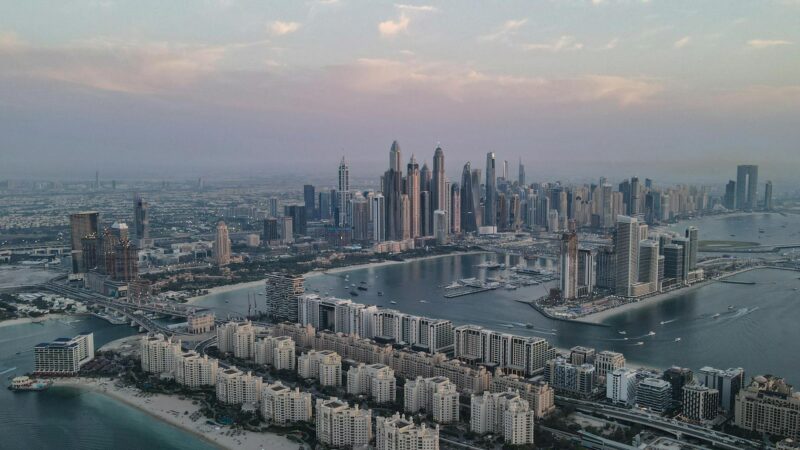
The UAE economy continues to deliver exceptional performance, proving the success of the economic diversification model the country has pursued for decades. In 2025, non-oil GDP grew by more than 6%, surpassing IMF forecasts and solidifying the Emirates’ position as one of the most resilient and diversified economies in the MENA region. While many oil-dependent nations struggle with restructuring, the UAE has built a multi-pillar economy drawing strength not only from oil prices but from trade, tourism, technology, and financial services.
Non-Oil GDP Growth in the UAE Economy: The Numbers and Key Drivers
The non-oil sector now accounts for more than 70% of total GDP, a dramatic shift from three decades ago when oil comprised over 60% of output. This transformation reflects the success of the economic diversification strategy launched under the founding vision and refined through UAE Vision 2021 and UAE Centennial 2071.
Major Sectors Driving Non-Oil Growth
Several sectors fuel growth beyond oil:

- Tourism and Hospitality: Dubai alone welcomed over 18 million tourists in 2025, generating revenues exceeding $35 billion. The emirate targets 25 million tourists annually by 2030.
- Trade and Re-exports: The Emirates serves as a global trading hub thanks to its strategic location and the Jebel Ali Free Zone. Non-oil foreign trade surpassed $600 billion in 2025.
- Financial Services: The DIFC houses more than 4,500 registered companies with assets under management exceeding $550 billion, while ADGM expands rapidly to compete as the region’s leading financial hub.
- Real Estate: Dubai’s real estate market is booming with sales rising 30% year-over-year, driven by international investor demand.
- Logistics: The country leads global logistics indices thanks to Jebel Ali Port and Dubai International Airport, the world’s busiest for international passengers.
“The UAE’s economic transformation is not simply income diversification — it is a comprehensive redefinition of the growth model for the entire region.”
— Bloomberg Gulf Economies Report, 2025
Dubai Economy: The Commercial and Tourism Engine
The Dubai economy represents a unique model — a city that transformed from a pearl-diving port into a global economic capital. Dubai’s GDP reached approximately $130 billion in 2025, targeting a doubling by 2033 under the D33 Economic Agenda.
The D33 Agenda: Doubling GDP
Launched by Sheikh Mohammed bin Rashid Al Maktoum, D33 targets:
- Doubling the Dubai economy to $260 billion by 2033
- Increasing foreign trade to $2 trillion
- Boosting infrastructure spending by $40 billion
- Attracting 100,000 new companies over ten years
Dubai’s Tourism Sector
Tourism is a primary pillar of the Dubai economy, ranking among the world’s top five destinations per Reuters. Iconic projects like the Burj Khalifa, Palm Jumeirah, and the Museum of the Future contribute over 11% of the emirate’s GDP.
Abu Dhabi Investment: The Sovereign Arm of UAE Economic Diversification
If Dubai is the commercial face, then Abu Dhabi is the financial powerhouse of the UAE economy. The capital holds several of the world’s largest sovereign wealth funds:
- ADIA: Assets exceeding $990 billion, among the world’s top three sovereign funds.
- Mubadala: Approximately $300 billion in assets, investing across technology, aerospace, and renewable energy.
- ADQ: Focuses on strategic domestic sectors including food, health, and energy.
Abu Dhabi’s Technology Investment Strategy
Abu Dhabi is transforming into a global technology hub. Mubadala has invested billions in major tech firms, while pioneering AI sector initiatives through MBZUAI — the world’s first dedicated AI university. The Falcon LLM developed by TII has gained global recognition as a leading open-source AI model.
UAE Free Zones: A Key Driver of Foreign Investment
With more than 45 free zones, these areas are among the most significant factors attracting foreign direct investment. Key advantages include:
- 100% foreign ownership with no local partner required
- Tax exemptions for up to 50 years
- Free profit and capital repatriation
- Streamlined setup in under 48 hours
Key Free Zones and Their Impact
- JAFZA: Over 9,000 companies, contributing 24% of Dubai’s FDI.
- Dubai Internet City / Media City: Regional HQs for Google, Microsoft, and Meta.
- DIFC: Independent English common law legal system.
- KIZAD: Heavy industry and advanced manufacturing hub.
According to CNBC, the UAE attracted over $27 billion in FDI in 2025, leading the region thanks to its free zone model.
Digital Transformation and Technology in the UAE Economy
The Emirates leads the Arab world in digital transformation and aims to rank among the global top ten in the digital economy.
E-Commerce Growth
The e-commerce market reached over $10 billion in 2025 with projections to hit $17 billion by 2028. Digital penetration exceeds 99%, making it the largest e-commerce market in the Arab world.
AI Strategy 2031
The country launched its AI Strategy 2031 and appointed the world’s first Minister of State for AI. Artificial intelligence is expected to contribute $96 billion to the UAE economy by 2030 — equivalent to 14% of GDP.
Digital Banking and Fintech
More than 15 digital banks have received licenses from the Central Bank. The digital banking revolution is reshaping finance, with DIFC and ADGM ranking among the world’s leading fintech hubs.
Smart Cities and Sustainability in the UAE Growth Model
The country is pioneering a smart cities model combining operational efficiency with sustainability. Masdar City was one of the world’s first sustainable cities, while Dubai’s Clean Energy Strategy 2050 targets 75% clean energy generation.
Renewable Energy
The Mohammed bin Rashid Solar Park is the world’s largest single-site solar project at 5,000 MW planned capacity. The Barakah Nuclear Plant — the first in the Arab world — supplies up to 25% of national electricity needs.
Green Finance and Sustainable Bonds
The UAE leads the Middle East in green bonds and sustainable finance. Abu Dhabi issued sovereign green bonds and launched the region’s first regulated carbon exchange. Hosting COP28 in 2023 cemented the country’s climate leadership.
Stock Market and Investment in the UAE
Mature financial markets — the DFM and ADX — have seen remarkable liquidity growth, driven by major IPOs including DEWA, ADNOC Drilling, and ADNOC Gas. Investors tracking regional dynamics may also follow the Saudi TASI index, while gold and precious metals remain key hedging instruments.
IPO Boom
Newly listed companies raised over $15 billion during 2022-2025, attracting major international institutional investors per Reuters. This deepens capital markets and strengthens the Emirates’ position as a premier emerging-market investment destination.
Challenges Facing the UAE Economy
Despite strong performance, several challenges require careful management:
- Demographics: Citizens represent only 11% of the population, raising questions about labor model sustainability.
- Energy Volatility: Oil still contributes ~30% of GDP; sharp oil price declines could impact revenues.
- Regional Competition: Saudi Arabia is investing heavily in similar sectors under Vision 2030.
- Regulatory Pressures: The new 9% corporate tax and international transparency rules require balancing compliance with competitiveness.
- Climate Change: Rising temperatures and water scarcity demand increased adaptation investment.
Future of the UAE Economy: Growth Outlook Through 2030
The IMF projects 4-5% annual non-oil GDP growth through 2030, while Bloomberg estimates total GDP could exceed $600 billion by decade’s end.
Future Growth Drivers
- Advanced Manufacturing: Operation 300bn targets AED 300 billion in industrial contribution by 2031.
- Circular Economy: Sustainable production models reducing waste and maximizing value.
- Space: The UAE Space Agency and Hope Probe Mars mission signal a growing space economy.
- Medical Tourism: Massive hospital and research investments position the country as a global hub.
- Green Hydrogen: Pioneering projects in Masdar and ADNOC develop this future fuel.
Frequently Asked Questions About the UAE Economy
What is the total GDP of the UAE?
Total GDP stands at approximately $510 billion in 2025, with projections to surpass $600 billion by 2030. The non-oil sector contributes over 70%, reflecting successful diversification.
What are the most important non-oil sectors?
Key sectors include tourism, trade and re-exports, financial services, real estate, logistics, technology and AI, and advanced manufacturing — all growing at 5-8% annually.
How do free zones attract foreign investment?
Over 45 free zones offer 100% foreign ownership, long-term tax exemptions, free profit repatriation, and fast setup. They help attract over $27 billion in annual FDI.
What role does AI play in the future of the UAE economy?
The AI Strategy 2031 targets $96 billion in AI contributions by 2030 (14% of GDP), supported by MBZUAI and homegrown models like Falcon.
Is the UAE economy safe for foreign investment?
Yes — the IMF and Bloomberg rank it among the safest in the Middle East, citing transparent regulations, world-class infrastructure, political stability, large reserves, and investment protection agreements with over 100 countries.
Disclaimer: This article is for educational and analytical purposes only and does not constitute financial or investment advice. Consult a licensed financial advisor before making investment decisions. Figures and projections are based on publicly available data and may change with market conditions.