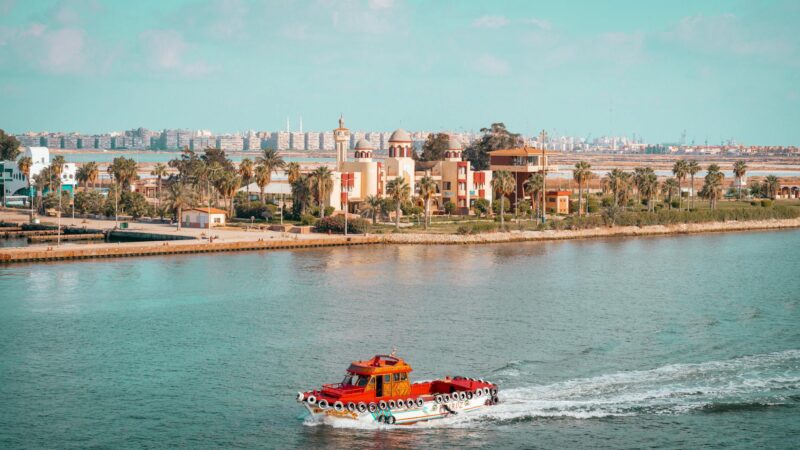
The Suez Canal — Egypt’s most strategic economic asset and one of the world’s most important shipping arteries — is poised for a rapid recovery following the April 7 Iran-US ceasefire. During the six-week war, the canal lost approximately 38% of its revenue as global shipping companies rerouted vessels around Africa to avoid the disrupted Persian Gulf routes. With the Strait of Hormuz reopening, the Suez Canal’s role as the world’s premier shipping shortcut is about to be restored.
This analysis breaks down how fast the recovery will happen, how much revenue Egypt will recapture, what shipping companies need to do before returning, and the broader impact on the Egyptian economy. For Egyptian investors and policymakers, this is one of the most consequential developments of 2026.
The Damage: Suez During the War
Revenue Collapse
| Metric | Pre-War (2025) | During War (Q1 2026) | Change |
|---|---|---|---|
| Annual revenue (estimated) | $8-9 billion | $5-5.5 billion (annualized) | -38% |
| Daily transits (vessels) | ~50 | ~30 | -40% |
| Annual cargo (tonnage) | ~1.3 billion | ~800 million | -38% |
| Foreign currency inflow | Strong | Severely reduced | Major |
Why Ships Left
The Iran war’s impact on Suez was indirect. Iran did not attack canal traffic. Instead, the closure of the Strait of Hormuz disrupted the entire supply chain that relied on the Mediterranean-Indian Ocean route. Asian goods bound for Europe typically traveled: Asian port → Indian Ocean → Bab el-Mandeb → Red Sea → Suez Canal → Mediterranean → European port. With Hormuz disrupted and broader Persian Gulf instability, shippers worried about the entire route.

Many shipping companies decided that the longer but safer route around Africa was preferable. The 4,300-mile detour added 15-20 days and $500,000-800,000 per voyage in costs, but eliminated security concerns. Major lines (Maersk, MSC, CMA CGM, Hapag-Lloyd) all rerouted significant portions of their fleets.
The Recovery: Phase by Phase
Phase 1: Immediate Response (Days 1-14)
Within 1-2 weeks of the ceasefire, the first shipping companies will begin returning to the Suez route. The earliest movers will be:
- Shipping lines with the most cost pressure (those with thinnest margins)
- Cargo owners with time-sensitive deliveries
- Mediterranean-focused shippers who can switch quickly
- Tankers from Gulf producers who never had alternative routes
Expected traffic in Phase 1: 30-40% of pre-war levels.
Phase 2: Insurance Normalization (Weeks 2-4)
Shipping insurance is the critical bottleneck. During the war, insurance premiums for vessels transiting the Persian Gulf surged to 5-8% of cargo value (from 0.1% pre-war). Lloyd’s of London and other major maritime insurers will need 2-4 weeks to:- Reassess actual risk levels post-ceasefire
- Update underwriting models
- Issue new policies at lower rates
- Process claims from the war period
Once insurance premiums normalize, more shipping companies can return economically. Expected traffic in Phase 2: 50-65% of pre-war levels.
Phase 3: Mass Return (Weeks 4-8)
After insurance normalizes and the first wave of shippers prove the route is safe, the bulk of remaining vessels return. Major shipping alliances coordinate fleet redeployment. New voyage schedules are established. Container shipping resumes more aggressively as customer demand for goods recovers.
Expected traffic in Phase 2: 75-85% of pre-war levels by end of Phase 3.
Phase 4: Full Recovery (2-3 Months)
Full return to pre-war traffic levels takes 2-3 months because some shippers permanently diversified during the crisis. Long-term contracts and strategic relationships with alternative ports (especially in Africa) won’t be unwound immediately. Some traffic may permanently shift to Cape of Good Hope routes for security reasons.
Expected traffic in Phase 4: 90-95% of pre-war levels.
Revenue Recovery Timeline
| Period | Expected Revenue | vs Pre-War |
|---|---|---|
| April 2026 | $0.4-0.5B | ~50% |
| May 2026 | $0.6-0.65B | ~75% |
| June 2026 | $0.65-0.70B | ~85% |
| Q3 2026 | $2.2-2.4B | ~90% |
| Q4 2026 | $2.3-2.5B | ~95% |
Impact on Egypt’s Economy
Foreign Currency Inflow
Suez Canal revenue is one of Egypt’s largest sources of foreign currency, alongside tourism, remittances, and exports. The recovery brings 2-3 billion dollars in foreign currency over the next 6 months — money that flows directly to the Central Bank’s reserves and supports the Egyptian pound.
This is critical because the pound has been under pressure at 54.45 USD/EGP. Suez recovery alone could allow the pound to stabilize at 53-54 by end of Q2, depending on other factors.
Government Budget Impact
The Suez Canal Authority is owned by the Egyptian state. Revenue flows directly to the Ministry of Finance. The 38% revenue loss during the war translated to approximately $1 billion in lost government income for Q1 2026. Recovery means restoring this income stream — important fiscal space for an Egyptian government already managing inflation and currency pressures.
Employment Impact
The Suez Canal directly employs approximately 14,000 people. Indirect employment in Ismailia, Port Said, Suez, and connected industries (logistics, services, tourism) reaches 50,000-70,000 jobs. The war disrupted employment but did not cause major layoffs because the Egyptian government prioritized job preservation. Recovery secures these jobs going forward.
Regional Economic Boost
Cities along the canal route — Ismailia, Port Said, Suez — depend heavily on canal-related activity. Hotels, restaurants, services, and tourism all benefit from canal recovery. These cities saw economic decline during the war and will see corresponding recovery.
Risks to Recovery
Risk 1: Ceasefire Collapse
If the two-week ceasefire collapses and the war resumes after April 21, shipping companies that returned to Suez will leave again. This would prolong the recovery by weeks or months. Probability: 20%.
Risk 2: Permanent Route Diversification
Some shipping companies may have decided during the crisis that the Cape of Good Hope route is safer despite being longer. They may continue using it even after Suez normalizes. This could permanently reduce Suez traffic by 5-10% from pre-war levels.
Risk 3: Insurance Premium Stickiness
Shipping insurance premiums may take longer to fall than expected. Insurers are notoriously slow to lower rates after periods of elevated risk. This could slow the Phase 2 recovery and push full recovery into Q3 2026.
What Egypt Should Do
Government Actions
- Accelerate negotiations with shipping lines: Offer transit fee discounts to encourage rapid return
- Improve marketing of safety and reliability: Demonstrate that Suez is safer than Cape of Good Hope
- Invest in modernization: Use this opportunity to upgrade canal infrastructure
- Diversify revenue sources: Don’t rely solely on transit fees; develop logistics zones
For Egyptian Investors
Suez Canal recovery is positive for Egyptian assets generally, but specific stocks benefit more directly:
- Logistics companies in Port Said and Ismailia
- Hotels in canal cities
- Egyptian banks that finance shipping and trade
- Real estate in canal cities (especially commercial)
Frequently Asked Questions
How much did Suez lose during the war?
Approximately 38% of revenue, about $3 billion annually.
When will traffic return to normal?
Gradual recovery: 50% in 2-4 weeks, 85% in 2 months, 95% in Q4 2026.
Why did ships leave Suez?
Indirect impact of Hormuz closure and broader Persian Gulf instability.
How does this help Egypt?
$2-3 billion in foreign currency over 6 months, fiscal recovery, job security, regional economic boost.
What are the risks?
Ceasefire collapse (20% risk), permanent route diversification, slow insurance normalization.
Related Articles
For more, see Reuters Shipping, Bloomberg Middle East, and Ahram Online.
Last Updated: April 8, 2026