In a move that redraws the alliance map of the Middle East, US President Donald Trump and Saudi Crown Prince Mohammed bin Salman announced an increase in planned Saudi investment in the United States from $600 billion to nearly $1 trillion, alongside Trump’s designation of Saudi Arabia as a major non-NATO ally. This announcement didn’t come in a vacuum — it arrived in the middle of a regional war with Iran, a near-total closure of the Strait of Hormuz, and mounting economic pressure on the Kingdom.
The timing is no coincidence. As Saudi Arabia faces unprecedented security threats from Iran, and as Trump seeks to cement American influence in the region against China’s rise, both parties found their interests converging like never before. This isn’t merely a commercial deal — it’s a comprehensive restructuring of the US-Saudi relationship that has governed the Middle East for eight decades.
Breaking Down the $1 Trillion Deal
To understand the scale of this agreement, it must be viewed as an integrated package rather than a single number. The trillion dollars is distributed across several sectors and timeframes:

Technology and AI: $300-350 Billion
This pillar includes massive Saudi investments in American technology companies, establishment of joint data centers, and development of AI platforms in collaboration with major US firms. Saudi Arabia’s Public Investment Fund (PIF) is already one of the world’s largest investors in the tech sector, and this deal dramatically expands that role. Think partnerships with Silicon Valley giants, co-development of AI models tailored to Arabic-language markets, and joint ventures in semiconductor design — all representing Saudi capital flowing into America’s most competitive sector.
Defense and Security: $150-200 Billion
New weapons deals include advanced air defense systems (Patriot and THAAD upgrades), potentially fifth-generation fighter jets (the long-sought F-35), intelligence and surveillance systems, and naval weapons platforms. The regional war with Iran has made this pillar more urgent than ever. Saudi Arabia’s existing defense infrastructure was designed for a different era — the current conflict has exposed gaps that only American technology can fill quickly.
Energy and Infrastructure: $200-250 Billion
This includes investments in American oil refineries, renewable energy projects, and perhaps most importantly — cooperation on civilian nuclear energy. Saudi Arabia has sought nuclear technology for electricity generation for years, and this deal may finally open that door. The Kingdom burns millions of barrels of oil annually for domestic power generation — every barrel burned locally is a barrel not exported. Nuclear energy would free those barrels for revenue-generating exports.
Real Estate and Infrastructure: $100-150 Billion
Saudi investments in American infrastructure projects, commercial centers, and real estate developments. This serves Trump’s goal of creating American jobs while serving Saudi Arabia’s goal of diversifying its investment portfolio beyond Middle Eastern assets.
Entertainment, Sports, and Tourism: $50-100 Billion
Enhanced Saudi investments in the American entertainment sector, including sports (PIF already holds stakes in major clubs), cinema, and gaming companies. This reflects the broader Vision 2030 strategy of building a Saudi entertainment ecosystem with American expertise and intellectual property.
Timeline and Conditions
The deal is designed for implementation over 10-15 years, with major milestones every two years. But it must be noted that “planned investments” are not legally binding commitments — they are a framework of intentions that can change based on economic and political conditions. This doesn’t diminish the deal’s importance, but it places it in realistic context. History shows that announced Saudi investment figures often exceed what ultimately materializes.
What Does “Major Non-NATO Ally” Actually Mean?
The designation of “Major Non-NATO Ally” (MNNA) isn’t merely an honorary title — it’s a specific legal status under US law that carries tangible privileges:
Military Privileges
First — Advanced Weapons Access: MNNA countries enjoy priority access to surplus US military equipment and advanced weapons systems. This means Saudi Arabia will be able to purchase weapons that were previously difficult to obtain, potentially including F-35 fighter jets that it has long sought. The designation removes bureaucratic hurdles that previously delayed or blocked sensitive arms sales.
Second — Joint Research and Development: MNNA countries can participate in American military R&D projects and access sensitive technologies. This dramatically accelerates Saudi military modernization and reduces dependence on reverse-engineering or purchasing from alternative suppliers like China or Russia.
Third — Pre-positioned Weapons Storage: The United States can permanently store military equipment on Saudi soil, enhancing rapid response capability in emergencies. This means faster reaction times when threats emerge — minutes instead of hours for certain capabilities.
Fourth — Enhanced Intelligence Sharing: A higher level of intelligence sharing, including sensitive information related to regional threats — specifically Iran. In the current war context, this means real-time sharing of satellite imagery, signals intelligence, and threat assessments that can make the difference between intercepting a missile and missing one.
Legal and Diplomatic Protections
The designation also carries legal protections related to government contracts and bilateral trade, and facilitates cooperation in energy, space, and cybersecurity. It gives Saudi Arabia stronger assurances that the United States will intervene to protect it in case of an existential threat — exactly what the Kingdom needs in the face of the current Iranian threat.
Who Else Is in the Club?
Countries currently designated as Major Non-NATO Allies include Egypt, Israel, Japan, South Korea, Australia, Jordan, Bahrain, Kuwait, Morocco, Pakistan, and Argentina, among others. Saudi Arabia’s admission places it alongside these nations in terms of security relationship with Washington — a status that was unthinkable just a few years ago when the Kingdom was being treated as a pariah over the Khashoggi affair.
Historical Context: From Oil-for-Security to Strategic Partnership
The US-Saudi relationship was founded in 1945 during a historic meeting between President Franklin Roosevelt and King Abdulaziz Al Saud aboard the USS Quincy in the Suez Canal. The fundamental deal was simple: oil for security. America guarantees the Kingdom’s protection, and Saudi Arabia ensures the flow of oil to global markets at reasonable prices.
This equation endured for decades but faced severe tests:
1973 — The Arab Oil Embargo: Saudi Arabia used the oil weapon against nations supporting Israel, demonstrating that the relationship wasn’t one-directional. Washington learned that its junior partner had real leverage.
1990 — The Gulf War: America intervened to protect Saudi Arabia from Saddam Hussein’s threat, proving the value of the American security guarantee. But the presence of US troops on sacred Islamic soil sparked internal controversy that would have far-reaching consequences — including, arguably, the radicalization that led to 9/11.
2001 — The September 11 Attacks: The most dangerous crisis in the bilateral relationship. Fifteen of the 19 hijackers were Saudi nationals. The relationship survived but was never the same. Trust was fundamentally damaged on both sides.
2015-2023 — The Yemen War: Declining US support for Saudi Arabia’s war in Yemen under Obama and Biden raised Saudi doubts about the reliability of the American security guarantee. The Saudis felt abandoned by the very ally that was supposed to have their back.
2018 — The Khashoggi Murder: The assassination of journalist Jamal Khashoggi at the Saudi consulate in Istanbul nearly destroyed the relationship entirely. The US Congress imposed restrictions on arms deals, and Biden pledged to make Saudi Arabia a “pariah.” For Mohammed bin Salman, it was the lowest point — personal condemnation from the leader of the free world.
2022-2025 — The China Courtship: Saudi Arabia responded to what it perceived as American abandonment by cozying up to China. President Xi Jinping’s state visit to Riyadh in 2022, cooperation agreements in 5G and AI, and talk of selling oil in yuan — all sent a clear message to Washington: we have alternatives. The strategy worked — it forced Washington to take Saudi concerns seriously again.
The trillion-dollar deal in 2026 is the conclusion of this chapter and the beginning of a new one. The war with Iran put things back in perspective: in a moment of real danger, there is no power on earth that can protect Saudi Arabia except America. And the price is a trillion dollars and clear strategic loyalty.
Why Now? The Iran War as Catalyst
The timing reveals everything. Before the regional war, Saudi Arabia was skillfully playing the balancing game between Washington and Beijing. Mohammed bin Salman was receiving offers from both sides and choosing what suited him without committing to either. This strategic ambiguity was an effective negotiating tool — and it worked brilliantly for several years.
But the war with Iran fundamentally changed the equation:
First — The Existential Threat: Iran possesses a ballistic missile arsenal capable of reaching every Saudi city. The Houthi attacks on Aramco facilities in 2019 exposed the fragility of Saudi oil infrastructure. Now, with a full-scale war, the threat has become existential rather than merely skirmishes. The Kingdom’s survival — not just its comfort — is at stake.
Second — No Substitute for the American Shield: China cannot — and does not want to — provide military protection for Saudi Arabia. What Beijing can offer is trade and investment, but when you need to intercept a ballistic missile over Riyadh, you need an American Patriot, not a Chinese Huawei. This reality was always understood intellectually, but the war made it visceral and urgent.
Third — The Hormuz Closure: The Strait of Hormuz is effectively closed, and Saudi Arabia is diverting its oil via the East-West Pipeline to Yanbu port on the Red Sea. But this is a temporary, capacity-limited solution. Continued Hormuz closure means catastrophic losses for the Saudi economy, and the solution runs through an American naval force capable of reopening the strait.
Fourth — The Alarming PMI: Saudi Arabia’s non-oil Purchasing Managers’ Index contracted to 48.8 — below the 50 threshold separating expansion from contraction. This means the Saudi non-oil economy is under real pressure from the war, increasing the need for external support and security guarantees that restore confidence. Vision 2030’s diversification project cannot succeed in a war environment without a powerful security guarantor.
What Saudi Arabia Gets from the Deal
The deal isn’t merely Saudi spending in America — it’s a complex exchange of interests:
Enhanced Security Guarantees
The MNNA designation provides a stronger security umbrella than ever before. In the current context, this means that any major Iranian attack on Saudi Arabia will be treated practically as an attack on an American ally — even though there’s no formal mutual defense commitment as in NATO. But the political message is clear: America will defend Saudi Arabia. For MBS, this is the single most valuable item in the entire package.
Advanced Weapons
Access to weapons systems that were previously prohibited or restricted — potentially including F-35 jets, more sophisticated missile defense systems, and electronic warfare platforms. The war with Iran has exposed weaknesses in Saudi military capabilities, and this deal addresses them directly. The Kingdom needs not just more weapons, but better ones — and only America can provide the most advanced systems.
Civilian Nuclear Cooperation
Perhaps the biggest prize: obtaining American nuclear technology for electricity generation. Saudi Arabia consumes massive quantities of oil and gas for domestic electricity — every barrel burned domestically is a barrel not exported. Nuclear energy would free millions of barrels for export and accelerate economic diversification. But this pillar is extremely sensitive and tied to nuclear non-proliferation guarantees. The so-called “123 Agreement” needed for nuclear cooperation comes with strict conditions that Saudi Arabia has historically resisted.
International Legitimacy
After years of criticism over the Yemen war, the Khashoggi file, and human rights, this deal gives Mohammed bin Salman what he wants most: international legitimacy and an end to the period of diplomatic ostracism. When the American president declares you his key ally, that effectively closes all outstanding files — or at least pushes them into the background. For more context on how regional dynamics are shifting, follow our analysis at The Middle East Insider.
What America Gets from the Deal
Oil Supply Stability
In the middle of a war that has closed the Strait of Hormuz and disrupted global energy markets, securing the loyalty of the world’s largest oil exporter is vital. Saudi Arabia possesses unique spare production capacity — it can increase output by millions of barrels per day if necessary. This gives America a crucial leverage point in energy markets and helps contain the inflationary pressure from high oil prices that threatens the US economy.
A Trillion Dollars in Investment
The American economy benefits directly from a trillion dollars in Saudi investment — jobs in technology, defense, and infrastructure sectors, tax revenue, and economic growth stimulation. This serves Trump’s economic agenda ahead of future political considerations. The ability to announce massive inward investment from a foreign ally is political gold.
A Regional Anchor Against Iran
America needs an operational base and reliable ally in the region to confront Iran. Saudi Arabia provides strategic depth, military infrastructure, and an ideal geographic position. The MNNA designation significantly facilitates operational cooperation, including basing rights, overflight permissions, and logistical support that would be far more complicated without the formal designation.
Containing Chinese Influence
Perhaps the deepest motivation: permanently pulling Saudi Arabia out of China’s orbit. If this deal succeeds, years of Saudi-Chinese courtship effectively end, and Beijing loses its most important potential partner in the Gulf. For Washington’s strategic planners, this alone may be worth the entire package. The Middle East has been the arena where US-China competition is most acute, and this deal tips the balance decisively.
Regional Reactions
Iran: Expected Fury
Tehran will view this deal as confirmation of what it has said for decades: Saudi Arabia is an American tool in the region. Iran is expected to use this announcement as justification for escalating rhetoric — and possibly military operations — against Saudi Arabia. The IRGC may portray the deal as proof that Saudi Arabia is the direct enemy, not merely a disagreeable neighbor. The deal may also harden Iranian resolve to continue the war rather than seek negotiation.
UAE: Careful Calculations
The UAE is already a US ally (designated MNNA for years) and is fighting alongside the coalition. But elevating Saudi Arabia’s status may be perceived as diminishing the UAE’s role. Abu Dhabi will watch closely whether this deal grants Saudi Arabia weapons that were withheld from the UAE itself, and will demand equivalent treatment. The Emirati response will likely be private rather than public — diplomatic pressure for matching concessions rather than public criticism.
Egypt: Convergence of Interests
Egypt — America’s oldest Arab ally in the region and an MNNA since 1989 — will view the deal with caution. On one hand, strengthening the Arab-American axis serves Egyptian security interests and provides a counterbalance to Iranian expansionism. On the other hand, Cairo may feel that its share of American attention and support will diminish in favor of Riyadh. Egypt will seek guarantees that its relationship with Washington won’t be affected, and may push for a parallel economic and military support package. The concern in Cairo isn’t about the deal itself, but about being overshadowed by it.
The Israel Angle
Israel — which had hoped the Abraham Accords would lead to full normalization with Saudi Arabia — may view with concern a deal that contains no mention of normalization. Trump may be holding the Saudi-Israeli normalization card for a later phase, but the current war has made this file more complex with the continuation of Palestinian suffering and Arab public anger. Netanyahu will want to ensure that weapons flowing to Saudi Arabia don’t ultimately threaten Israeli security — a concern that the F-35 question makes particularly acute.
The Khashoggi Shadow: How the Deal Buries That Chapter
Let’s be direct: the trillion-dollar deal and MNNA designation are effectively a rehabilitation certificate for Mohammed bin Salman in Washington’s eyes. After Jamal Khashoggi’s murder in 2018, the Saudi Crown Prince became persona non grata in Western capitals. Biden refused to speak with him directly at first and pledged to make Saudi Arabia pay for what happened.
But geopolitics doesn’t do morality. The war with Iran reordered priorities: global energy security and containing Iran matter more than a painful but aging human rights file. Trump, who was never particularly invested in the Khashoggi issue, used the war to close this file permanently. The message: Mohammed bin Salman isn’t just an acceptable partner — he’s America’s primary ally in the region.
This raises legitimate questions about the value of Western discourse on human rights and accountability. But it also reflects a reality older than any discourse: interests govern relationships between nations, not values. Every American president since Roosevelt has made this calculation with Saudi Arabia, and every one has chosen strategic interest over moral principle. Trump is simply more transparent about it.
Impact on OPEC
Here lies one of the deal’s most complex dimensions: can Saudi Arabia simultaneously be America’s key ally and OPEC’s leader?
Today’s OPEC+ meeting puts this question on the table. Saudi Arabia is the organization’s swing producer — major decisions don’t pass without its approval. But America historically wants low oil prices, while OPEC wants high prices. These interests are fundamentally opposed.
The regional war has created a unique situation: oil prices are elevated due to the Hormuz closure and tensions, which serves the Saudi budget but hurts the American and global economy. If America demands that Saudi Arabia increase production to lower prices as part of the implicit understanding behind the trillion-dollar deal, it would come at the expense of other OPEC members — particularly Iraq, Nigeria, and Algeria, which depend on every dollar of oil revenue.
Saudi Arabia will try to balance both roles, but the task will be difficult. Ultimately, if forced to choose between pleasing Washington and pleasing OPEC, the trillion dollars and the American shield will clearly tip the scales. This could lead to fractures within OPEC that weaken the organization’s cohesion and pricing power — a development that would serve American interests but potentially destabilize oil-dependent economies across the developing world.
The China Angle: Is the Saudi-Chinese Courtship Over?
The most important long-term question: does this deal effectively end Saudi Arabia’s strategy of balancing between Washington and Beijing?
The short answer: practically yes, strategically no.
On a practical level, MNNA designation places restrictions on the type of technical and military cooperation Saudi Arabia can conduct with China. America will demand guarantees regarding non-transfer of American technology to Beijing, and restrictions on sensitive infrastructure projects (such as 5G networks) involving Chinese companies. Saudi Arabia will need to wind down certain Chinese partnerships that conflict with its new status.
But on a strategic level, China remains the largest buyer of Saudi oil — and this won’t change. Saudi-Chinese bilateral trade exceeds $100 billion annually, and Saudi Arabia neither can nor wants to sever this relationship. What it will do is draw clear lines: military and security cooperation is exclusive to America, while commercial and investment exchange remains open to everyone, including China.
Beijing will accept this arrangement — not because it’s satisfied, but because it’s pragmatic. China needs Saudi oil more than it needs a military alliance with Riyadh. But in the long run, this deal confirms what Beijing already knows: America remains the dominant player in the Middle East, and the war with Iran has proven it. The dream of a Chinese-led Middle Eastern order remains distant. For deeper analysis of the US-China competition in the region, visit our Politics section.
Public Opinion in Saudi Arabia and the Arab World
Saudi public opinion on the deal is divided:
Supporters see American protection as an existential necessity against the Iranian threat, and view the price (a trillion dollars) as acceptable in exchange for security and stability. They point out that the investments aren’t a “gift” but rather investments that will generate financial returns for PIF and the Saudi economy. In their view, the Kingdom is making a smart business decision while securing its survival.
Critics see the deal as entrenching dependence on the United States and constraining Saudi sovereignty. They ask: why should we pay a trillion dollars to an ally that should protect us for purely strategic reasons? They point out that America has abandoned previous allies (Iraq in 2011, Afghanistan in 2021) and could do so again. The skeptics worry about being locked into an alliance with a power whose domestic politics make it an unreliable partner.
In the broader Arab world, the deal evokes mixed feelings. On one hand, strengthening the Arab axis against Iran is viewed positively — Iran’s expansionism threatens Arab sovereignty from Lebanon to Yemen. On the other hand, a close alliance with America — the primary supporter of Israel — triggers deep sensitivities, especially as Palestinian suffering continues and what many see as American complicity in the Palestinian cause persists. The absence of any Palestinian component in the deal is notable and will be widely criticized across Arab media.
This tension isn’t new — but it deepens with each deal that brings Riyadh closer to Washington without including any real progress on the Palestinian file. For Saudi Arabia’s leadership, managing this public sentiment while pursuing strategic imperatives represents one of the deal’s most delicate challenges.
Economic Implications: TASI, Foreign Investment, and Diversification
The deal carries multi-dimensional economic implications for the Kingdom:
Stock Market (Tadawul/TASI)
The Saudi financial market is expected to receive the news positively in the short term, particularly stocks in defense, technology, and energy sectors. Companies like SAMI (Saudi Arabian Military Industries) and STC (Saudi Telecom) may benefit directly from the deal. However, the market will remain under pressure from war factors and economic slowdown. The non-oil PMI contraction to 48.8 is a warning signal that the broader economy is struggling even as headline deal numbers dazzle.
Foreign Direct Investment
The MNNA designation strengthens confidence among international investors — especially Americans and Europeans — in the Saudi market. The message is that Saudi Arabia is now “under the umbrella,” reducing perceived geopolitical risks. This could accelerate the flow of foreign investment needed for Vision 2030. Companies that were hesitant to commit to Saudi Arabia due to political risk now have cover to invest aggressively.
Accelerating Economic Diversification
Technical cooperation with America in AI, nuclear energy, and defense can accelerate the building of competitive non-oil sectors. But this depends on the seriousness of implementation — and the history of mega-deals with Saudi Arabia shows that announced figures are often much larger than what is actually executed. The trillion-dollar number should be taken as a ceiling of ambition, not a floor of commitment.
For tracking the deal’s impact on Saudi and Gulf markets, follow The Middle East Insider Markets section.
What Could Derail the Deal?
Despite the grand announcement, potential obstacles exist:
The US Congress: The MNNA designation is made by presidential decision, but some elements of the deal — especially major arms deals and nuclear cooperation — require Congressional approval. There are members in both parties who oppose strengthening Saudi Arabia militarily due to human rights concerns or fears of a regional arms race. The nuclear dimension in particular will face intense scrutiny.
Nuclear Non-Proliferation: Any nuclear cooperation with Saudi Arabia will face fierce resistance from non-proliferation lobbies and from Israel, which doesn’t want any nuclear capability — even civilian — in any Arab country’s hands. The “123 Agreement” required for nuclear cooperation comes with conditions that Saudi Arabia has historically resisted, particularly full-scope IAEA safeguards and a commitment not to enrich uranium domestically.
Administration Change: If the American administration changes in the next election, momentum could stall. However, the MNNA designation remains in place regardless of the president, and investments already executed cannot be reversed. The structural elements of the deal are designed to outlast any single administration.
The Bigger Picture: The End of Strategic Ambiguity
The bottom line: the trillion-dollar deal represents the end of Saudi strategic ambiguity. For decades, Saudi Arabia built its foreign policy on balancing between major powers without fully aligning with any side. The war with Iran forced a choice — and it chose America.
This choice is logical in the present moment: America alone has the capability to protect Saudi Arabia militarily. But it carries long-term costs: loss of diplomatic flexibility, alignment with American policies that may not always serve Arab interests, and exposure to the volatility of American domestic politics. What happens when the next American president decides Saudi Arabia is expendable? What happens if China eventually develops power-projection capabilities that make it a viable alternative protector?
The real question isn’t whether the deal is good for Saudi Arabia now — it’s whether the price paid (a trillion dollars and strategic loyalty) will look reasonable a decade from now. History will judge. But in a moment of war and danger, Mohammed bin Salman didn’t have many options. He played the hand he was dealt, and he played it with the only partner who could keep him in the game.
The Military Dimension: What Actually Changes on the Ground?
Beyond the big headlines and massive numbers, what will actually change militarily on the ground? The answer lies in several technical and operational areas that will make a tangible difference in the Kingdom defense capabilities.
Air and Missile Defense Enhancement: The war with Iran exposed gaps in Saudi Arabia air defense system, particularly in dealing with large-scale simultaneous attacks. The trillion-dollar deal includes a comprehensive upgrade of existing Patriot systems and addition of new THAAD batteries designed for high-altitude ballistic missile interception. Advanced radar systems capable of detecting ballistic missiles at early launch stages are also expected, providing critical additional time for interception. These upgrades could mean the difference between intercepting 90% and 99% of incoming threats.
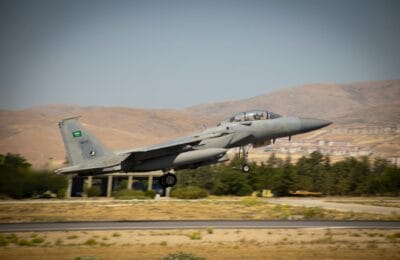
Air Power: Obtaining F-35 jets would be a quantum leap for the Royal Saudi Air Force. The F-35 is not merely a fighter aircraft but a flying intelligence, surveillance, and reconnaissance platform. Its stealth capabilities and network connectivity with coalition forces would give Saudi Arabia clear air superiority in any future confrontation. However, Saudi acquisition of the F-35 still faces Congressional hurdles and will require years of negotiations and training before becoming an operational reality. The estimated timeline from agreement to combat readiness is 5-7 years.
Naval Capabilities: Given the importance of maritime security, especially after the Hormuz closure experience, the deal includes strengthening the Royal Saudi Naval Forces with advanced warships and maritime surveillance systems enabling better protection of coastlines and sea lanes. This also includes cooperation in undersea warfare, an area where the Kingdom has historically been weak. The Red Sea, the Persian Gulf, and the vital shipping lanes connecting them represent Saudi Arabia maritime frontier.
Cybersecurity and Electronic Warfare: Perhaps the least visible but most important long-term dimension. Iran has demonstrated advanced cyber capabilities in targeting critical infrastructure, including previous attacks on Aramco. US-Saudi cybersecurity cooperation will strengthen protection of oil facilities, critical infrastructure, and financial systems from Iranian cyber attacks. In modern warfare, a successful cyber attack on oil infrastructure could be as devastating as a physical missile strike.
The Deal in the Context of Vision 2030
The trillion-dollar deal cannot be separated from the larger Vision 2030 project led by Mohammed bin Salman to transform the Saudi economy from oil dependence to a diversified economy based on knowledge, technology, tourism, and entertainment.
The war with Iran proved that oil alone, despite its strategic importance, is insufficient for building a resilient and sustainable economy. When the Strait of Hormuz closes and oil exports are disrupted, the fragility of depending on a single income source becomes starkly apparent. This reinforces Vision 2030 central argument: diversification is an existential necessity, not an optional luxury.
Technical cooperation with America in AI, data centers, and civilian nuclear energy can provide the technological foundation for this transformation. But the challenge lies in execution. The gap between grand announcements and actual implementation has always been a weakness in major Saudi projects. NEOM, for example, was announced with great fanfare in 2017 but remains years behind its original targets. The question is whether the trillion-dollar deal will be different.
Optimists point out that wartime pressure creates a stronger implementation incentive since existential threats leave no room for procrastination and bureaucracy. Pessimists argue that history repeats itself and announced figures will shrink dramatically during actual implementation. The truth will likely fall somewhere in between: partial implementation with genuine impact on Saudi military and economic capabilities, but well short of the headline trillion-dollar figure.
Implications for the Regional Balance of Power
The trillion-dollar deal does not merely affect the bilateral US-Saudi relationship. It redraws the balance of power across the entire Middle East. Here is how key regional dynamics will be affected:
The Resistance Axis: Iran and its allies in Lebanon, Iraq, and Yemen will view the deal as confirmation of their theory that the region is divided between a resistance axis and an axis of normalization and American dependency. This may increase the axis cohesion in the short term and provide Iran with additional justification for its aggressive regional policies. But in the long run, the military superiority the deal grants Saudi Arabia may alter Iran strategic calculations and push it toward greater caution. A Saudi Arabia armed with F-35s and advanced missile defense changes the deterrence equation fundamentally.
Turkey: Ankara will watch the strengthening of the Saudi-American axis with caution. Turkey itself is a NATO member but its relationship with Washington has been strained in recent years. Saudi military strengthening may be viewed in Ankara as a challenge to Turkish ambitions for regional hegemony. However, Turkey may also benefit from economic opportunities linked to supply chain restructuring in the region due to the Hormuz closure, positioning itself as an alternative logistics hub.
Iraq: Baghdad, caught between Iranian and American influence, will find itself under increasing pressure to choose a side. Strengthening the Saudi-American axis means more pressure on Iraq to distance itself from Iran, which is resisted by Iranian-backed militias that still wield significant influence in Baghdad. Iraq may be the biggest loser from this increasing polarization, torn between two powerful forces with little room for the neutrality it has tried to maintain.
Other Gulf States: Kuwait, Bahrain, Oman, and Qatar will recalculate in light of the deal. Kuwait and Bahrain, traditional Saudi allies, will seek to shelter under the new security umbrella. Qatar will continue its relatively independent policy but will be careful not to clash with Riyadh. Oman, which built its policy on neutrality between Iran and Saudi Arabia, will find that neutrality increasingly difficult as regional polarization deepens. The days of hedging between all parties may be ending for smaller Gulf states.
Possible Scenarios: Where Does the Relationship Go?
Looking ahead, three main scenarios can be drawn for the trajectory of the US-Saudi relationship after the trillion-dollar deal:
Scenario One, Deep Strategic Partnership: The deal is successfully implemented, the war with Iran ends in coalition victory, and the US-Saudi relationship transforms into a strategic partnership similar to the US-Israel or US-Japan relationship. In this scenario, Saudi Arabia becomes America security and economic anchor in the Gulf, and the Kingdom benefits from near-absolute American protection and advanced technologies that dramatically accelerate Vision 2030. This is the best-case outcome for Riyadh.
Scenario Two, Partial Implementation and Tensions: The deal is partially implemented, perhaps 40-50% of the announced amount, with some sensitive elements like nuclear cooperation stalled by Congressional opposition. The relationship remains strong but experiences periodic tensions over oil prices, human rights, and the position on Israel. This is the most likely scenario based on the historical track record of major Saudi-American deals. Grand announcements followed by pragmatic downsizing is the pattern.
Scenario Three, Retreat and Return to Balance: The American administration changes or regional circumstances shift in ways that make the deal less relevant. The relationship cools and Saudi Arabia gradually returns to its balancing policy between America and China. This scenario is possible but less likely in the near term due to the continuing Iranian threat and the Kingdom dependence on American protection. The war has created facts on the ground that make a return to ambiguity very difficult.
Whichever scenario materializes, the trillion-dollar deal represents a historic turning point in the US-Saudi relationship and in the structure of regional alliances. The Arab world is changing rapidly, and the war with Iran is accelerating that change. What was impossible yesterday is reality today, and tomorrow holds surprises no one has imagined. The only certainty is that the Middle East of 2030 will look nothing like the Middle East of 2020.
For more analysis on the future of the region, follow us at The Middle East Insider, your premier source for Middle East political and economic news.