Gold at $150.66 Per Gram — A Price That Rewrites the Playbook
On April 5, 2026, gold reached a new all-time high of $150.66 per gram ($4,686 per ounce). Twelve months ago, the metal traded near $3,046 per ounce. That means gold has surged $1,640 per ounce in a single year — a move that has stunned even the most bullish analysts.
But the global price is only half the story for Egyptian investors. The Egyptian pound has lost 8.29% of its value in just the past month, falling to 54.35 EGP per dollar. For Egyptians sitting on cash, waiting for gold to “come back down” is not a strategy — it is a guaranteed way to lose purchasing power every single day.
This article provides a comprehensive breakdown: current prices across all karats, the forces driving this historic rally, three scenarios for what happens next, a practical buying guide for Egyptian investors, and an honest comparison of gold versus every other investment option available in Egypt today.

Gold Prices in Detail — April 5, 2026
Before any analysis, the numbers. Here is a complete price table for all gold karats in both USD and Egyptian pounds:
| Karat | Price (USD/gram) | Price (EGP/gram) | Monthly Change |
|---|---|---|---|
| 24K | $150.66 | ~5,023 EGP | +12.4% |
| 21K | $131.83 | ~4,395 EGP | +11.8% |
| 18K | $113.00 | ~3,767 EGP | +11.2% |
| 14K | $87.89 | ~2,930 EGP | +10.6% |
Spot price per ounce: $4,686 (1 troy ounce = 31.1035 grams)
USD/EGP exchange rate: 54.35
Note: These are raw gold prices. Retail prices for jewelry and bars in Egypt include a fabrication fee (known locally as “masna’iya”) ranging from 30 to 150 EGP per gram depending on the piece and the dealer.
How Each Karat Price Is Calculated
Understanding the formula helps you verify any price a dealer quotes you:
24K: Spot price per ounce ÷ 31.1035 = price per gram in USD
21K: 24K price × 0.875 (21/24 = 87.5% purity)
18K: 24K price × 0.75 (18/24 = 75% purity)
EGP conversion: USD price × 54.35
If a dealer’s price deviates significantly from this calculation, the excess is fabrication cost — or a red flag.
Why Gold Is Breaking Records Every Week
This rally is not random. Multiple forces are converging simultaneously, and every single one points in the same direction.
1. The Iran War and the Hormuz Closure
Since March 27, 2026, the Strait of Hormuz — through which 20% of the world’s oil supply transits — has been closed. This is not merely an oil crisis. It is a crisis of confidence in the global financial system. When the world’s most critical maritime chokepoint shuts down, investors flee to the oldest safe-haven asset in human history: gold.
The war with Iran is now in its fifth week with no signs of de-escalation. Every day the conflict continues, gold rises. This relationship is direct and historically proven — in every major geopolitical crisis, gold is the first refuge.
Read our full analysis: Iran War Timeline — Everything You Need to Know
2. Central Banks Are Buying at Unprecedented Rates
It is not just individual investors driving demand. Central banks around the world are accumulating gold at historic rates. China, India, Turkey, and Poland have all significantly increased their reserves through 2025 and into 2026.
The significance here is informational. Central banks have access to intelligence and analysis that no individual investor possesses. When a central bank buys gold aggressively, it signals a belief that the global financial system is unstable and that the US dollar’s role as the world’s reserve currency is no longer guaranteed.
The notable exception: Gulf states recently sold approximately 47 tonnes of gold. This is not a bearish signal on gold itself — it reflects a liquidity need. With Hormuz closed, Gulf oil exports are severely constrained, and these nations need cash to fund mega-projects (NEOM, Vision 2030, Expo) and offset revenue losses. This is tactical selling, not strategic repositioning.
3. Global Inflation and Recession Fears
Oil above $111 per barrel means inflation will remain elevated in every energy-importing economy. When inflation runs hot, the purchasing power of fiat currencies erodes, and gold — as a finite, physical asset — becomes the natural alternative.
The US Federal Reserve faces an impossible dilemma: raise rates further to fight inflation and risk choking the economy, or hold and watch the dollar’s purchasing power deteriorate. In either scenario, gold benefits.
4. Growing Industrial Demand
Gold is not just a store of value. It is a critical industrial material used in electronics, advanced technology, and medicine. With the AI revolution driving demand for advanced semiconductors and chips, industrial gold consumption has risen measurably. This adds a structural demand floor beneath gold prices independent of investment flows.
The Egyptian Story — Why It’s Different Here
Everything above applies globally. But the Egyptian investor faces an additional, compounding challenge: the pound is losing value at an alarming rate.
The Devaluation Math Nobody Talks About
The Egyptian pound has weakened 8.29% in just one month. Let us put that in practical terms. If you held 100,000 EGP in cash at the start of March and did nothing, you lost purchasing power equivalent to approximately 8,290 EGP — not because anyone took your money, but because the currency itself became worth less.
Now consider: gold in EGP terms has risen roughly 57% year-over-year. An Egyptian who bought gold one year ago gained twice — once from the global rise in gold’s dollar price, and again from the pound’s decline against the dollar. This is what analysts call a “double hedge.”
Historical Comparison — Gold in EGP Terms
| Period | 21K Price (EGP/gram) | Change |
|---|---|---|
| April 2021 | ~770 EGP | — |
| April 2022 | ~1,050 EGP | +36% |
| April 2023 | ~1,900 EGP | +81% |
| April 2024 | ~2,300 EGP | +21% |
| April 2025 | ~2,800 EGP | +22% |
| April 2026 | ~4,395 EGP | +57% |
In five years, 21K gold went from 770 EGP to 4,395 EGP per gram. An investor who bought gold in April 2021 has seen their money multiply 5.7 times. Name another asset class in Egypt that delivered that return.
“Gold Is Too Expensive” — The Argument That’s Costing People Money
Every day, the same refrain: “Gold is too expensive,” “It can’t keep going up,” “It has to come down.” People saying this are looking at the absolute number — 4,395 EGP per gram — and experiencing sticker shock.
But the right question is not “Is gold expensive or cheap?” The right question is: “Expensive relative to what?”
Measured in Egyptian pounds, the number looks large. But the pound itself is shrinking. Gold is not getting more expensive — the pound is getting cheaper.
Think of it this way: if your measuring stick (the pound) changes size every day, how can you use it to declare something “expensive”? It is like measuring your height with a rubber ruler that shrinks a little each day — you feel taller, but really the ruler is just shorter.
The mathematical reality: If the pound loses 8% in a month and you’re waiting for gold to drop 5%, you are still net-down 3% even if gold does fall. Waiting is expensive.
21K Gold — Egypt’s Preferred Karat
In Egypt, 21-karat gold dominates the market. Most Egyptian jewelry is crafted in 21K, making the local market fundamentally different from global markets that focus on 24K bars and coins.
Why 21K Is Optimal for Egyptian Investors
1. Balance of purity and durability: At 87.5% pure gold and 12.5% alloy metals, 21K is strong enough for everyday wear while maintaining high gold content.
2. Liquidity: You can sell 21K gold at any jewelry shop in Egypt within minutes. No other karat has comparable liquidity in the Egyptian market.
3. Lower relative fabrication costs: Fabrication fees on 21K tend to be lower than on 18K (which requires more precise crafting) and lower than bars (which carry additional taxes).
21K Price Trajectory in 2026
| Date | Price (EGP/gram) | Change |
|---|---|---|
| January 1, 2026 | ~3,450 | — |
| February 1, 2026 | ~3,650 | +5.8% |
| March 1, 2026 | ~3,900 | +6.8% |
| March 27 (Iran war begins) | ~4,050 | +3.8% |
| April 5, 2026 | ~4,395 | +8.5% |
Since January 1, 21K gold has risen 27.4%. An investor who bought 10 grams in January at 34,500 EGP now holds 43,950 EGP in value — a gain of 9,450 EGP in three months.
Central Bank Behavior — Who’s Buying, Who’s Selling
Central bank activity is the single most important indicator for gold’s long-term direction. Individual investors buy and sell on emotion; central banks act on deep strategic analysis.
The Buyers
China: The People’s Bank of China added approximately 316 tonnes of gold to its reserves during 2024-2025 and continues buying in 2026. The objective is clear: reduce dependence on the US dollar as a reserve asset.
India: The Reserve Bank of India increased reserves by roughly 77 tonnes over the same period, driven by both cultural affinity for gold and a desire to hedge against rupee volatility.
Turkey: The Central Bank of Turkey has been one of the most aggressive buyers in recent years, attempting to offset years of lira erosion and rebuild confidence in the country’s monetary position.
Poland and Eastern Europe: Post-Ukraine war, multiple Eastern European nations have increased gold reserves as a precautionary measure against regional instability.
The Sellers
Gulf states (47 tonnes sold): Saudi Arabia, the UAE, and other Gulf nations have sold approximately 47 tonnes of gold reserves recently. This might seem counterintuitive — why sell gold in a bull market?
Context provides the answer. The Hormuz closure has directly impacted Gulf oil exports, the primary revenue source for these nations. They need liquidity to fund mega-projects and compensate for declining oil revenue. This is tactical selling driven by circumstance, not a strategic bet against gold.
Related reading: Strait of Hormuz Closure — Full Impact Assessment
Three Scenarios for April 2026
On April 6, 2026 — tomorrow — a critical deadline arrives related to negotiations over the Iran crisis. These three scenarios will determine gold’s direction in the weeks ahead:
Scenario 1: Agreement or Ceasefire (15% probability)
| Indicator | Expected Impact |
|---|---|
| Global gold price | Decline 5-10% ($140-143/gram) |
| 21K in EGP | Retreat to 3,900-4,100 EGP |
| USD/EGP | Modest improvement (53-54 EGP) |
| Duration of impact | 2-4 weeks |
Even in this scenario, any decline would be temporary. The structural forces supporting gold — inflation, central bank buying, global instability — do not disappear overnight.
Scenario 2: Military Escalation (45% probability)
| Indicator | Expected Impact |
|---|---|
| Global gold price | Surge 10-20% ($165-180/gram) |
| 21K in EGP | 4,800-5,500 EGP |
| USD/EGP | Upward pressure (56-60 EGP) |
| Duration of impact | Weeks to months |
If the war escalates — for example, if the Bab el-Mandeb strait also closes or if Saudi oil facilities are struck — gold could reach extraordinary levels. In this scenario, $180/gram ($5,600/ounce) is not out of the question.
Scenario 3: Deadline Extension (40% probability)
| Indicator | Expected Impact |
|---|---|
| Global gold price | Stable at $148-153/gram |
| 21K in EGP | 4,300-4,500 EGP |
| USD/EGP | Relative stability (54-55 EGP) |
| Duration of impact | 1-2 weeks until next development |
An extension means the status quo continues — and the status quo is inherently bullish for gold because uncertainty itself is gold’s greatest ally.
Practical Buying Guide for Egyptian Investors
If you have decided to buy gold, here is what you need to know about execution.
Where to Buy
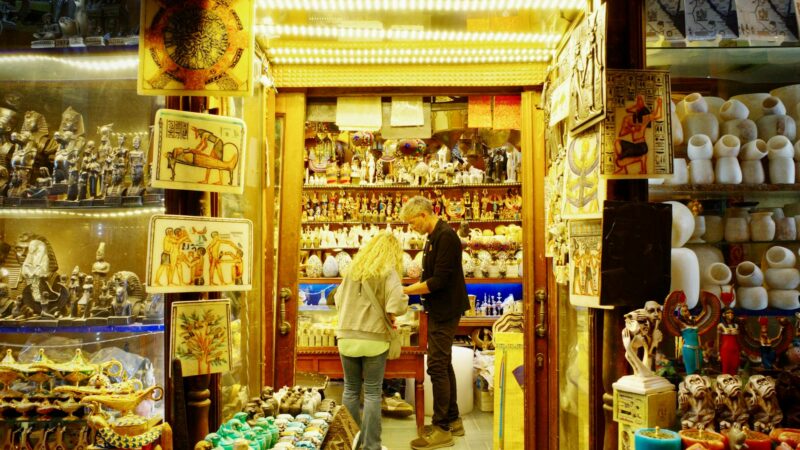
1. Licensed jewelers in the Sagha (gold souk): Hussein’s Sagha in Cairo is Egypt’s largest gold market. Prices tend to be close to the official rate and fabrication fees are reasonable. Ensure the shop is licensed and certified.
2. Bank bullion: Egyptian banks sell gold bars in various sizes (1 gram to 100 grams). The advantage is guaranteed 99.99% purity. The drawback is higher premiums and occasional supply shortages.
3. Certified gold companies: Companies like Egypt Gold sell certified bars and coins with purity certificates. A good option for larger purchases.
4. Gold pounds: The Egyptian gold pound (8 grams of 21K gold) is one of the best investment vehicles in the Egyptian gold market — easy to sell, minimal fabrication premium, and directly tied to global gold prices.
Karat Comparison Guide
| Karat | Gold Content | Primary Use | Best For |
|---|---|---|---|
| 24K | 99.9% | Bars and coins | Long-term investment |
| 21K | 87.5% | Jewelry and ornaments | Investment + wearability |
| 18K | 75% | Fine jewelry | Daily wear |
| 14K | 58.3% | Accessories | Decorative only |
How to Verify Purity
1. The hallmark (damgha): Every piece of gold sold in Egypt must carry the hallmark of the Egyptian Assay and Weights Authority. The stamp includes the karat designation (21, 18, or 24) and the dealer’s mark.
2. Purchase receipt: Always obtain a detailed receipt showing weight, karat, fabrication fee, and total price. This receipt is essential for resale.
3. Acid test: If you doubt purity, any licensed gold shop can perform an acid test in front of you for a small fee. This provides near-certain verification.
4. Electronic scale: Ensure the dealer weighs your purchase on a certified electronic scale in your presence — not a manual balance.
Gold vs. Every Other Investment in Egypt
Sound investment decisions require comparison. Here is how gold stacks up against every major alternative available to Egyptian investors today.
Gold vs. Real Estate
| Criteria | Gold | Real Estate |
|---|---|---|
| Annual return (2025-2026) | +57% | +15-25% |
| Liquidity | Immediate | Months to years |
| Minimum investment | 1 gram (~4,400 EGP) | Hundreds of thousands |
| Holding costs | Near zero | Maintenance + taxes |
| Risks | Price volatility | Illiquidity + legal disputes |
Real estate remains a solid long-term investment in Egypt, but during the current crisis, gold dominates in both returns and liquidity.
Gold vs. The Egyptian Stock Exchange (EGX)
The EGX has risen 46% year-over-year — an impressive figure. However, several important distinctions apply:
1. Volatility: The stock market can lose 10% in a week. Gold moves more slowly and less violently.
2. Knowledge requirement: Stock investing requires understanding of companies, sectors, and financial statements. Gold requires none — buy and hold.
3. Time commitment: Stocks demand daily monitoring. Gold can be purchased and forgotten for years.
For investors with the expertise and time, a combination of stocks and gold is optimal. For those without, gold is the simpler and safer choice.
Read our guide: EGX Beginner’s Guide 2026
Gold vs. The US Dollar
Many Egyptians buy dollars as a hedge. But in 2025-2026, gold has vastly outperformed:
| Investment | Return (April 2025 – April 2026) |
|---|---|
| Gold (21K in EGP) | +57% |
| US Dollar (in EGP) | +12-15% |
| Bank certificates (27%) | +27% (fixed) |
| Egyptian Stock Exchange | +46% |
The dollar itself is losing purchasing power globally due to inflation. Buying dollars protects against pound weakness but not against global inflation. Gold protects against both.
Gold vs. Bank Certificates
Bank certificates offering 27% annual returns appear attractive. Let us do the math:
100,000 EGP in a 27% certificate yields 127,000 EGP after one year.
100,000 EGP in 21K gold in April 2025 (approximately 35.7 grams at 2,800 EGP/gram) is now worth 156,915 EGP — a gain of 56,915 EGP versus 27,000 EGP from the certificate.
The difference: +29,915 EGP in gold’s favor.
Certificates offer guaranteed, fixed returns with zero risk. Gold does not guarantee future performance. But the numbers are clear: in periods of crisis and currency weakness, gold dominates.
Buying Strategies — Don’t Go All-In at Once
The biggest mistake new investors make is deploying all their capital at a single price point. This is risky regardless of the asset.
Dollar Cost Averaging
Instead of buying 100 grams at once, buy 10 grams per month for 10 months. This approach:
1. If gold dips, you buy at a lower price, improving your average cost basis.
2. If gold rises, you already own a portion purchased at a lower price.
3. Reduces psychological stress — no anxiety about having “bought at the top” because your capital is spread across multiple price points.
Buy-the-Dip Strategy
For more experienced investors, set specific price levels and buy when gold retreats to them:
– Buy 30% at the current price (4,395 EGP/gram for 21K)
– Buy 30% if it falls to 4,100 EGP
– Buy 40% if it falls to 3,800 EGP
The risk: gold may never fall to your target levels, and you miss the rally entirely.
Allocation Rule — How Much Gold Should You Own?
General guidance: 10-20% of total investments in gold. During crisis periods like the current one, this can increase to 25-30%.
But never put all your money in gold. Diversification remains the foundation of any successful investment portfolio.
Honest Risk Assessment — Gold Is Not Without Dangers
In the interest of balanced analysis, here are the genuine risks:
1. Sudden Correction Risk
If the Iran crisis resolves unexpectedly (possible though unlikely), gold could drop 10-15% in days. This would be painful for anyone who bought at the peak.
2. Opportunity Cost
Money in gold generates no periodic income. No dividends, no coupons, no interest. If stocks rise 50% while gold rises 20%, you have paid an opportunity cost.
3. Theft and Storage Risk
Physical gold must be stored securely — a home safe or bank safety deposit box. This adds cost and ongoing concern.
4. Counterfeiting Risk
The market includes counterfeit gold. Buying from licensed, certified dealers and verifying hallmarks and receipts is essential.
5. Liquidity Risk During Acute Crises
During severe market dislocations, gold shops may close or refuse to buy and sell. This happened in Egypt in 2023 when prices spiked sharply.
Technical Analysis — Key Levels
For traders who follow technical analysis, here are the critical levels to watch:
Support Levels
$4,500/oz ($144.7/gram): First support level. A break below could extend to $4,200.
$4,200/oz ($135/gram): Strong support. This was February’s resistance level, now converted to support.
$4,000/oz ($128.6/gram): Major psychological level. A break below would be a strong bearish signal.
Resistance Levels
$4,700/oz ($151.1/gram): Near the current price. A clean break above opens the door to new highs.
$5,000/oz ($160.8/gram): The next major psychological milestone. Many analysts project gold reaches this level before year-end 2026.
$5,600/oz ($180/gram): Full escalation scenario. If Bab el-Mandeb closes alongside Hormuz.
Gold Price Forecasts — Multiple Perspectives
Here is what major institutions and analysts are projecting:
Goldman Sachs
Raised their year-end 2026 target to $5,200/oz ($167/gram) under continued geopolitical tensions. In a global recession scenario, they project $5,800/oz.
JP Morgan
More conservative — projecting $4,800-5,000/oz ($154-161/gram) by year-end 2026. They argue a portion of the current rally is a “war premium” that would evaporate if tensions ease.
World Gold Council
Points to sustained institutional buying as the key structural support. Their view: even in a peace scenario, gold is unlikely to fall below $4,000/oz because structural drivers (inflation, central bank purchases, global debt levels) remain firmly in place.
Egyptian Analysts
For the Egyptian market specifically, analysts project 21K gold could reach 5,000-5,500 EGP by year-end 2026 in the base case, and could exceed 6,000 EGP if conditions escalate and the pound weakens further.
The Gold-Oil Connection
Oil is currently above $111/barrel. The relationship between gold and oil matters:
Higher oil = Higher inflation = Higher gold
This is because oil is an input cost for virtually everything — food, transportation, manufacturing. When oil rises, inflation accelerates, fiat currencies lose purchasing power, and capital flows into gold.
Read our analysis: Oil at $111 — OPEC Meets Today to Decide Your Fuel Bill
For Egypt specifically, higher oil means a larger import bill, more pressure on the pound, and consequently higher gold prices in EGP terms. This is a self-reinforcing cycle.
Practical Advice — The Bottom Line
After all this analysis, here is actionable guidance:
1. If you have surplus cash you won’t need for six months: Buy gold — but gradually, not all at once.
2. If you want to protect savings from pound depreciation: Gold is the best hedging tool available to ordinary Egyptians.
3. If you need this money within three months: Do not buy gold. Short-term volatility could mean losses.
4. If you need regular, fixed income: Bank certificates are better. Gold pays no interest.
5. If you’re a first-time investor: Start with gold pounds (8 grams of 21K) — simplest to buy and sell.
6. Document every purchase: Receipt, hallmark photo, price record, date. Essential for resale and dispute resolution.
7. Ignore anyone claiming to know gold’s direction tomorrow: Nobody does — not me, not you, not the best analyst in the world. Work with strategy, not predictions.
Conclusion — The Numbers Speak
Gold at $150.66/gram ($4,686/ounce) in April 2026 is not an anomaly. It is the natural consequence of war with Iran, the Hormuz closure, record central bank buying, elevated global inflation, and currencies losing their purchasing power.
For the Egyptian investor specifically, the case is even clearer: the pound has lost 8.29% in a single month, while 21K gold has risen 57% year-over-year. Those who bought gold a year ago preserved and grew their wealth. Those who waited lost purchasing power with each passing day.
Can gold decline? Yes. Could waiting pay off? Possibly. But the mathematics are unambiguous: in an environment where your currency is weakening and the world is at war, gold is the rational choice, not the irrational one.
Egyptians buying gold right now are not “panic buying” — they are making a calculated, mathematically sound decision.
Related reading: How to Invest $10,000 in the Middle East in 2026
Gold in Ramadan and Seasonal Patterns — When Is the Best Time to Buy?
Many Egyptian investors ask whether there is an optimal time of year to buy gold. The short answer: seasonal patterns have become far less significant during the current geopolitical crisis. However, historically:
Post-Ramadan and holidays: Demand for jewelry peaks before Eid and festive seasons (engagement gifts, wedding gold). It dips afterward. This can create a small buying window — but the difference tends to be in fabrication fees rather than the gold price itself.
Summer months: Historically, gold tends to be quieter globally during summer. In 2026, however, the war environment has completely overridden seasonal patterns.
Year-end: Investment funds rebalance portfolios in December, which can cause temporary volatility and occasional dips.
The bottom line: In current conditions, the best time to buy is “whenever you have surplus funds you do not need” — not a specific calendar date.
Digital Gold vs. Physical Gold — What’s Best for Egyptian Investors?
Recent years have introduced new options for buying gold without physically holding it:
Gold ETFs (Exchange-Traded Funds)
Funds like SPDR Gold Trust (GLD) allow you to buy a “share” of physical gold stored in vaults. The advantage is zero storage or theft risk. The disadvantage is accessibility — most Egyptian investors would need an international brokerage account, which adds complexity and cost.
Digital Gold Platforms in Egypt
Several Egyptian banks and fintech companies now offer digital gold purchasing through mobile apps. The concept is straightforward: you buy a specific amount of gold (even less than one gram) and the bank holds it in their vaults on your behalf. This is a good option for people who want to invest small amounts regularly.
Advantages:
– You can invest very small amounts (from 100 EGP)
– No storage risk
– Easy buying and selling through the app
Disadvantages:
– Not all platforms are trustworthy — verify they are licensed by the Central Bank of Egypt
– You never physically hold gold
– If the company fails or the bank encounters problems, your legal position is more complex than if you held physical gold
Recommendation
For serious, long-term investment: physical gold (bars or gold pounds) is superior. For regular saving in small amounts: digital gold from a reputable, licensed bank is a reasonable option. The key principle is not to put all your investment in one format.
Common Mistakes Gold Investors Make in Egypt
Based on Egyptian market experience, here are the most costly mistakes investors make:
1. Buying jewelry for investment: Jewelry carries high fabrication fees (50-150 EGP/gram). When you resell, the shop will not pay you for the fabrication cost. This means you are underwater from the moment of purchase. For investment, bars and gold pounds are far superior.
2. Buying from unlicensed dealers: The Egyptian market includes shops selling counterfeit gold or gold at lower purity than advertised. Always buy from certified, hallmarked dealers and demand a receipt.
3. Panic selling on every dip: Gold fluctuates — this is normal. If you sell every time gold drops 5%, you will lose money over the long term. Gold investment requires patience and a long time horizon.
4. Not diversifying across karats: Allocate a portion to 24K bars for pure investment, and a portion to 21K gold pounds for easier resale in smaller denominations.
5. Ignoring opportunity cost: Even if gold will rise, if stocks rise more, you are losing out. This is why diversification matters — never put everything in one basket.
6. Following social media advice: Many self-proclaimed “experts” on social media lack genuine expertise and advise based on emotion rather than analysis. Rely on trusted sources and real data.
Frequently Asked Questions
Is it still a good time to buy gold in April 2026?
Yes, with conditions. First, buy gradually rather than all at once. Second, only use money you will not need in the short term. Third, the structural forces supporting gold — war, inflation, currency weakness — remain firmly in place and are unlikely to reverse overnight. Even if gold corrects 5-10% on a peace deal, the long-term trajectory remains upward as long as central banks keep buying and global debt levels continue rising.
What is the best gold karat for investment in Egypt?
21K is optimal for most Egyptian investors. It offers the highest liquidity in the Egyptian market — you can sell it at any jewelry shop at any time. For larger amounts (over 100 grams), 24K bars may be preferable because fabrication fees are proportionally lower. The Egyptian gold pound (8 grams of 21K) is an excellent entry point for beginners.
How much did gold reach per ounce in April 2026?
Gold reached $4,686 per ounce ($150.66 per gram) on April 5, 2026. This represents an increase of $1,640 per ounce compared to the same period last year. The primary drivers are the Iran war, the Strait of Hormuz closure, and record central bank purchasing.
Could gold prices fall in the coming period?
Yes. If a peace agreement or ceasefire with Iran materializes, gold could retreat 5-15%. However, even in that scenario, the decline would likely be temporary because structural supports — inflation, global debt, central bank buying — remain unchanged. Analysts suggest $4,000 per ounce ($128.6/gram) has become a new floor that would be difficult to breach.
What is the difference between international and Egyptian gold prices?
The international price is the raw gold price in USD. The Egyptian price equals the international price multiplied by the USD/EGP exchange rate, plus fabrication fees. The fabrication premium ranges from 30 to 150 EGP per gram depending on the type of jewelry. Bars carry lower premiums than jewelry. Additionally, the Egyptian market sometimes commands an extra premium due to supply shortages.
Is gold or the US dollar a better investment for Egyptians?
Over the past 12 months, gold has significantly outperformed the dollar. Gold in EGP terms rose 57% versus 12-15% for the dollar. Gold also protects against global inflation, while the dollar only protects against pound weakness. However, there is no single correct answer — the optimal approach is to diversify across both assets.
How many grams of gold can I buy with 10,000 EGP?
At today’s price (April 5, 2026), 21K gold is approximately 4,395 EGP per gram. With 10,000 EGP, you can purchase roughly 2.27 grams before fabrication fees. After fees, the actual weight will be slightly less. For a zero-fabrication option, consider a 1-gram 24K bar (approximately 5,023 EGP plus a small premium).
How does today’s OPEC meeting affect gold prices?
The OPEC meeting on April 5, 2026 affects gold indirectly through the oil-inflation channel. If OPEC significantly increases production, oil falls, inflation eases, and gold may soften. If OPEC maintains or cuts production, oil rises further, inflation accelerates, and gold continues climbing. The relationship is indirect but meaningful — higher oil prices have historically correlated with higher gold prices during inflationary periods.