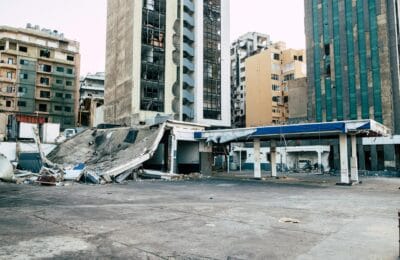
At 3:47 a.m. local time on March 30, 2026, an Iranian ballistic missile struck the Doha Power and Desalination Complex on the northern edge of Kuwait City — killing one Bangladeshi maintenance worker, wounding four others, and knocking an estimated 340 megawatts of power generation offline. Emergency crews contained the fire within six hours. But the damage to something far more important than infrastructure had already been done: the strategic calculus of Gulf water security has fundamentally shifted.
Kuwait derives approximately 90% of its fresh water from desalination. The country has no rivers, negligible groundwater, and receives less than 120 millimeters of rainfall per year. It is, in the bluntest possible terms, a nation that cannot survive without the energy infrastructure that turns seawater into drinking water — and that infrastructure is now demonstrably within Iran’s targeting envelope.

- March 30: Iranian missile hits Kuwait’s Doha Power and Desalination Complex, killing 1 worker
- Kuwait’s water dependency: ~90% from desalination
- UAE desalination dependency: 42% | Saudi Arabia: 50% | Qatar: 99%
- Kuwait’s airport was also targeted in an earlier attack (March 22)
- Kuwait’s Shuaiba oil refineries: targeted twice, partially offline
- A sustained desalination outage of 72+ hours in Kuwait would trigger a humanitarian emergency
- No GCC state has meaningful strategic water reserves beyond 48–72 hours of consumption
The March 30 Attack: What Happened
The Doha complex — Kuwait’s second-largest power and water production facility — was struck by what Kuwaiti authorities confirmed as a medium-range ballistic missile, assessed by US CENTCOM as an Iranian Fateh-110 derivative with a circular error probability (CEP) of approximately 10 meters. The targeting precision was not random: the Doha facility sits adjacent to Kuwait’s main seawater intake infrastructure and supplies approximately 18% of the country’s desalinated water.
Kuwait activated emergency water rationing protocols within two hours of the strike — reducing pressure to residential areas by 30% and halting non-essential commercial water supply. Tanker trucks from the Ministry of Electricity and Water began distribution to hospitals, the airport, and priority residential zones.
This attack follows a pattern of Iranian and Iranian-proxy strikes on Kuwaiti infrastructure that have escalated through March 2026. Kuwait’s Ali Al Salem Air Base — a facility hosting US and allied aircraft — was targeted on March 8. Kuwait International Airport’s runway infrastructure was struck on March 22, causing 43 hours of closures. And the Shuaiba industrial complex — home to three oil refineries — has been hit twice, reducing Kuwait’s refining capacity by approximately 35%.
Why Water Infrastructure Is the Gulf’s Most Critical Vulnerability
The strategic logic of targeting desalination plants is unambiguous. Unlike oil wells, which can be capped and restarted, desalination infrastructure has a critical fragility: you cannot stockpile water the way you stockpile oil. Gulf states maintain strategic petroleum reserves measured in months. Strategic water reserves, across all GCC nations, average 48–72 hours of consumption.
The regional dependency map is stark:
Qatar is the most exposed: 99% desalination-dependent, with the Ras Laffan Industrial City — which produces most of Qatar’s water alongside its LNG — a single-point-of-failure of extraordinary strategic consequence. A sustained strike on Ras Laffan would simultaneously threaten Qatar’s water supply, its LNG exports (which supply 20% of global LNG), and the US Air Force’s Al Udeid base which hosts approximately 10,000 US personnel.
Saudi Arabia sources roughly 50% of its water from desalination, with the Saline Water Conversion Corporation (SWCC) operating 30 plants along the Red Sea and Gulf coasts. The Eastern Province plants — closest to Iran — supply water to Aramco’s Dhahran headquarters, Dammam, and Al Khobar. A successful strike sequence on Eastern Province desalination would simultaneously threaten civilian water supply and Aramco’s operational capacity.
UAE derives approximately 42% of its water from desalination, with Abu Dhabi’s Taweelah plant alone producing 200 million imperial gallons per day. The UAE has invested more aggressively than any regional peer in desalination redundancy and protected infrastructure, but the concentration of capacity in coastal plants remains a strategic liability.
Kuwait’s Broader Infrastructure Assault: A Campaign, Not Incidents
What is happening to Kuwait is not a series of isolated incidents — it is a systematic campaign against a state that Iran views as a logistical and political supporter of the coalition opposing it. Kuwait hosts US forces. It has provided overflight rights for coalition strikes. Its oil infrastructure feeds global markets that fund the economic pressure on Iran.
Iran’s targeting of Kuwait’s airport — the aviation hub for a country of 4.9 million people and a critical regional transit point — represents a direct economic attack. The 43-hour runway closure in March alone cost an estimated $120–180 million in diverted flights, cargo delays, and tourism losses. Kuwaiti authorities have since erected additional missile defense batteries sourced from the US Patriot system around the airport perimeter.
The Shuaiba refinery strikes have more direct commodity market implications. Kuwait produces approximately 2.7 million barrels per day of crude, but its refinery damage means it is exporting more crude and less refined product — a shift that affects regional refined product markets and is contributing to the diesel and jet fuel premiums currently visible in Mediterranean and South Asian markets.
The Escalation Logic: Why Iran Is Hitting Kuwait
From Tehran’s strategic perspective, attacking Kuwait serves multiple purposes simultaneously. It signals that no Gulf state — including those not directly involved in combat operations — is immune. It strains the GCC coalition’s political cohesion by making smaller states question the cost of proximity to US bases. And it tests the Patriot defense systems that the US has deployed across the region, generating intelligence on response times and intercept rates.
Iran has a documented historical preference for infrastructure targeting over civilian casualties — a posture designed to maximize economic and psychological impact while minimizing the political blowback that comes with mass civilian deaths. The Doha plant attack fits this template precisely: a facility hit, a worker killed, but no mass casualty event that would force a categorical US military escalation.
The regional economic implications of this escalation intersect directly with the broader Gulf economic impact analysis and the Hormuz shipping disruption that has already raised marine insurance rates by 340%.
The Humanitarian Calculus: What a Sustained Desalination Outage Means
A sustained desalination outage lasting more than 72 hours in Kuwait — or any comparable Gulf state — would trigger a cascading humanitarian emergency. The mathematics are unforgiving. Kuwait City’s population of approximately 2.4 million consumes roughly 500 liters per person per day (among the highest per-capita water consumption globally, driven by low water prices and cultural norms). At that rate, the 48-hour strategic reserve runs dry in two days.
Emergency response would require the immediate activation of regional water tanker networks, emergency imports from Turkey (which has been supplying bottled water to Kuwait under a contingency agreement since February), and potentially the activation of US military logistics assets to deliver emergency water supplies. None of these alternatives can replace desalination at scale within a 72-hour window.
The precedent for concern is not hypothetical: during the 1990 Iraqi invasion of Kuwait, water supply disruption was one of the most immediate humanitarian consequences of infrastructure attack. Modern Gulf states are marginally more resilient but structurally more water-dependent than they were 36 years ago.
The Kuwait desalination strike has two direct investment implications. First, it elevates the tail risk on Gulf energy and commodity exports — any further infrastructure degradation in Kuwait, Qatar, or Saudi Arabia directly impacts global LNG, crude, and refined product availability. Second, it creates a structural investment theme in water security technology: emergency desalination, water storage solutions, and defense of critical infrastructure. US defense contractors (Raytheon, L3Harris) with Patriot system contracts in the Gulf are direct beneficiaries of the infrastructure defense spending surge. The Saudi economy analysis provides context on how oil windfall revenues are being allocated to defense procurement.
FAQ: Kuwait, Iran, and Gulf Water Security
What happened in Kuwait on March 30, 2026?
An Iranian ballistic missile struck the Doha Power and Desalination Complex in Kuwait, killing one maintenance worker, wounding four others, and knocking approximately 340 megawatts of power offline. Emergency water rationing was activated within two hours.
How dependent is Kuwait on desalination?
Kuwait sources approximately 90% of its fresh water from desalination. The country has no rivers and receives less than 120mm of rainfall annually. Its strategic water reserve is roughly 48–72 hours of consumption.
How water-dependent are other Gulf states?
Qatar is 99% desalination-dependent, Saudi Arabia approximately 50%, and the UAE approximately 42%. Every GCC state faces critical vulnerability to sustained attacks on desalination infrastructure.
Why is Iran targeting Kuwait’s infrastructure?
Iran views Kuwait as a logistical and political supporter of the coalition opposing it — Kuwait hosts US forces, provided overflight rights, and its oil revenues fund economic pressure on Iran. Infrastructure targeting maximizes economic and psychological impact while minimizing mass civilian casualties that would trigger categorical US escalation.
What would happen if Gulf desalination plants were knocked offline for a week?
A 7-day sustained outage in any major Gulf state would trigger a humanitarian emergency within 72 hours of strategic reserve depletion. Emergency tanker networks, imported bottled water, and US military logistics assets would be activated but could not fully replace desalination capacity at the required scale.