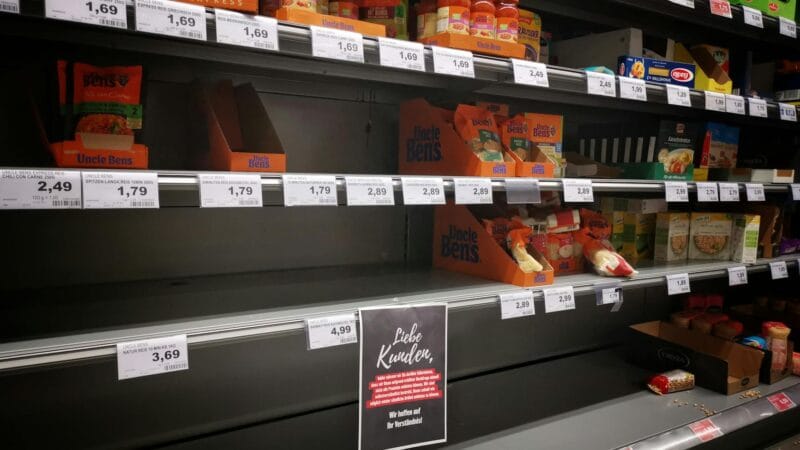
Twenty-six days after US military operations against Iran began on February 28, 2026, the economic consequences are no longer confined to oil prices and shipping rates. They have reached the grocery store. Commodity markets are pricing in a supply shock that runs deeper than the immediate disruption of Hormuz shipping — touching fertilizer supply chains, regional food trade, and the global agricultural system in ways that will persist long after any ceasefire.
This is the consumer end of a supply chain crisis. Our previous analysis covered the fertilizer price shock hitting US farmers. This article examines what happens when that shock works its way to the shelf.
Key Takeaways
- Wheat prices — Up 15% since February 28, 2026 (Chicago Board of Trade front-month futures)
- Rice prices — Up 8% over the same period
- FAO Food Price Index — Hit a 14-month high in March 2026
- Gulf food trade — MENA is the world’s largest food-importing region; Hormuz disruption cuts off 40% of its import routes
- US food CPI projection — Estimated +3–5% for Q4 2026 if the conflict continues through summer
- Comparison — Ukraine war food shock (2022): global wheat +60% in 6 weeks; Iran shock so far is smaller but fertilizer compounding adds a 2023–2024 harvest risk layer
Why Is the Iran War Affecting Food Prices at All?
The connection between a military conflict in the Persian Gulf and American grocery prices runs through three distinct channels — each reinforcing the others.

Channel 1: Fertilizer disruption. The Gulf region produces over 30% of the world’s urea and ammonia — the nitrogen fertilizers that underpin global grain production. Iran is itself a major fertilizer producer (approximately 6.5 million tonnes per year), and the Strait of Hormuz is the export route for fertilizers from Iran, Qatar (the world’s largest LNG and ammonia exporter), and the UAE. The closure of Hormuz — even a partial or risk-premium-driven closure — disrupts this supply chain. Urea prices have risen 38% since February 28. Farmers who cannot afford or cannot source fertilizer plant less, or plant without adequate inputs, directly reducing crop yields.
Channel 2: Shipping and logistics costs. Container shipping rates on routes avoiding the Gulf — diverting around the Cape of Good Hope — have risen 65% since the conflict began, adding 2–3 weeks to transit times and $2,000–$4,000 per container in costs. Food that is perishable, temperature-sensitive, or time-linked in its supply chain (fresh produce, dairy, seafood) is disproportionately affected. These costs ultimately appear in retail pricing.
Channel 3: Speculative and precautionary buying. Countries that depend heavily on Gulf-routed food imports — Egypt, Pakistan, Bangladesh, several Sub-Saharan African nations — have accelerated strategic reserve purchasing since February 28. Egypt, which imports approximately 60–70% of its wheat consumption (making it the world’s largest wheat importer), has been buying aggressively on world markets. This precautionary demand is pushing prices higher even where physical supply has not yet been directly disrupted.
Which Specific Food Prices Are Rising Fastest?
Wheat: Chicago Board of Trade front-month wheat futures hit $7.85 per bushel on March 24, 2026 — up 15% from $6.82 on February 28. This is not yet at the level of the Ukraine shock (wheat briefly touched $13.60/bushel in March 2022) but the trajectory is concerning because the fertilizer channel means next season’s crop yields are also under pressure. Bread, pasta, cereals, and baked goods are the primary retail transmission channels.
Rice: Thai 5% broken rice — the global benchmark — has risen 8% since February 28. Rice does not route through Hormuz directly (Asia is the production center) but is affected by: substitute demand from wheat buyers in MENA; India’s ongoing export restrictions (in place since 2023); and elevated shipping costs on Asian routes that have risen in sympathy with global freight markets.
Vegetable oils: Palm oil (Malaysia/Indonesia) and soybean oil (US/Brazil) are both up 6–9% since late February. The Gulf is a major palm oil importer and re-exporter; disruption to Gulf distribution networks has created regional tightness that is feeding back into global price benchmarks.
Meat and poultry: The fertilizer-to-feed-grain transmission takes longer — typically one growing season — but is already visible in futures pricing. Corn, the primary US livestock feed, is up 11% since February 28. This will translate into higher poultry, pork, and beef retail prices by Q3–Q4 2026, with estimates ranging from 5–12% increases depending on how long the conflict continues.
How Does This Compare to the 2022 Ukraine War Food Shock?
The 2022 Ukraine war food shock was dramatic and rapid: global wheat prices rose 60% in six weeks between February and mid-March 2022 because Ukraine and Russia together account for approximately 28% of global wheat exports, and that supply was physically cut off overnight. The FAO Food Price Index hit an all-time record in March 2022.
The Iran war food shock is proceeding more slowly and through different channels. It is not primarily a direct food supply disruption — Iran is not a major wheat or rice exporter. Rather, it is a fertilizer and logistics disruption whose effect on food prices is time-lagged, compounding over growing seasons rather than hitting immediately.
This slower trajectory is both reassuring and concerning. Reassuring because it means a ceasefire in April or May 2026 would likely prevent the worst agricultural impact. Concerning because if the conflict continues through the Northern Hemisphere planting season (March–May), the fertilizer shortage will reduce 2026 harvest yields, creating a food price problem that persists into 2027 regardless of when the conflict ends.
What Is the MENA Food Security Dimension?
The Middle East and North Africa is the world’s most food-import-dependent region. The 22 Arab League member states import approximately $60 billion in food annually, with a large share transiting through or originating in the Gulf. Egypt imports 60–70% of its wheat; Yemen imports over 90% of its basic food needs; Lebanon is near-entirely import-dependent following the destruction of the Beirut port silos.
The Hormuz disruption is creating acute food security stress in these countries. Egypt’s General Authority for Supply Commodities (GASC) — the world’s single largest wheat buyer — has been purchasing emergency reserves at elevated prices, adding to its already stressed external debt burden. The Egyptian pound, which lost over 50% of its value between 2022 and 2025, makes dollar-priced commodity imports more expensive in local currency terms, compressing household purchasing power for the 60% of Egyptians who spend more than half their income on food.
The UN World Food Programme has issued warnings about food access deterioration in Yemen, Sudan, and Syria — all countries whose already-precarious food situations are being worsened by the Gulf-routed supply chain disruption.
What Does the Food Shock Mean for the American Grocery Bill?
The US food system is less directly exposed to Gulf food trade than MENA countries, but it is not insulated. The transmission runs through three mechanisms: commodity price pass-through (US wheat and corn prices have risen in line with global benchmarks); energy cost pass-through (food processing, cold storage, and transportation are energy-intensive, and US energy prices have risen with oil); and imported food inflation (specialty foods, seafood, and out-of-season produce imported from affected regions).
The USDA’s Economic Research Service (ERS) currently projects US food-at-home prices (grocery inflation) will rise 3.2% in 2026 — a forecast made before February 28. Independent economists tracking the Iran war impact have revised this upward to 3–5% for 2026 as a whole, with the Q4 2026 figure likely to be higher (4–6%) as the fertilizer-to-crop-to-shelf transmission chain completes.
The distributional impact is severe. Low-income American households spend approximately 30–35% of their income on food, compared to 8–10% for middle-income households. A 5% food price increase costs a low-income household earning $30,000/year approximately $450–$525 per year in additional food expenditure — a meaningful income shock for families already stretched by 2024–2025 inflation. SNAP (Supplemental Nutrition Assistance Program) benefits, which are adjusted for food inflation annually but with a lag, will not compensate beneficiaries for this shock until fiscal year 2027.
What Happened to SNAP and Food Aid Budgets?
The Trump administration’s fiscal year 2027 budget proposal, submitted in February 2026, included significant cuts to SNAP funding — estimated at $30 billion over 10 years through tightening eligibility and work requirements. These cuts, if enacted, would reduce the food security safety net precisely as food prices are rising due to the Iran war shock — a policy and economic collision that food security advocates have described as a compounding crisis.
Congressional Republicans have defended the SNAP reductions as necessary deficit control; Democrats have proposed offsetting emergency supplemental food aid funding tied to the Iran war emergency authorization. The resolution of this political standoff will materially affect the welfare of approximately 42 million Americans who rely on SNAP.
What This Means for US Investors
Rising food prices are stagflationary — they add to CPI without contributing to productive economic growth, complicating Federal Reserve policy at a moment when rate cuts were already anticipated. For portfolio positioning: agricultural commodity ETFs (DBA, CORN, WEAT) are direct beneficiaries of the current price environment. Fertilizer producers including Mosaic (MOS) and CF Industries (CF) are benefiting from elevated urea and ammonia prices. Food retailers with strong private-label penetration (Kroger, Costco) tend to outperform branded-goods-heavy competitors in food inflation environments. Avoid companies with high exposure to food service and restaurant supply chains — these are the last link in the chain and absorb margin compression before passing costs on. Monitor the FAO Food Price Index release in early April for confirmation of trend acceleration or stabilization.
Frequently Asked Questions
Why is the Iran war causing food prices to rise?
The Iran war is disrupting three channels simultaneously: fertilizer supply from Gulf producers (affecting next season’s crop yields), shipping costs through Strait of Hormuz alternatives (adding $2,000–$4,000 per container), and precautionary buying by food-import-dependent nations like Egypt that is driving up global commodity prices.
How much have food prices risen because of the Iran war?
As of March 25, 2026: wheat futures are up 15%, rice is up 8%, corn is up 11%, and palm oil is up 6–9% since February 28. The FAO Food Price Index hit a 14-month high in March 2026.
Will US grocery prices rise significantly in 2026?
Yes. US food-at-home prices are projected to rise 3–5% in 2026 overall, with Q4 2026 potentially seeing 4–6% increases as the fertilizer shortage works through the crop cycle. This is above pre-war USDA projections of 3.2%.
How does the Iran war food shock compare to the Ukraine war in 2022?
The Ukraine war directly cut off 28% of global wheat exports overnight, causing wheat to spike 60% in six weeks. The Iran war’s food impact is more indirect (fertilizer and logistics rather than direct crop supply) and slower-moving, but potentially more persistent because it affects future harvest yields.
Which Americans are most affected by the food price increases?
Low-income households spending 30–35% of income on food bear the greatest burden. A 5% food price increase costs families earning $30,000/year approximately $450–$525 extra annually. The 42 million Americans on SNAP will not receive compensating benefit increases until fiscal year 2027, creating an acute 12-month window of food stress.