Key Takeaways
- Nikkei 225 — fell approximately 3% in the session following the Qatar LNG terminal strike, its sharpest single-day loss in 2026
- KOSPI — dropped ~3% as South Korea’s near-total energy import dependency amplified the shock
- Brent crude — surged above $112/barrel after the attack, with options markets pricing further upside
- LNG spot prices — spiked to multi-year highs; Qatar supplies roughly 25% of global LNG, making any disruption systemic
- S&P 500 divergence — energy sector outperforming by wide margin while tech and consumer discretionary sold off on inflation and demand fears
When an Iranian missile struck a Qatar LNG terminal in mid-March 2026, the shockwave reached Tokyo and Seoul within hours — not as physical damage but as a repricing of risk across every asset class exposed to energy imports. For American investors watching the S&P 500, the session that followed was a masterclass in how a single geopolitical event can simultaneously create winners (energy) and punish everything else.
Japan imports roughly 80% of its energy. South Korea imports 95%. Both countries are among the world’s largest LNG buyers. When Qatar — which supplies approximately 25% of global LNG — takes a direct hit to export infrastructure, the math becomes brutal and immediate.
What Happened to Asian Markets After the Qatar Strike?
The Nikkei 225 fell approximately 3% in the first full trading session after news of the Qatar LNG terminal attack broke. The KOSPI in Seoul matched that decline. Both moves were orderly — not panic selling — but the magnitude reflected genuine fundamental repricing, not just sentiment overshoot. These were markets correctly processing a supply shock that their economies have almost no ability to absorb domestically.

The selling concentrated in energy-intensive industrials, utilities, and petrochemical companies whose input cost assumptions had just been invalidated. Japanese automakers — already navigating supply chain complexity from the broader Iran-Israel conflict — fell alongside trading houses with LNG procurement exposure. In Seoul, the POSCO group and Korea Electric Power Corporation (KEPCO) led declines.
Why Is Qatar’s LNG So Critical to Asian Markets?
Qatar is not just a large LNG supplier — it is the structural backbone of Asian energy security. Its 77 million tonnes per annum (mtpa) of production capacity makes it the world’s second-largest LNG exporter after Australia, and its long-term supply contracts are woven through the energy procurement strategies of Japan, South Korea, China, Taiwan, and India.
Japan, in particular, has no realistic short-term alternative to Qatari LNG at scale. Its nuclear restart program — accelerated after the 2011 Fukushima disaster reversed course — has brought some capacity back online, but the country remains structurally dependent on imported LNG for power generation, industrial feedstock, and heating. A prolonged disruption to Qatar’s export capacity would not merely raise prices; it would force emergency spot market purchases at prices that would meaningfully damage Japan’s current account position.
South Korea faces a structurally similar problem with even less cushion. Its 95% energy import dependency is the highest among OECD nations, and its industrial base — semiconductors, shipbuilding, steel, chemicals — is among the most energy-intensive per dollar of GDP in the developed world. A 10% sustained increase in LNG input costs compresses KOSPI earnings estimates by a measurable margin.
What Did Brent Crude Do After the Attack?
Brent crude surged above $112/barrel following the Qatar terminal strike — an acceleration of the upward move that had been building since the Iran-Israel conflict began in early March. The move above $112 is significant because it crosses the threshold that most global airline and shipping companies use for fuel surcharge triggers, meaning the second-order cost pass-through to consumers and freight rates activates automatically.
Options markets told an even more aggressive story. The 30-day implied volatility on Brent contracts spiked, and call options at $120 and $130 saw heavy volume as traders positioned for further escalation. The oil price trajectory for March 2026 had already been elevated before this event; the Qatar attack removed the ceiling from the near-term pricing discussion.
WTI followed, though at a slightly smaller premium to Brent than usual — a function of US domestic production partially insulating American benchmark pricing from pure Middle East supply shocks.
How Did US Markets Respond?
What This Means for US Investors
The S&P 500 energy sector (XLE) is outperforming the broader index by its widest margin since 2022. US LNG exporters — Cheniere Energy, New Fortress Energy, and Venture Global — are direct beneficiaries of the Qatar supply disruption, as Asian buyers scramble to redirect spot purchases toward US Gulf Coast export terminals. The Fed’s dilemma sharpened after the Qatar attack: sustained energy inflation above $100/barrel makes rate cuts increasingly difficult to justify, even as non-energy growth slows. Nasdaq’s tech-heavy composition makes it particularly vulnerable to the “stagflation lite” scenario — rising energy input costs, compressed consumer demand, and a Fed that cannot rescue with rate cuts. Watch for Fed commentary at the next meeting on whether $112 Brent changes the inflation path guidance.
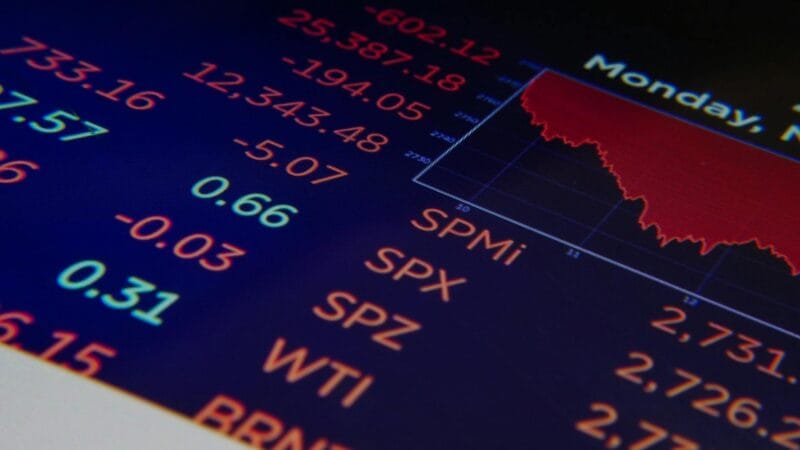
The S&P 500 sold off in the session following the Qatar attack, led by consumer discretionary and technology. The divergence with energy was stark. Companies like ExxonMobil and Chevron — which benefit directly from higher crude prices — gained, while Amazon, Apple, and Tesla fell on demand destruction fears and higher cost of goods assumptions.
The Dow Jones Industrial Average, with its heavier weighting toward energy and industrial companies relative to the S&P 500, outperformed the broader market on a relative basis, though it still declined in absolute terms. The Nasdaq Composite, with its technology concentration, bore the worst of the sell-off — a pattern consistent with energy-driven inflation shocks across the past two decades.
What Does This Mean for the Federal Reserve?
The Fed’s policy calculus became materially harder after the Qatar strike. Before March 2026, markets had been pricing roughly two rate cuts by year-end based on softening US inflation data. Brent crude above $112 — if sustained — feeds directly into headline CPI through gasoline prices, utility costs, and transportation freight within 60-90 days. That timeline collides squarely with the Fed’s next two meeting cycles.
The central bank cannot cut rates to support slowing growth while simultaneously watching energy-driven inflation re-accelerate. The Qatar attack has not made a hard landing inevitable, but it has narrowed the Fed’s corridor of action. Gold markets responded accordingly, with the metal continuing its role as a hedge against both inflation and geopolitical uncertainty.
Which Sectors and Companies Are Most Exposed?
Most Vulnerable (US-listed)
Airlines (Delta, United, American) — jet fuel is the single largest operating cost, and hedging programs provide only partial, time-limited protection. A sustained move above $110 Brent hits margins within one to two quarters. Shipping and logistics (FedEx, UPS, CH Robinson) — fuel surcharges activate but with lag, creating a margin compression window. Petrochemicals and plastics manufacturers — feedstock cost spikes compress margins before downstream price increases can be pushed through.
Beneficiaries (US-listed)
US LNG exporters (Cheniere Energy, New Fortress Energy) — Asian spot buyers are now paying premium prices for any available US LNG cargoes. Energy majors (ExxonMobil, Chevron, ConocoPhillips) — higher realized oil prices flow directly to free cash flow at existing production costs. Oilfield services (Schlumberger, Halliburton, Baker Hughes) — elevated prices sustain and potentially increase drilling activity.
Frequently Asked Questions
Why did the Nikkei and KOSPI fall 3% after the Qatar LNG attack?
Japan imports approximately 80% of its energy and South Korea imports 95% — both among the world’s largest LNG buyers. Qatar supplies roughly 25% of global LNG. A strike on Qatari export infrastructure is a direct threat to the energy security of both nations, and markets repriced equities to reflect higher input costs and potential supply shortfalls with immediate effect.
What share of global LNG does Qatar supply?
Qatar produces approximately 77 million tonnes per annum (mtpa) of LNG, representing roughly 25% of global LNG supply. It is the world’s second-largest exporter after Australia and holds long-term supply contracts with Japan, South Korea, China, India, and European nations. Any disruption to its export capacity is inherently systemic for global energy markets.
How does Brent crude above $112 affect the US stock market?
Energy stocks (XLE) benefit directly. But the broader S&P 500 faces headwinds: higher fuel costs compress margins across airlines, logistics, retail, and manufacturing. Consumer spending power erodes as gasoline prices rise. Most critically, sustained oil above $110 makes Federal Reserve rate cuts harder to justify, removing a key market support mechanism that tech-heavy Nasdaq valuations depend on.
Are US LNG exporters benefiting from the Qatar disruption?
Yes, directly. US Gulf Coast LNG export terminals — primarily operated by Cheniere Energy and Venture Global — are receiving increased spot demand from Asian buyers seeking to replace Qatari supply. US LNG already trades at a discount to Qatari supply on a long-term contracted basis; the current spot premium environment is highly favorable for US exporters and their shareholders.
Will the Fed cut rates despite oil above $112?
The probability has declined significantly. Before the Qatar attack, markets priced roughly two Fed rate cuts by year-end. Sustained Brent above $112 feeds into headline CPI within 60-90 days, making it difficult for the Fed to cut without appearing to tolerate inflation. The base case has shifted toward a longer hold, with cuts potentially pushed into late 2026 or beyond depending on how the conflict evolves.
Conclusion: A Regional Conflict With Global Market Consequences
The Qatar LNG terminal attack has demonstrated that the Iran-Israel conflict is not a contained regional event — it is a global energy markets event. The 3% drops in the Nikkei and KOSPI are the most visible expression of that reality, but they are not the most important one. The more significant consequence is the narrowing of options available to the world’s major central banks, the extension of energy price uncertainty into corporate planning horizons, and the acceleration of US LNG exporters’ competitive position relative to Middle East supply.
For US investors, the playbook is clear even if the duration is not: energy exposure works, rate-sensitive tech faces headwinds, and the Fed is in a harder position than it was a month ago. The war has a balance sheet, and markets are beginning to calculate it in real time.