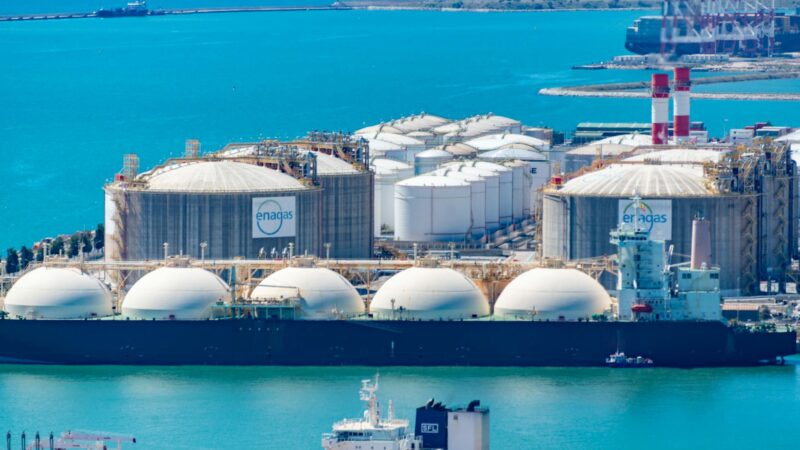
Liquefied natural gas is reshaping the Middle East’s energy landscape at an accelerating pace in 2026. While oil prices dominate headlines, natural gas is quietly becoming the backbone of Gulf energy strategies, underpinned by massive production expansions in Qatar and strategic investments in the UAE. In March 2026, the global LNG market stands at a critical crossroads between imminent supply surplus and unrelenting Asian demand.
The Price Landscape: Where Do We Stand in March 2026?
Natural gas prices varied across key benchmarks in Q1 2026:
- Henry Hub (US): Trading at $3.20 per MMBtu, up 18% from March 2025 levels
- TTF (European benchmark): Ranging between $11 and $13 per MMBtu, significantly below the 2022 peak but 25% above pre-pandemic averages
- JKM (Asia benchmark): Ranging between $12 and $14.50 per MMBtu, supported by strong seasonal demand from Japan and South Korea
- Gulf spot delivery prices: Ranging between $10 and $12.50 per MMBtu for near-term delivery contracts
The price spread between Henry Hub and Asian markets (approximately $10 per MMBtu) remains the primary driver for global LNG projects, including Qatar’s massive expansions.
Qatar: The Largest Expansion in LNG History
The North Field Expansion project represents the largest LNG project in history, progressing ahead of schedule in several phases.
Phase 1: North Field East (NFE)
This phase aims to raise Qatar’s production capacity from 77 million tonnes per annum (mtpa) to 110 mtpa by end of 2026. Completion reached 92% in March 2026, with commissioning of the first two liquefaction trains beginning in January 2026. Total phase investment: $28.7 billion.
Phase 2: North Field South (NFS)
This phase will add an additional 16 mtpa, bringing the total to 126 mtpa by 2028. Construction progress reached 45% in March 2026. The phase includes two new liquefaction trains at an investment of $10 billion.
Long-Term Contract Strategy
QatarEnergy has signed long-term supply contracts worth over $200 billion since 2022. Notable contracts in 2025-2026:
- Agreement with China (CNPC): 4 mtpa for 27 years
- Agreement with Shell: 3.5 mtpa for 27 years
- Agreement with Bangladesh: 1.8 mtpa for 15 years
- Agreement with Germany (RWE): 2 mtpa for 15 years
This strategy guarantees Qatar stable revenues regardless of spot market fluctuations, with most contracts priced on an oil-linked basis with slope factors ranging from 12% to 14%.
The UAE: A Fundamentally Different Gas Strategy
While Qatar focuses on exports, the UAE pursues a dual strategy: achieving gas self-sufficiency first, then exporting. In March 2026, several developments stand out:
Hail and Ghasha Sour Gas Project
ADNOC is developing this mega sour gas project in shallow waters off Abu Dhabi at an investment of $15 billion. The project is designed to produce 1.5 billion cubic feet per day, with production start expected in Q1 2027. It will reduce the UAE’s reliance on gas imports by 40%.
Fujairah as a Regional LNG Hub
The UAE is developing the Port of Fujairah as a regional LNG trading hub. Recent investments include expanding the regasification terminal by an additional 800 million cubic feet per day and $2 billion in storage and shipping infrastructure.
Net Zero 2050 Target
The UAE is the first Gulf state to announce a net-zero carbon target by 2050. Natural gas plays a pivotal role in this transition as a cleaner bridge fuel compared to oil and coal. Currently, gas accounts for 95% of the UAE’s electricity generation mix.
Asian Demand: The Market’s Primary Driver
Asian LNG demand remains the primary driver of prices and investments. In 2026, the following trends emerge:
- China: Imported 95 mtpa in 2025, up 12% year-on-year, and is expected to exceed 105 mtpa in 2026
- India: Aims to increase gas’s share in the energy mix from 6.2% to 15% by 2030, implying additional demand of approximately 30 mtpa
- Southeast Asia: Vietnam, Thailand, and the Philippines have become net LNG importers, adding 15-20 mtpa of new demand
- Japan and South Korea: Despite renewable energy transition policies, demand remains stable at a combined 100 mtpa
The Coming Supply Wave: Is the Market Facing a Surplus?
The market is anticipating a massive wave of new production capacity between 2026 and 2029:
- Qatar (NFE + NFS): 49 mtpa additional
- United States (Golden Pass, Plaquemines, Rio Grande): 45 mtpa
- Canada (LNG Canada): 14 mtpa
- Mozambique (Phase 1): 12.9 mtpa
Total: more than 120 mtpa additional by 2029, a 25% increase over the current global capacity of 480 mtpa.
However, analysts at Wood Mackenzie argue that projected Asian demand growth (80-100 mtpa additional by 2030) will absorb most of this new supply, limiting price declines. The central forecast: JKM prices stabilizing between $10 and $13 per MMBtu during 2026-2028.
Impact on Gulf Economies
The evolution of the LNG market carries profound implications for regional economies:
- Qatar: Will become the world’s largest LNG producer by a wide margin, with projected annual gas revenues exceeding $70 billion after expansion completion
- UAE: Achieving gas self-sufficiency will save $4-5 billion annually on gas import bills
- Saudi Arabia: Investing $110 billion in developing the massive Jafurah unconventional gas field, with production start expected in 2027
- Oman: Continuing to develop LNG projects in Sohar and Duqm with a combined capacity of 18 mtpa
What to Watch for the Rest of 2026
Three factors will determine the market’s trajectory in the coming months. First, the pace of commissioning new liquefaction trains in Qatar and the United States and any potential delays. Second, the scale of Chinese demand, which remains tied to the Chinese economy’s performance and government stimulus policies. Third, geopolitical tensions at the Strait of Hormuz, through which more than 20% of global LNG trade passes.
For investors, Gulf LNG represents a long-term opportunity supported by strong fundamentals: structurally growing demand, some of the lowest production costs globally, and long-term contracts that limit price risk.