In a week that saw the DFM Real Estate Index plunge 21% from 16,700 to 13,353, and UAE corporate bonds named the worst performers in emerging markets by Bloomberg, a fundamental question emerges: is Dubai’s real estate market collapsing, or does this correction represent a rare investment opportunity? The actual data from the second week of March 2026 paints a far more complex picture than the headlines suggest.
The DFM Real Estate Index: Breaking Down the Crash
The DFM Real Estate Index wiped out all of its 2026 gains within days. The decline from 16,700 to 13,353 — a 21% drop — came directly after the drone strike on DP World’s Jebel Ali port, which temporarily suspended operations. This event triggered a broad sell-off that extended well beyond the real estate sector into wider financial markets.
However, a closer examination reveals that actual property prices declined only 5-8% in most areas, starkly contrasting with the sharp drop in listed real estate company shares. This gap between real prices and stock prices is what analysts call the “fear gap” — historically one of the strongest buy signals in property markets.

UAE Bond Market: Warning Signal or Overreaction?
Bloomberg’s report revealed that UAE corporate bonds are the worst performers in emerging markets since the conflict erupted. This development reflects a comprehensive repricing of regional risk, not necessarily a deterioration in the UAE’s economic fundamentals.
Factors pressuring the bond market include surging shipping insurance premiums through the Strait of Hormuz, the suspension of Jebel Ali port operations, and Bloomberg itself telling Gulf-based staff they could temporarily relocate. All these factors sharply raised the risk premium.
But context matters: UAE sovereign credit ratings have not been downgraded, Abu Dhabi’s financial reserves exceed $900 billion, and the Abu Dhabi Investment Authority has the capacity to intervene to support markets if necessary.
Transaction Data: Numbers That Defy the Narrative
Despite the turbulence, Dubai recorded 36,831 real estate transactions from January 1 to March 8, 2026 — up 7% from the same period in 2025. The median price reached AED 1,770 per square foot, a 14% year-over-year increase. In the week of March 2-9 alone, property sales hit AED 11.93 billion.
More significantly, property viewing activity surged 75% in the last three days — a clear signal that serious investors view the current downturn as a market stress test rather than the beginning of a collapse.
Off-plan sales accounted for 69% of total transaction value, reflecting buyer confidence in the market’s medium- to long-term future — those buying off-plan are betting on delivery 2-4 years from now.
Prices by Area: Where Are the Opportunities?
The impact was not uniform across Dubai’s districts. Areas closest to logistics infrastructure and ports were hit hardest, while interior residential areas showed remarkable resilience. For foreign investors considering buying property in Dubai, understanding this geographic disparity is critical.
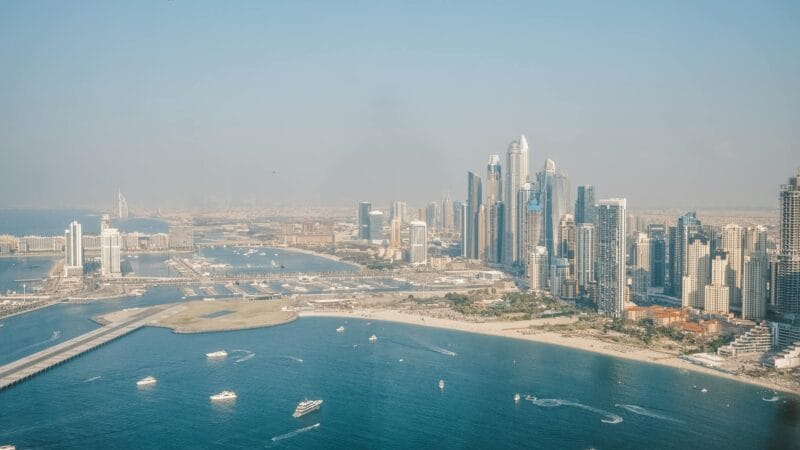
Downtown Dubai and Dubai Marina saw limited declines of 3-5%, while luxury projects on Palm Jumeirah maintained prices almost entirely due to limited supply. Emerging areas like Dubai South and Mohammed Bin Rashid City experienced deeper corrections of 8-12%, creating attractive entry points for long-horizon investors.
Three Scenarios: What Comes Next?
Bear Scenario (25% probability): Continued Escalation
If infrastructure strikes continue and the conflict widens, prices could decline an additional 15-20% during Q2. In this scenario, new projects freeze and mortgage financing stalls, but it also creates a historic buying opportunity for those with liquidity and patience.
Base Scenario (50% probability): Limited Containment
A partial ceasefire or diplomatic de-escalation within 4-8 weeks. Prices stabilize at current levels then gradually recover 5-8% by end of 2026. This is the scenario most institutional investors are currently positioning for.
Bull Scenario (25% probability): Diplomatic Breakthrough
A comprehensive ceasefire agreement restores stability. Prices return to pre-crisis levels within 3-6 months, with additional momentum from pent-up demand. The DFM Real Estate Index recovers above 15,000.
What Is Smart Money Doing Right Now?
Smart money doesn’t flee from downturns — it prepares for them. The 75% surge in viewings suggests veteran investors are doing exactly what theory prescribes: conducting due diligence and preparing to buy at support levels. The market distinguishes between “stability” and “panic” — and the data so far clearly points to the former.
For the best off-plan projects in 2026, the flexible payment plans developers are currently offering were not available before the crisis — an advantage smart investors are capitalizing on.
Conclusion: Stability, Not Panic
The picture the data paints is clear: Dubai’s real estate market in March 2026 is undergoing a genuine stress test, but it is not in collapse. The gap between the DFM Real Estate Index performance (-21%) and actual property prices (-5% to -8%) reflects exaggerated institutional fear more than fundamental deterioration. With 36,831 transactions and a 75% surge in viewings, the question is not whether the market will recover — but when, and who will be positioned to benefit.