President Abdel Fattah el-Sisi has declared what he described as a “state of near-economic emergency.” Egypt faces its worst regional turbulence since the 2024 Gaza-Red Sea crisis. An economy already on life support after 2019 reforms is now under attack from four fronts simultaneously — something unprecedented in Egypt’s modern history.
What makes Egypt’s situation unique is that any single one of these fronts would be enough to destabilize a developing economy. Their convergence creates a compound crisis with no precedent in the region.
Front One: Suez Canal Revenue Collapse
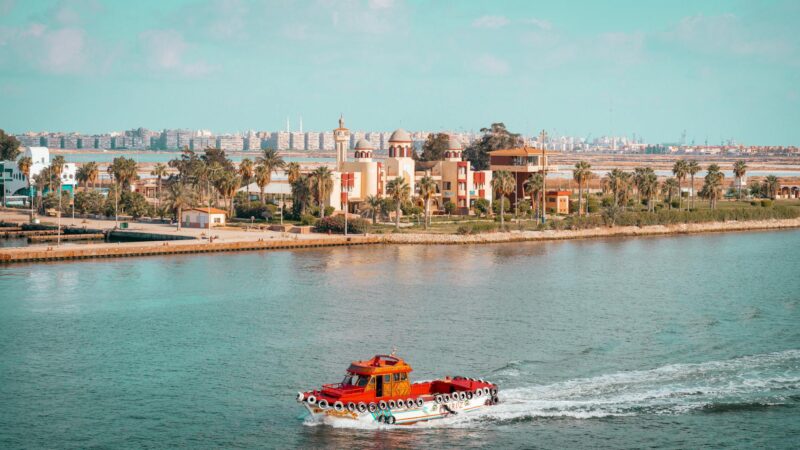
Suez Canal revenues reached $10.25 billion in 2023 — then collapsed to $4 billion in 2024, a 61% decline. The direct cause was Houthi attacks that forced global shipping companies to reroute. The canal saw a brief recovery in early 2026 with revenues of $449 million in January, but the Iran war redirected ships once again.

Maersk, CMA CGM, and Hapag-Lloyd are rerouting their vessels around the Cape of Good Hope once more. Monthly losses are estimated at $800 million. More critically, this is not the first time — it is the second time in two years, raising fundamental questions about the canal’s future as a reliable revenue source.
Front Two: Israeli Gas Cutoff
Israel suspended natural gas supply from the Tamar and Leviathan fields — 1.1 billion cubic feet per day halted. Egypt depends on this gas for electricity generation and industrial use. Losing this supply forces the government into a harsh choice: cut energy supply to industry to maintain household provision, or implement nationwide electricity rationing.
Egypt had built its energy strategy on the assumption of continued Israeli gas flow. It had even converted part of its infrastructure for LNG re-export. Now, there is no gas for domestic consumption, let alone for export.
Front Three: Currency Under Attack
The Egyptian pound fell to 50.2 per dollar — an 8-month low. Foreign investors withdrew $1.12 billion from government debt instruments. A weaker pound means higher import bills for wheat, cooking oil, and medicine — essential goods that affect the daily lives of 107 million Egyptians.
The risk of an inflationary spiral is real: a weaker currency means more expensive imports, more expensive imports mean higher inflation, higher inflation means pressure to raise wages, raising wages pressures the budget — a vicious cycle. And the IMF program that was supposed to be a lifeline is under immense strain.
Front Four: The Refugee Burden
Egypt hosts 10.5 million refugees from neighboring conflicts — Sudan, Syria, Libya, and Gaza. This represents enormous additional strain on infrastructure, subsidies, and public services. International aid is nowhere near proportionate to the burden. Egypt is bearing the cost of crises it played no part in creating.
For context, 10.5 million refugees is roughly equivalent to the entire population of a country like Jordan or the UAE. Absorbing this number in a country already under economic pressure doubles the burden on every sector — from healthcare to education to food supply.
What Egypt Needs — And Likely Will Not Get
Renegotiation with the IMF has become a necessity, not an option. But the institution will demand additional painful reforms at a time when Egyptian citizens cannot bear more austerity. Suez revenue recovery depends on regional stability that Egypt cannot control. Alternative energy sources require investment and time. And Gulf financial support — traditionally Egypt’s last resort — faces challenges because Gulf states themselves are under pressure from the Hormuz crisis.
Every solution available to Egypt depends on the war ending — something over which Egypt has no control.
The Bigger Picture
Egypt’s crisis reveals the fragility of economies built on geographic advantages (the Suez Canal) and external energy (Israeli gas). When both are disrupted simultaneously, there is no safety net. Egypt did not choose this war, but it is paying the price from every direction. The question that must be asked is not only how Egypt will recover from this crisis — but how it will rebuild its economic model to be less vulnerable to external shocks in the future.
History shows that Egypt possesses an extraordinary capacity for endurance. But endurance alone is not enough — what Egypt needs is a structural transformation in revenue sources, energy, and food security. The 2026 crisis may be the catalyst for this transformation — or it may be the crisis that proves the current model has reached its absolute limits.