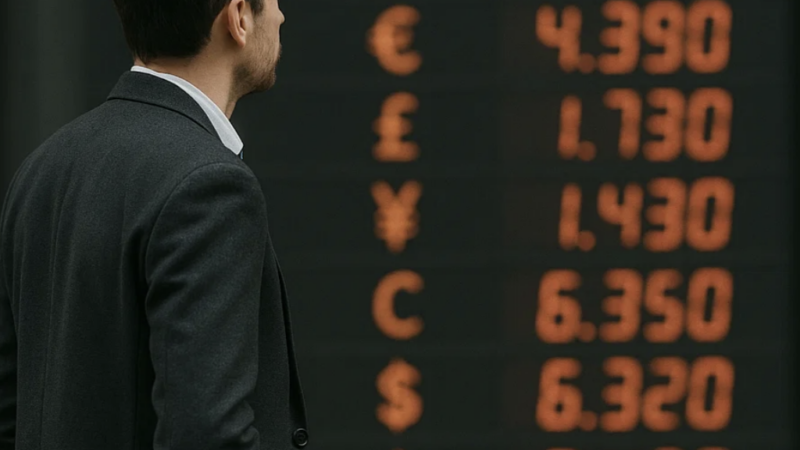
All economic indicators and financial analyses point to the conclusion that Gulf currencies — led by the Saudi Riyal (SAR), UAE Dirham (AED), Qatari Riyal (QAR), Bahraini Dinar (BHD), Omani Rial (OMR), and Kuwaiti Dinar (KWD) — will remain pegged to the US dollar until at least 2035, despite the escalating global de-dollarization debate and BRICS initiatives to create an alternative currency. This forecast rests on deep structural factors related to the nature of oil trade, foreign exchange reserves, and the monetary stability that the peg system has provided for decades.
Historical Context: How Gulf Currencies Became Pegged to the Dollar
The linkage between Gulf currencies and the US dollar dates back to the 1970s, when oil began to be priced and traded exclusively in dollars following the petrodollar agreement between the United States and Saudi Arabia in 1974. This system granted Gulf economies exceptional monetary stability in exchange for tying their monetary policy to the decisions of the US Federal Reserve.
Saudi Arabia fixed its riyal at 3.75 per dollar since 1986, while the UAE pegged its dirham at 3.6725 per dollar since 1997. Qatar pegged its riyal at 3.64 per dollar, Bahrain at 0.376 dinar per dollar, and Oman at 0.3845 rial per dollar. The exception is Kuwait, which pegs its dinar to a currency basket dominated by the dollar at over 70%, according to estimates from the International Monetary Fund.

This system has endured without fundamental change for over four decades, surviving major financial crises including the 2008 Global Financial Crisis, the 2014-2016 oil price collapse, and the COVID-19 pandemic. The Bank for International Settlements (BIS) has confirmed in recent reports that the Gulf peg system is among the most successful fixed exchange rate regimes in the history of the international monetary system.
Why the Dollar Peg Persists: Five Structural Factors
Several fundamental factors make the de-pegging of Gulf currencies from the dollar highly unlikely in the foreseeable future. These factors complement each other to form a robust defense of the peg system:
- Oil Priced in Dollars: More than 80% of global oil trade continues to be priced and settled in US dollars. Since oil revenues represent between 50% and 85% of Gulf government revenues — even with ongoing economic diversification and non-oil GDP growth — maintaining the peg reduces exchange rate volatility risks and simplifies fiscal management.
- Massive Foreign Exchange Reserves: The Saudi Central Bank (SAMA) holds over $430 billion in foreign reserves, while the Central Bank of the UAE holds over $190 billion. These enormous reserves give central banks the capacity to defend fixed exchange rates against any speculative pressures.
- Monetary Stability and Investor Confidence: The peg system provides a predictable business environment that facilitates long-term planning and attracts foreign direct investment. According to World Bank reports, Gulf states with fixed exchange rates have experienced 40% higher foreign investment flows compared to emerging economies with flexible exchange rates.
- High Transition Costs: Moving to a flexible exchange rate regime requires developing sophisticated monetary institutions, deep financial markets, and effective inflation targeting mechanisms — a process that takes years of preparation and carries significant risks during the transition.
- Absence of a Reliable Alternative: No practical alternative to the dollar currently exists as a primary international settlement currency. The euro faces its own structural challenges, the Chinese yuan remains not fully convertible, and any proposed BRICS currency remains at the stage of theoretical discussion with no clear implementation framework.
The De-Dollarization Debate: Reality vs. Rhetoric
In recent years, a wave of analyses and speculation about the end of dollar dominance in global markets has intensified, especially after the imposition of sweeping Western sanctions on Russia following the Ukraine invasion in 2022 and the freezing of a significant portion of its dollar reserves. This fueled a sharp debate about whether Gulf states might reconsider pegging their currencies to a currency that can be wielded as an economic weapon.
But reality diverges sharply from media rhetoric. IMF data reveals that the dollar’s share in global reserves has indeed declined from approximately 71% in 2000 to around 58% today, but this gradual decline does not constitute a fundamental shift — it reflects natural diversification amid the growth of other economies. More importantly, the dollar is still used in more than 88% of foreign exchange transactions globally, according to the BIS Triennial Survey.
“Talk of the dollar’s demise is premature by decades. The global financial infrastructure is built around the dollar, and changing that requires a geopolitical and economic transformation that has yet to materialize.”
— Peterson Institute for International Economics, 2025
The Financial Times noted in a detailed analysis that current dollar alternatives lack three essential elements: deep liquidity, open bond markets, and transparent legal frameworks — the pillars that give the dollar its unique status in the global financial system.
Saudi-China Talks and Oil Settlement in Yuan
The announcement of talks between Saudi Arabia and China regarding the possibility of pricing some oil exports in Chinese yuan sparked widespread speculation about the future of the petrodollar system. Although China has become the largest importer of Saudi oil — accounting for over 25% of the Kingdom’s total oil exports — the volume of actual yuan settlements remains marginal.
Reuters reports indicate that Saudi Aramco has begun accepting yuan in some contracts with Chinese buyers, but this step represents limited diversification rather than a strategic shift. Most of these contracts are ultimately converted to dollars through foreign exchange markets, keeping the dollar at the core of the oil financial ecosystem.
The primary reason for the limited scope of oil settlement in yuan is that the Chinese yuan remains a non-freely convertible currency. Beijing maintains strict capital controls, meaning exporting nations cannot reinvest their yuan surpluses with the same ease and liquidity offered by the US Treasury bond market — the world’s largest and most liquid, exceeding $25 trillion in size.
Additionally, broad acceptance of the yuan exposes Gulf states to political and economic risks tied to decisions by the People’s Bank of China, which operates under Communist Party directives — conflicting with Gulf central banks’ objective of preserving monetary policy independence within the peg framework.
BRICS Currency: Political Ambition or Economic Project?
With the expansion of the BRICS group to include new members such as Saudi Arabia and the UAE, discussions about creating a common BRICS currency that could rival the dollar in international trade settlements have resurfaced. However, analyses from major financial institutions unanimously conclude that this project faces enormous obstacles making it unattainable in the foreseeable future.
The most significant obstacles include:
- Vast Economic Disparities: BRICS encompasses radically different economies — from China with a GDP exceeding $18 trillion to economies of just a few hundred billion — making unified monetary policy virtually impossible.
- Conflicting Geopolitical Interests: BRICS members disagree on a unified vision for the international order. India and China compete for regional influence, while other nations seek to balance relationships between Washington and Beijing.
- Absence of Institutional Framework: There is no common central bank, unified bond market, or sophisticated settlement mechanism that could support a new currency — infrastructure that took decades of negotiations to build in the case of the euro.
- Internal Resistance: Even within BRICS, many members prefer strengthening the use of their local currencies in bilateral trade rather than creating a new common currency that requires surrendering part of monetary sovereignty.
A report published by the Institute of International Finance (IIF) estimated that the probability of an effective BRICS currency emerging before 2040 does not exceed 5%, keeping the US dollar in its dominant position within the foreseeable time horizon.
Gulf Central Bank Policies: Balancing the Peg and Inflation
The pegging of Gulf currencies to the dollar imposes a specific monetary reality: when the US Federal Reserve raises interest rates, Gulf central banks must follow suit to maintain the fixed exchange rate and prevent capital outflows. This means Gulf monetary policy is tied to the American economic cycle rather than necessarily to local conditions.
During the aggressive monetary tightening cycle between 2022 and 2024, Gulf central banks raised interest rates in lockstep with the Fed — even though some Gulf economies needed more accommodative monetary policy to support growth in non-oil sectors. Bloomberg documented how higher interest rates led to a temporary slowdown in real estate across some Gulf markets.
However, inflation pass-through in Gulf states remains relatively limited compared to other economies, for several reasons:
- Domestic Energy Subsidies: Fuel and electricity prices remain partially subsidized in most Gulf states, mitigating the impact of imported inflation on consumers.
- Diversified Import Sources: Gulf states do not depend on a single import source, reducing the impact of any single currency’s fluctuations on domestic prices.
- Expansionary Fiscal Policies: Gulf governments possess broad fiscal space to absorb shocks through government spending and direct citizen transfers.
- Sovereign Wealth Funds: These serve as strategic reserves that can be drawn upon during periods of economic pressure without resorting to money printing or excessive borrowing.
According to Brookings Institution analyses, the dollar peg system remains the optimal choice for Gulf states as long as their economies continue to depend significantly on hydrocarbon exports denominated in dollars.
The Digital Dirham and the Future of Gulf Currencies
While the dollar peg remains firmly in place, Gulf states are actively moving toward innovation in their monetary systems through Central Bank Digital Currencies (CBDCs). The UAE Digital Dirham project is among the most advanced in the region, aiming to modernize payments infrastructure without altering the peg system.
The Central Bank of the UAE has announced advanced stages in developing the digital currency infrastructure, emphasizing that the Digital Dirham will maintain the same fixed exchange rate against the dollar. The goal is not to replace traditional currency with digital money, but to enhance the efficiency of cross-border payments and reduce remittance costs.
The Saudi Central Bank (SAMA) and the Central Bank of the UAE also participate in Project “Aber” — a joint initiative to develop a bilateral digital currency facilitating settlements between the two countries. The Bank for International Settlements has praised this project as a model for regional monetary cooperation in the digital currency era.
These developments demonstrate that Gulf central banks are approaching technological transformations in the global financial system with strategic pragmatism — embracing digital innovation while preserving the monetary anchor that the dollar peg has provided for decades.
Future Scenarios: What Could Change the Equation?
Despite the strength of factors supporting the peg’s continuity, analysts identify several scenarios that could push toward reconsidering Gulf exchange rate regimes over the long term:
- Sharp Decline in Global Oil Demand: If the energy transition leads to a significant drop in oil revenues — a scenario international institutions do not anticipate before 2040 — Gulf states may need greater monetary flexibility to manage their diversified economies.
- Significant Divergence Between US and Gulf Economic Cycles: If non-oil sectors come to comprise the majority of Gulf GDP, tying monetary policy to the Fed could become more of a constraint than an advantage.
- Emergence of a Multipolar Monetary System: If China succeeds in liberalizing its capital account and developing sovereign bond markets deep and liquid enough to rival US Treasuries — a remote possibility — the cost-benefit calculation for Gulf states could shift.
- Gulf Monetary Union: The unified Gulf currency project — discussed for years within the GCC framework — remains theoretically on the table, but faces the same challenges encountered by the eurozone with additional differences in economic structures.
A recent study published by the Institute of International Finance concluded that even in the most optimistic scenarios for economic diversification, oil revenues will continue to form a substantial part of the Gulf economy until at least 2040, making the dollar peg a rational and sustainable choice.
Kuwait’s Special Case: The Currency Basket Peg Model
Kuwait stands apart from other Gulf states with its system of pegging the dinar to a currency basket dominated by the dollar but also including the euro, British pound, Japanese yen, and other currencies. Kuwait adopted this system in 2007 after a period of directly pegging the dinar to the dollar.
The currency basket system gives the Central Bank of Kuwait relatively greater flexibility in managing monetary policy, as it does not require precisely tracking Fed decisions. This system has proven effective in achieving monetary stability with a wider flexibility margin — the Kuwaiti Dinar remains the highest-valued currency in the world.
Some analysts at the Peterson Institute have proposed the Kuwaiti model as a middle-ground option that other Gulf states could adopt in the future — maintaining the dollar’s dominant role while adding limited diversification that reduces absolute dependence on a single currency. However, none of the other Gulf central banks have shown serious intention to change their system to date.
According to data from the Saudi Central Bank and the Qatar Central Bank, inflation rates in Gulf states that directly peg to the dollar have not fundamentally differed from Kuwait’s over the past decade — weakening the economic case for transitioning to a currency basket system at the current stage.
Conclusion: The Dollar Peg Is a Strategic Choice, Not a Constraint
Ultimately, the pegging of Gulf currencies to the dollar should not be viewed as a historical constraint these nations cannot free themselves from — rather, it is a deliberate strategic choice reflecting precise cost-benefit calculations. The peg provides monetary stability, enhances investor confidence, simplifies oil revenue management, and reduces trade transaction costs with the world’s largest trading partner and biggest economy.
While the global financial system is undergoing gradual shifts toward greater multipolarity, and Gulf states themselves are engaging in limited monetary diversification initiatives — such as accepting yuan in some oil contracts and developing digital currencies — these steps complement the peg rather than threaten it. All indicators point to the Saudi Riyal, UAE Dirham, Qatari Riyal, Bahraini Dinar, and Omani Rial maintaining their fixed exchange rates against the dollar through 2035 and beyond — unless unexpected, fundamental geopolitical transformations rewrite the rules of the entire international financial system.
This article is for educational purposes only and does not constitute financial advice. Consult a licensed financial advisor before making investment decisions.