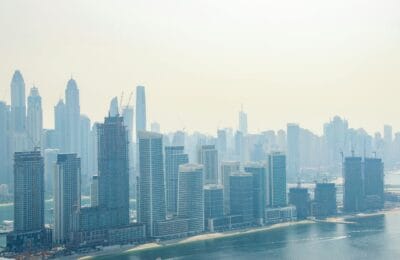
The Arabian Gulf faces an unprecedented existential challenge as the escalating climate change crisis threatens to transform one of the world’s wealthiest regions into one of its most environmentally vulnerable. From temperatures exceeding 50°C (122°F) to rising sea levels that endanger entire coastal cities, climate change is no longer a future threat but a present reality reshaping Gulf economies, energy systems, and food and water security across the region. Yet at the heart of this challenge lies a historic opportunity: reinventing the region’s economies for a post-carbon age.
COP28 in the UAE: A Turning Point in Gulf Climate Commitments
The United Arab Emirates’ hosting of COP28 in December 2023 marked a watershed moment in Gulf climate policy. For the first time, a major oil-producing nation hosted the global climate summit, placing the region under historic responsibility to prove its seriousness about combating global warming.
Key outcomes from the conference include:

- “Transition Away from Fossil Fuels” Declaration: A total of 198 nations agreed to a historic formula calling for a gradual transition away from fossil fuels in energy systems — an unprecedented acknowledgment in climate negotiation history, according to reports from the United Nations Framework Convention on Climate Change (UNFCCC).
- Loss and Damage Fund: Operationalization of a fund with initial capitalization exceeding $700 million to assist the most climate-affected nations, with major contributions from the UAE, Germany, and the United Kingdom.
- Tripling Renewable Energy Pledge: Agreement to triple global renewable energy capacity by 2030 and double energy efficiency.
- UAE Net-Zero Commitment: The UAE announced its commitment to achieving carbon neutrality by 2050, backed by investments exceeding $50 billion in clean energy through 2030.
“COP28 proved that Gulf states are not merely part of the problem — they can be a pivotal part of the solution. The energy transition is not a threat to oil economies; it is an opportunity to reinvent them.”
— International Energy Agency (IEA) Net Zero Report
The Saudi Green Initiative: The Middle East’s Largest Afforestation and Environmental Transformation Program
Saudi Crown Prince Mohammed bin Salman launched the Saudi Green Initiative and the Middle East Green Initiative in 2021 — among the most ambitious environmental programs in the region’s history. The initiative targets bold objectives including:
- Planting 10 Billion Trees: As part of the world’s largest afforestation program, aiming to restore 40 million hectares of degraded land and increase the Kingdom’s green cover by 12 times.
- Reducing Carbon Emissions by 278 Million Tons Annually: More than double previous commitments, according to Reuters Climate reports.
- Generating 50% of Electricity from Renewables by 2030: With massive investments in solar energy and wind power exceeding $100 billion.
- Protecting 30% of the Kingdom’s Land and Marine Areas: Through establishing new nature reserves and expanding existing ones.
Bloomberg Green estimates that total investments in the Saudi Green Initiative will exceed $180 billion over the next three decades, making it one of the largest single-country environmental investments in history. The Kingdom also aims to become a global leader in green hydrogen production through the NEOM project, which includes the world’s largest green hydrogen plant at a cost of $8.4 billion.
Extreme Heat Risks: When Climate Becomes a Direct Economic Threat
The Arabian Gulf region is among the world’s most affected by rising temperatures. Data from NASA Climate Data shows that the warming rate in the region exceeds the global average by 50%, with some Gulf areas recording temperatures above 54°C (129°F) in recent years.
Direct economic risks from extreme heat include:
- Labor Productivity Losses: The World Bank estimates that heat stress could reduce outdoor labor productivity in the Gulf by up to 30% during summer months by 2050, costing Gulf economies over $40 billion annually.
- Escalating Cooling Costs: Air conditioning currently consumes over 70% of peak summer electricity consumption in some Gulf states. With rising temperatures, cooling costs are projected to increase by 25-40% by 2040.
- Increasing Health Risks: Reports from the Intergovernmental Panel on Climate Change (IPCC) warn that some Gulf areas may exceed the limits of human survivability outdoors for extended periods during summer months by the end of the century if drastic action is not taken.
- Impact on Tourism and Events: Extreme heat threatens the summer tourism sector and imposes constraints on outdoor events, pushing Gulf states to reschedule tourism and sports seasons.
Gulf states are combating this challenge through advanced green building standards. The UAE has adopted the Estidama green building rating system, while Saudi Arabia enforces the Saudi Green Building Code mandating strict energy efficiency standards for all new construction. Estimated savings from applying green building standards across the Gulf exceed $15 billion annually by 2035.
The Water Crisis and Desalination Energy Costs: The Most Urgent Challenge
Gulf states depend on desalination for between 60% to 90% of their freshwater needs, making them the most dependent on this technology worldwide. But desalination is an energy-intensive process — consuming up to 15% of total energy production in some regional countries.
As temperatures rise and water demand increases, challenges escalate:
- Growing Energy Costs: Gulf desalination plants consume the equivalent of 350,000 barrels of oil daily, at a cost exceeding $10 billion annually. As seawater temperatures rise, desalination efficiency drops by 1-2% for each additional degree of temperature.
- Environmental Impact of Brine Discharge: Desalination plants return massive quantities of concentrated brine to the sea, increasing Gulf water salinity and threatening marine ecosystems.
- Water Security Under Climate Change: Rainfall in the region is projected to decrease by 10-20% by 2050 according to IPCC Sixth Assessment Report scenarios, increasing pressure on already depleting groundwater sources.
Gulf states are investing heavily in more efficient reverse osmosis desalination technologies and solar-powered desalination plants. The Jubail 3 facility in Saudi Arabia is one of the world’s largest desalination plants with a production capacity of 600,000 cubic meters daily. The region is also exploring innovative water scarcity solutions including water recycling, fog harvesting, and smart irrigation.
Agricultural Adaptation and Food Security: Survival in an Extreme Climate
Food security represents one of the gravest challenges that climate change poses to Gulf states. The region imports between 80% to 90% of its food needs, and any disruption to global supply chains — whether from heat waves, drought, or conflict — poses a direct threat to its food security.
Gulf states are adopting multiple agricultural adaptation strategies:
- Vertical and Hydroponic Farming: The UAE and Saudi Arabia are investing billions of dollars in closed vertical farming that consumes 95% less water than traditional agriculture. Dubai now houses one of the world’s largest vertical farms.
- Agricultural Technology (AgriTech): The Gulf’s AgriTech ecosystem is growing at 25% annually, employing artificial intelligence, drones, and remote sensing to optimize agricultural production efficiency.
- Foreign Agricultural Land Investments: Gulf states have purchased vast agricultural lands in Africa, Central Asia, and Eastern Europe to secure stable food sources.
- Heat and Salinity-Resistant Crop Development: Research centers in Abu Dhabi and Riyadh are developing new crop varieties that withstand high temperatures and salinity levels.
Food security reports indicate that Gulf states need to invest at least $50 billion in food infrastructure over the next decade to ensure supply chain resilience against climate shocks.
Coral Reef Bleaching and Sandstorm Economic Impact: The Environmental and Economic Toll
The Arabian Gulf is experiencing alarming acceleration in coral reef bleaching. Data from NASA Vital Signs of the Planet shows that Gulf water temperatures have risen at a rate of 0.5°C per decade over the past forty years — twice the global average. This has led to bleaching of over 70% of coral reefs in some Gulf areas.
The economic value of coral reefs in the Gulf is estimated at over $3 billion annually through supporting fisheries, marine tourism, and coastal protection. Losing these reefs means massive cumulative economic losses spanning decades.
As for sandstorms, their frequency and intensity have increased notably due to desertification and changing wind patterns linked to global warming. Economic costs of sandstorms include:
- Aviation Disruption: Sandstorms cost the Gulf aviation sector over $2 billion annually through flight cancellations, delays, and equipment damage.
- Reduced Solar Energy Output: Dust and sandstorms reduce solar panel efficiency by up to 40%, diminishing returns on renewable energy investments.
- Health Costs: Sandstorms cause respiratory diseases that cost Gulf healthcare systems billions of dollars annually.
- Infrastructure Damage: Erosion and sand accumulation damage buildings, roads, and industrial facilities at an estimated cost exceeding $5 billion annually across the region.
Carbon Capture Investments: The Gulf’s Technology Bet
Gulf states are placing significant bets on Carbon Capture and Storage (CCS) technologies as a solution that enables them to continue oil and gas production while achieving climate goals. The region leads global investments in this field:
- Al Habshan Facility in Abu Dhabi: Launched by ADNOC as the region’s first commercial carbon capture facility with a capacity of 800,000 tons annually, with plans to expand to 5 million tons by 2030.
- Jubail Carbon Capture Hub: Saudi Aramco is developing one of the world’s largest carbon capture hubs with a capacity of 9 million tons annually by 2027.
- Direct Air Capture (DAC): Both the UAE and Saudi Arabia are investing in promising Direct Air Capture technologies, although costs remain high at $250 to $600 per ton.
- Captured Carbon Utilization: The region is exploring ways to convert captured CO2 into industrial products, building materials, and synthetic fuels, creating a circular carbon economy.
According to International Energy Agency (IEA) reports, Gulf states plan to invest over $100 billion in carbon capture technologies by 2040. However, critics warn that over-reliance on CCS may delay the genuine transition away from fossil fuels.
Climate Migration Patterns: Redrawing the Region’s Demographic Map
Climate change is reshaping migration patterns in and around the region in profound ways. Estimates from the World Bank suggest that the Middle East and North Africa could see up to 19 million people internally displaced due to climate impacts by 2050.
These patterns manifest in several trends:
- Rural-to-Urban Migration: Drought and land degradation are pushing rural populations in Iraq, Iran, and Yemen toward cities, exacerbating pressure on urban infrastructure.
- Cross-Border Migration: Water scarcity and crop failures are fueling migration waves from neighboring countries toward the wealthier and more stable Gulf states.
- Intra-Gulf Population Redistribution: Extreme heat may drive internal demographic shifts, with greater population concentration in coastal areas or regions with better climate infrastructure.
- Migrant Workforce Challenges: The Gulf economy relies heavily on migrant workers who often work in outdoor conditions. Extreme heat could force a reduction in outdoor working hours by up to 50% during summer months by 2050.
These demographic shifts require new urban planning that accounts for climate resilience, reflected in new city projects like NEOM and The Line, designed as zero-carbon cities capable of adapting to the climate of the future.
Net-Zero Targets: Between Ambition and Execution
All Gulf Cooperation Council (GCC) states have announced carbon neutrality targets, but timelines and mechanisms vary significantly:
- UAE: Net-zero by 2050 — the most ambitious in the region, supported by the Barakah nuclear power plant and massive solar energy investments.
- Saudi Arabia: Net-zero by 2060 — emphasizing the circular carbon economy, carbon capture, and green and blue hydrogen.
- Bahrain: Carbon neutrality by 2060 — with investments in solar energy and energy efficiency.
- Oman: Net-zero by 2050 — focusing on green hydrogen production leveraging its vast solar and wind resources.
- Kuwait and Qatar: Have not yet announced specific net-zero targets, but are investing in clean energy and energy efficiency.
Analysts at McKinsey Climate Risk argue that achieving these targets requires a fundamental structural transformation of the region’s economies, including:
- Energy Subsidy Reform: Gulf states still subsidize fossil fuels by billions of dollars annually, which hinders the transition to clean energy.
- Carbon Pricing: No Gulf state has yet adopted a comprehensive carbon pricing system, although the UAE has begun studying options.
- Government Revenue Diversification: Governments need sustainable financial alternatives to compensate for the anticipated decline in oil revenues as the global energy transition progresses.
- Technical Capacity Building: The green transition requires skilled human capital in renewable energy, environmental engineering, and sustainable finance.
Ultimately, the Arabian Gulf stands at a historic crossroads. The region that built its wealth on fossil fuels now faces the imperative of completely reinventing its economic model to confront a climate threat that intensifies year after year. But what distinguishes Gulf states is that they possess the financial resources, political will, and capacity for rapid execution — prerequisites that could transform this existential challenge into an economic opportunity that redefines the region’s role in the world for decades to come.
Disclaimer: This article is for educational and analytical purposes only and does not constitute investment or financial advice. The information presented is based on publicly available sources and may change. Consult a licensed financial advisor before making any investment decisions. The Middle East Insider assumes no responsibility for decisions made based on the content of this article.