Moving to Dubai in 2026 requires three things in this order: a residency pathway, a job offer or business plan, and a clear-eyed budget. The pathways break into four categories. First is the employer-sponsored employment visa, which still accounts for roughly 80% of expat arrivals; minimum salary thresholds are set by the Ministry of Human Resources and Emiratisation and start at around AED 4,000 monthly for skilled labour in most categories, though specific occupations and skill levels can raise that floor. Second is the freelance permit, available through TECOM, DIFC, Dubai Internet City, and the federal Green visa, with no minimum salary but proof-of-income requirements of roughly AED 360,000 over the previous two years for the Green visa route. Third is the 10-year Golden Visa, available to investors (AED 2 million in property or business), to salaried professionals earning at least AED 30,000 a month with a relevant degree, and to scientists, top students, exceptional creatives, and humanitarian workers. Fourth is the family-sponsored residence, available when a spouse or parent holds a UAE residency and earns at least roughly AED 4,000-10,000 a month depending on relationship and dependents. For a single person aiming to live comfortably in Dubai in 2026, you should budget AED 9,000 to AED 12,000 a month before saving anything; for a family of four with two children in school, you need AED 25,000 to AED 40,000 a month, with the entire range driven primarily by school fees and the neighbourhood you choose. There is no federal personal income tax, and there will not be one announced through 2027 according to current Ministry of Finance guidance, although the 5% VAT applies to most goods and services and a 9% corporate tax now applies above AED 375,000 of profit, with small-business relief for many freelancers.
That is the headline answer. The rest of this article is the operating manual. We will go through visas, salary expectations by job and nationality, full cost of living with 2026 numbers, neighbourhoods with current rent ranges, work culture, banking, healthcare, schools by curriculum and nationality, a 30/60/90-day settling-in checklist, cultural and legal rules you absolutely need to know, and a list of the things expats tell us, repeatedly, surprised them most.
## Visa Pathways in 2026

**Employment Visa (Standard Residence).** Sponsored by your employer, valid for two or three years, renewable. Your employer pays for the visa, the medical, the Emirates ID, and labour-card fees. You must enter the UAE on an entry permit, complete a medical fitness test and biometrics, then receive your Emirates ID and residence stamp. The whole process, from offer letter to stamped residence, takes anywhere from two to six weeks in 2026, faster if the company is a free-zone employer using its own visa-processing channels. Minimum salary thresholds are sector-specific. Domestic workers operate under a separate Tadbeer system. White-collar professional roles in most industries carry no federal minimum but the labour-market reality means a credible Dubai job offer for a graduate professional starts around AED 12,000 to AED 18,000 a month and rises sharply with experience.
**Freelance Permit and Green Visa.** TECOM, Dubai Internet City, Dubai Media City, and DIFC all offer freelance permits — annual fees range from roughly AED 7,500 to AED 20,000 depending on activity and free zone, plus visa costs of around AED 3,000 to AED 5,000. The Green visa, introduced in 2022 and well-bedded by 2026, is a five-year self-sponsored residence for skilled employees, freelancers, and investors. For freelancers and self-employed, the requirements are a bachelor’s degree or specialised diploma, proof of annual income of at least AED 360,000 over the previous two financial years (or savings demonstrating the same), and a valid freelance permit. The Green visa lets you sponsor family without an employer.
**Golden Visa.** A 10-year renewable residence with no employer sponsor required. Categories: real-estate investors with AED 2 million in property (single or aggregated), public-investment investors with AED 2 million in investments, entrepreneurs with an approved business, salaried professionals with a monthly salary of at least AED 30,000 in a recognised profession and a relevant degree, scientists and researchers, outstanding students, exceptional talent in arts and culture, and frontline humanitarian workers. The Golden visa allows you to sponsor spouse, children of any age, and domestic workers, and to stay outside the UAE for more than six months without losing residence.
**Family Sponsorship.** A UAE-resident expatriate earning at least AED 4,000 a month with accommodation, or AED 3,000 with accommodation, can sponsor spouse and unmarried children. For sponsoring parents the bar is higher, typically AED 20,000 a month plus a two-bedroom apartment, with medical insurance covering each parent.
**Retirement Visa.** A five-year retirement residence is available for those aged 55+ with either AED 1 million in property, AED 1 million in financial savings, or a monthly income of at least AED 20,000.
## Salary Expectations in 2026
Dubai salaries are highly variable, more than any other major global financial centre, because two professionals with identical CVs can be paid 30-50% differently depending on company type (multinational vs local conglomerate vs free-zone start-up), nationality benchmarking practices that still exist in parts of the market, and bargaining at hire. Below are honest 2026 mid-market base-salary ranges for common roles. All figures are monthly in AED, before housing and transport allowances where applicable. Total cost-to-employer is typically 25-40% higher than base.
Entry-level graduate professional: 12,000-18,000. Mid-career marketing/sales/operations manager: 25,000-40,000. Senior manager with 8-12 years of experience: 40,000-65,000. Director level: 65,000-95,000. C-suite at a regional headquarters: 95,000-220,000, frequently with bonus and stock or LTIP. Software engineer entry-level: 14,000-22,000; senior: 30,000-55,000; staff/principal at a major tech firm or fintech: 55,000-90,000. Investment banking associate: 50,000-75,000; VP: 90,000-150,000; MD: 200,000+ with bonus. Doctor in private practice (specialist): 45,000-90,000; consultant surgeon: 90,000-200,000. Teacher at a mid-tier British or American curriculum school: 12,000-22,000; head of department: 25,000-40,000; principal at a top-tier school: 60,000-100,000. Pilot first officer (major airline): 35,000-55,000; captain wide-body: 70,000-110,000. Construction project manager: 25,000-50,000. Lawyer (associate at a major firm): 35,000-65,000; senior counsel: 70,000-130,000. Accountant (qualified, mid-career): 22,000-38,000; CFO at a mid-cap: 75,000-150,000.
Negotiate housing allowance, schooling allowance for children, annual flight home for the family, end-of-service gratuity (mandatory by law — roughly 21 days of base salary per year for the first five years, 30 days per year thereafter, capped at two years of salary), and health insurance for the family. A standard expat package adds 35-55% on top of base salary when all benefits are valued.
## Cost of Living in Dubai, 2026
The single largest line item is rent. The 2026 rental market is up roughly 20-25% in median terms versus 2022 levels, with the most desirable family neighbourhoods up more, and the more inland or older communities up less. Rents in Dubai are typically paid in one, two, four, or twelve cheques per year. Annual figures below are 2026 mid-market estimates.
**Apartments.** Studio in JLT, Business Bay, or Al Furjan: AED 55,000-85,000 per year. One-bedroom in JLT, Business Bay, Downtown peripheral: AED 80,000-130,000. One-bedroom in Dubai Marina or Downtown central: AED 110,000-180,000. Two-bedroom in Dubai Marina: AED 160,000-260,000. Two-bedroom in Downtown: AED 180,000-300,000. Three-bedroom apartment in Marina or Downtown: AED 240,000-450,000.
**Townhouses and Villas.** Three-bedroom townhouse in Arabian Ranches, Mira, or Town Square: AED 200,000-320,000. Four-bedroom villa in Arabian Ranches or Damac Hills: AED 280,000-450,000. Five-bedroom villa in Emirates Hills, Palm Jumeirah, or Jumeirah Golf Estates: AED 600,000-2,000,000+. Older single-family villa in Mirdif or Al Barsha: AED 180,000-280,000 for three bedrooms.
**Utilities and Internet.** DEWA (electricity and water) for a two-bedroom apartment: AED 600-1,400 a month depending on AC usage and season. Internet (du or Etisalat fibre, 500 Mbps): AED 350-500 a month. Mobile plan: AED 125-300.
**Groceries.** A single person spending sensibly at Carrefour, Lulu, or Spinneys: AED 1,200-2,000 a month. A family of four: AED 3,500-6,500. Imported brands and Waitrose increase that. Local produce, dairy, and chicken are competitively priced; imported beef, cheese, and packaged goods are 30-60% more expensive than the UK or EU.
**Transport.** A litre of Special 95 petrol fluctuates with monthly UAE-administered pricing, but expect roughly AED 2.70-3.30 per litre across 2026. RTA Metro and bus monthly pass (Nol Silver): AED 350. Owning a mid-sized car: AED 3,500-5,500 a month all-in (loan or lease, insurance, petrol, parking, Salik tolls, RTA fines). Taxi from Marina to DIFC: AED 35-55. Careem and Uber comfort: AED 45-75 for the same trip.
**Healthcare.** Mandatory employer-provided insurance covers most employees. Family-sponsored dependents must be insured separately. A mid-tier family plan with global cover: AED 8,000-22,000 per adult per year, AED 5,000-12,000 per child. Out-of-pocket GP visit with insurance co-pay: AED 50-150. Specialist visit: AED 150-400. Childbirth at a top private hospital (uncomplicated, vaginal): AED 25,000-50,000; C-section AED 35,000-70,000.
**Schools.** This is the largest single shock for newly arriving families. Annual fees for the 2026/27 academic year at established British, American, IB, French, German, Indian, and other curriculum schools range as follows.
Indian-curriculum CBSE schools (Gems, Indian High, etc.): AED 6,000-30,000 a year. Pakistani, Filipino, and similar national-curriculum schools: AED 6,000-15,000. Mid-tier British or American curriculum: AED 35,000-70,000 a year for primary, AED 55,000-95,000 for senior. Top-tier British (Repton, Brighton College, North London Collegiate, Dubai College, Jumeirah College): AED 75,000-110,000 in primary, AED 95,000-130,000 in senior. Top-tier IB (Dwight, Swiss International Scientific School, GEMS Wellington International): AED 75,000-120,000. French Lycée network (AEFE): AED 30,000-65,000. German schools: AED 40,000-65,000. Add admissions tests, registration, transport (AED 7,000-12,000 a year), uniforms, and trips.
**Leisure.** A gym membership at Fitness First, GymNation, or hotel chains: AED 200-700 a month. Dinner at a mid-range restaurant for two with non-alcoholic drinks: AED 250-450. Brunch at a five-star hotel: AED 350-750 per person, alcoholic packages add AED 150-400. Cinema: AED 50-80. Beach club day pass: AED 150-400.
Putting this together, the realistic 2026 monthly budget for a single professional living comfortably in a one-bedroom in Marina or JLT, eating out twice a week, going to the gym, and saving meaningfully is AED 14,000-22,000. For a family of four in a three-bedroom townhouse with two children in a mid-tier British school, expect AED 35,000-55,000 monthly all-in.
## Neighbourhoods: Where to Live
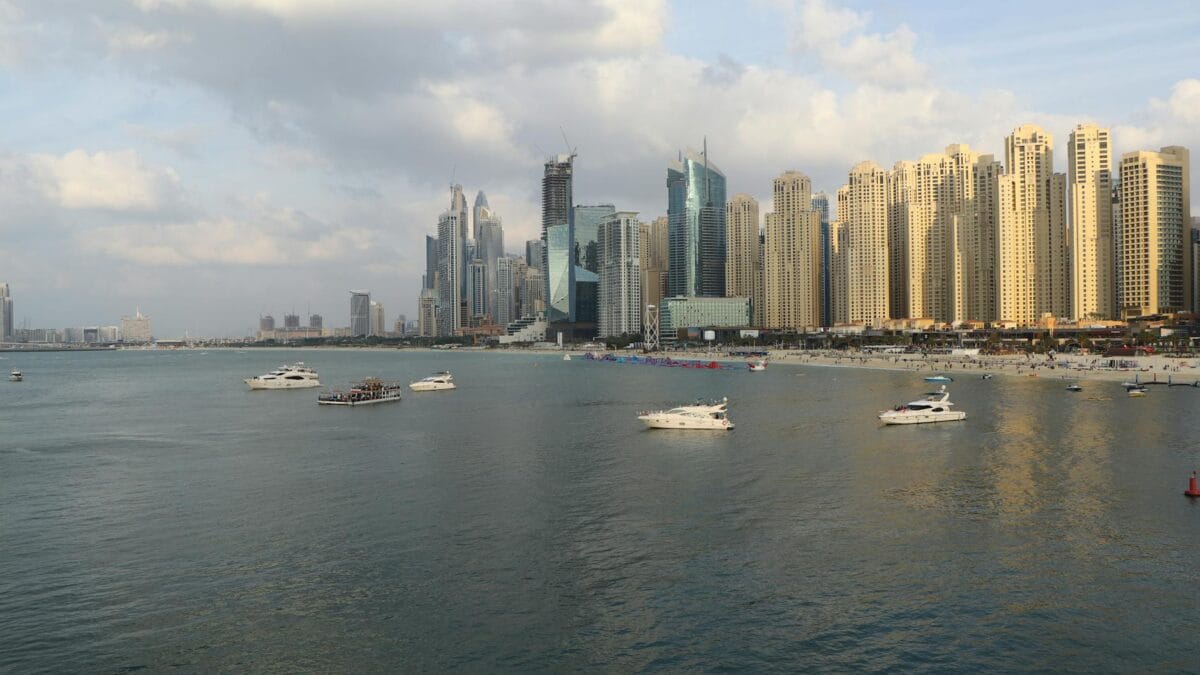
**Dubai Marina and JBR.** Dense, walkable, beach access. Lifestyle-driven, popular with young professionals and short-term renters. Traffic on Sheikh Zayed Road and Marina exits is intense at peak. One-bed: AED 110-180k. Two-bed: AED 160-260k.
**Downtown Dubai.** Burj Khalifa, Dubai Mall, financial proximity to DIFC. Premium prices, premium amenity, lower beach access. One-bed: AED 130-200k. Two-bed: AED 180-300k.
**Business Bay.** Cheaper than Downtown, very central, large young-professional population, building density. One-bed: AED 85-140k.
**JLT.** A long-standing expat favourite for value-conscious professionals. Walkable to Marina, Metro-connected. Studios: AED 55-85k. One-bed: AED 80-130k.
**Dubai Hills and Al Wasl/Jumeirah villas.** Family neighbourhoods with parks, schools, and lower-density villas/townhouses. Townhouses: AED 220-360k. Villas: AED 380-900k.
**Arabian Ranches, Mira, Mudon, Town Square.** Suburban villa communities, popular with families, longer commute to DIFC and the marina but excellent for schools and lifestyle. Townhouses: AED 180-320k. Villas: AED 280-650k.
**Palm Jumeirah.** Iconic, premium, beach-front. Apartments AED 200k+, villas AED 1m+.
**Mirdif, Al Barsha, Al Nahda.** Older, more affordable family areas, large South Asian and Arab expat populations.
**Dubai Silicon Oasis, JVC, JVT, Al Furjan, Dubai South.** Newer, lower-cost, growing communities favoured by first-time arrivals and remote workers.
The rule of thumb: pick by commute first, school second, lifestyle third. Trying to optimise all three in Dubai’s traffic geometry is the single most expensive mistake new arrivals make.
## Work Culture in Dubai
Working hours are governed by the 2022 Federal Labour Law and its 2024-2025 amendments. The standard work week is 48 hours over six days or 40 hours over five days, depending on contract. Friday is a half-day in the public sector and many private-sector firms, with Saturday and Sunday as the weekend in most companies. Ramadan reduces working hours by two per day for all employees regardless of religion. Annual leave is at least 30 calendar days after one year of service. Maternity leave is 60 days (45 fully paid, 15 at half pay). End-of-service gratuity is mandatory and calculated on basic salary.
Culturally, Dubai is one of the most cosmopolitan working environments on earth. English is the working language of almost every multinational and free-zone firm. Hierarchy matters more than in Northern Europe or North America but less than in much of Asia. Business hospitality — coffee, dates, sometimes lunch — is part of building relationships, particularly with Emirati and other GCC counterparts. Building local relationships matters: a Dubai career is built as much through wasta (relationships) as through CV.
## Tax and Banking
The UAE has no federal personal income tax. Salary is paid in full. The Federal Tax Authority introduced 9% corporate tax in June 2023, applicable to profits above AED 375,000; freelancers operating through a sole proprietorship or natural-person basis are generally exempt below the AED 1 million revenue threshold under the small-business relief regime in force in 2026. VAT remains 5% on most goods and services. Dubai charges a 5% municipality fee on rents, included in DEWA bills. There is a tourism dirham on hotel stays.
For banking, the major retail banks include Emirates NBD, FAB, Mashreq, ADCB, ENBD, HSBC, Standard Chartered, and Citi. Opening a salary account requires your Emirates ID, residency stamp, salary certificate from your employer, and proof of address (Ejari tenancy contract or utility bill). Most expats can open an account within 3-7 working days. Wio and other digital-only banks have eased account opening considerably. Mortgages are available up to 80% LTV for first-property purchases by residents up to AED 5 million, with 25-year terms. Personal-loan limits are 20 times monthly salary, regulated by the Central Bank.
## Schools by Nationality
Dubai has more than 220 private schools across 17 curricula. Choose by curriculum, fee tier, and KHDA rating (Outstanding, Very Good, Good, Acceptable, Weak). British-curriculum schools dominate the market and span the full price range from AED 18,000 to AED 130,000. American-curriculum and IB schools serve growing North American and international populations. Indian-curriculum schools educate the largest single national community in Dubai and offer outstanding value, with several schools achieving Outstanding KHDA ratings at fees under AED 25,000. French Lycée AEFE network is government-subsidised and excellent for francophone families. German and Swiss schools are smaller but high-quality. Arabic/MOE-curriculum schools are growing in number and quality and increasingly popular among Arab expat families wanting to preserve Arabic-language competence.
Application timelines: apply 6-12 months before the September academic year start. Most top-tier schools have waiting lists. Sibling priority is significant. KHDA assessments and entry tests are normal for primary and senior school entry.
## 30/60/90 Day Settling-In Checklist
**Days 1-30.** Enter on entry permit or visit visa. Complete medical fitness test (Smart Forms via Al Hosn, several centres, AED 250-500). Biometrics at GDRFA. Receive Emirates ID. Activate eSIM with du or Etisalat. Open temporary hotel-week stay if employer-provided housing isn’t ready. Book a real-estate agent for property viewings. Sign tenancy contract, pay deposit (5%) plus first cheque, register Ejari (mandatory tenancy registration with RERA), pay DEWA security deposit and activate utilities. Buy a Nol card.
**Days 31-60.** Open salary bank account with Emirates ID and salary certificate. Apply for driving licence — if you hold a licence from one of approximately 50 reciprocity countries (UK, EU, US, GCC, Australia, etc.), you can transfer directly with eye test and Emirates ID; otherwise, RTA driving school. Register children in school (admissions, KHDA). Set up Salik tag if you own a car. Get household contents insurance.
**Days 61-90.** Build local network — community Facebook groups, Internations, expat WhatsApp groups. Identify family doctor and paediatrician. Sign up for gym, sports clubs, and community amenities. Establish credit card if needed. Schedule a final tax-residency clarification with your home-country tax adviser; UAE will issue a Tax Residency Certificate after 180 days for residents who request one.
## Cultural and Legal Rules You Must Know
Dubai is more liberal than other GCC capitals but it is not Berlin or Brooklyn. The rules that catch expats out, every year, are these.
**Alcohol.** Available in licensed restaurants, hotels, and clubs to anyone over 21 with valid ID. Home consumption is legal for non-Muslims with no licence required since 2023, but possession in a vehicle requires a transport licence. Public drunkenness is a criminal offence.
**Ramadan.** Eating, drinking, and smoking in public during daylight hours is illegal for everyone, Muslim or not. Most restaurants serve takeaway only during daylight. Working hours are reduced for all. Live music in public spaces is restricted. Iftar, the breaking of fast at sunset, is a wonderful cultural experience widely shared with non-Muslims. Suhoor — the pre-dawn meal — is a popular hotel dining tradition.
**Public behaviour.** Public displays of affection beyond hand-holding can lead to fines or, rarely, deportation. Profanity, including on social media and rude gestures in traffic, is a criminal offence with fines and possible jail time. Photographing strangers without consent — particularly women and children — is illegal.
**Dress code.** Beachwear is fine on beaches and pools. In malls, government offices, and traditional areas, cover shoulders and knees. Friday prayers in mosques are open to non-Muslims under modest dress.
**Drugs.** Zero tolerance. Possession of even small amounts results in long custodial sentences. Some over-the-counter medicines in Europe (codeine, certain antihistamines) are controlled substances; check the MoH list before flying in.
**Cohabitation.** Decriminalised in November 2020 and not enforced against unmarried expat couples renting together.
## What Surprised Expats Most
We ran a small reader survey for this article. The top surprises, in order, were these. First, the speed of rent inflation since 2022 — many returners felt priced out of their old neighbourhoods. Second, the cost and competitive nature of school admissions, particularly for sought-after British schools. Third, the heat from June to September: 45°C+ days, humidity that can reach 80%, and the absolute necessity of indoor amenity. Fourth, the hidden costs of car ownership: Salik tolls add up, Dubai Police speeding fines are draconian, and parking in older neighbourhoods is genuinely difficult. Fifth, how good the public transport actually is: the Metro, RTA buses, and a Nol card cover a surprising portion of professional commuting. Sixth, how friendly the city is to female expats, both in safety terms and in career terms — Dubai has more women in C-suite roles in financial services than any other regional capital. Seventh, the diversity: with more than 200 nationalities, every cuisine, every prayer space, every cultural festival is within reach.
Dubai in 2026 is not the cheapest place to move and not the simplest. But it is the most efficient place in the Middle East to build a high-income, tax-free, internationally connected career, and the visa, banking, and lifestyle infrastructure has never been better. Plan the budget honestly, choose the neighbourhood by commute, and the city will reward you.
## A Realistic First-Year Budget Walkthrough
Let us walk through a concrete first-year budget for two representative households. These are not best-case or worst-case; they are honest mid-market 2026 numbers.
**Single 32-year-old marketing manager, AED 28,000 base salary, package value AED 38,000.**
– One-bedroom in JLT or Business Bay, AED 110,000 a year on annual contract: AED 9,167 per month.
– DEWA, internet, mobile: AED 1,100.
– Groceries (sensible Spinneys/Carrefour mix, some eating out): AED 2,500.
– Transport (Metro pass + occasional taxi/Careem, no car): AED 700.
– Health/gym/wellness: AED 600.
– Eating out, brunches, entertainment: AED 2,000.
– Travel home twice a year economy: AED 1,200 amortised monthly.
– Annual visa, insurance top-ups, sundries: AED 800.
– Total essentials and lifestyle: AED 18,067 per month.
– Savings target: AED 10,000-15,000 per month, banked offshore.
This is a financially strong single Dubai life. A bonus on top adds savings velocity. If this person upgrades to Marina or Downtown, add AED 4,000-7,000 to monthly rent and the savings rate halves.
**Family of four, two children aged 6 and 9, principal earner AED 65,000 base, package value AED 95,000 with allowances.**
– Three-bedroom townhouse in Mira or Town Square, AED 240,000 a year: AED 20,000 per month.
– DEWA, internet, mobile (multiple lines): AED 2,500.
– Groceries (family of four, mixed Spinneys/Carrefour/Waitrose): AED 5,500.
– Two children at a mid-tier British school: AED 65,000 each, AED 130,000 a year total: AED 10,834 per month.
– School transport: AED 1,500.
– One family car (leased, fuel, Salik, insurance): AED 4,500.
– Family health insurance top-ups beyond employer: AED 1,200.
– Domestic help (live-in or daily): AED 3,500.
– Family eating out, entertainment, weekend activities: AED 4,000.
– Annual flights for family of four economy/premium economy: AED 3,500 amortised.
– Sundries, school trips, uniforms, after-school activities: AED 2,500.
– Total essentials and lifestyle: AED 59,534 per month.
– Savings/investment target from the AED 35,000 surplus: AED 15,000-25,000.
This is, again, a financially strong family Dubai life — but tighter than the single equivalent, and the school fees are the dominant swing factor. Families who choose Indian-curriculum schools (where fees can be AED 25,000 per child rather than AED 65,000) reclaim AED 6,000+ per month immediately. Families who buy rather than rent face higher initial outlay but lock in housing cost.
## When Should You Buy Property?
This is the single most asked question by expats with 5+ year horizons. The honest 2026 answer: buy if you have a 7+ year time horizon and at least a 25% downpayment in cash, mortgage-ready credentials, and a clear understanding of total cost of ownership.
**The math.** Dubai property prices have appreciated significantly since 2020, with prime areas (Palm Jumeirah, Downtown, Emirates Hills) up 50-80%, mid-market areas (Dubai Hills, Arabian Ranches, Marina) up 25-45%, and value areas (JVC, Sports City, Discovery Gardens) up 10-25%. Rental yields are typically 5-7% net of service charges and maintenance. Mortgage rates in 2026 are roughly 4-5.5% for residents on dirham mortgages, with up to 80% LTV for first-property purchases up to AED 5 million and 75% LTV above that.
The break-even rent-versus-buy crossover for a typical Dubai expat at 2026 mortgage rates is approximately 7-9 years, longer for premium areas. If you plan to stay shorter, rent. If you plan to stay longer and have the downpayment, buying typically wins, particularly when service charges and Dubai Land Department transfer fees (4% one-off) are properly modelled.
**Golden Visa optionality.** Property worth AED 2 million qualifies a buyer for the Golden Visa, which has substantial value as an exit option from employer dependency.
## Healthcare in Dubai: A Quick Tour
The Dubai Health Authority (DHA) regulates a mostly private system that ranks among the world’s most modern. Top hospitals include Mediclinic City Hospital, American Hospital Dubai, Saudi German Hospital, Emirates Hospital, King’s College Hospital Dubai, NMC Royal, Aster, Zulekha, and the public Rashid Hospital and Latifa Women’s & Children’s Hospital. Mandatory employer insurance covers most employees; spouse and children must be insured separately or by the employer voluntarily. Family premium plans with global cover range AED 12,000-32,000 per adult and AED 6,000-15,000 per child. Emergency response is fast (Dubai Civil Defence and DHA ambulance services average sub-10-minute response times in central districts). Prescription and over-the-counter medication is available at private pharmacies; some medications routine in Europe (codeine, certain antihistamines) require prior approval. Dental and optometry are largely out-of-pocket or covered only at premium tiers.
## Pets and Domestic Help
Dubai is pet-friendly. Importing a dog or cat requires advance vaccination, microchipping, and entry permits from the Ministry of Climate Change and Environment; budget AED 2,500-5,000 plus quarantine and shipping. Veterinary care is excellent and expensive. Pet-friendly buildings exist in JLT, Marina, JVC, and most townhouse communities.
Domestic help is widely employed by expat families. A live-in housekeeper is AED 2,500-4,500 a month plus sponsorship costs (visa, medical, health insurance), or a daily/hourly arrangement through a Tadbeer agency at AED 35-50 an hour. The 2022 Federal Domestic Workers Law sets minimum standards, weekly rest days, paid annual leave, and end-of-service gratuity for domestic workers. Treat your domestic staff well; the legal and cultural framework demands it.
## Final Thoughts
Dubai in 2026 is one of the world’s most operational expat cities. The bureaucratic friction has fallen substantially since 2018, the visa system has matured, banking is fast, healthcare is excellent, schools are world-class if expensive, and the tax-free salary structure makes the financial calculus work for the right professional profile. The risks are predictable: rent inflation, school costs, summer heat, traffic, and the long-term geopolitical context of the wider Middle East. Manage those risks with eyes open and Dubai is, for most professionals at most career stages, an outstanding move.
## A Year in Dubai: Month-by-Month Lifestyle Guide
Dubai’s calendar shapes expat life in ways new arrivals do not anticipate. Here is what each month genuinely looks like.
**January and February.** The peak of Dubai’s outdoor season. Temperatures 18-26°C, low humidity, no rain. Tennis (Dubai Tennis Championships), golf (Slync.io Dubai Desert Classic, Hero Dubai Desert Classic), and the Dubai Shopping Festival fill the calendar. The Dubai International Boat Show, Gulfood, and other major B2B exhibitions run. Beach clubs are full. Brunches run every Saturday and Sunday.
**March.** Still excellent weather, slightly warmer. The Dubai World Cup horse-racing finale and many corporate offsites. School half-term coincides with peak outdoor activity for families.
**April.** Temperatures rising into the low 30s. The last fully outdoor month. Ramadan often falls in this window (it moves earlier by 11 days each year on the Gregorian calendar); 2026 Ramadan is February 17 to March 18, so April 2026 is post-Ramadan and into the run-up to summer.
**May.** Pre-summer transition. Temperatures 30-38°C. School year wraps up. Family summer-travel planning intensifies. Many expat families leave Dubai for the entirety of July and August.
**June, July, August.** The summer. Daytime temperatures regularly 42-48°C; humidity in July-August can be brutal on the coast. Indoor amenity becomes essential. Many businesses shift to summer hours. Schools are closed. Dubai Summer Surprises and Modhesh World provide indoor entertainment. Expat families with children typically travel home; single expats sometimes stay and treat it as quiet, cheap, work-focused time.
**September.** Transition back. Late September is still hot but the school year restarts and corporate Dubai returns from leave.
**October.** Weather returns to pleasant. GITEX Global, the largest tech exhibition in the Middle East, anchors the October corporate calendar.
**November.** Excellent weather. Dubai Air Show (biennial), Dubai Design Week, Dubai International Film Festival, and the National Day celebrations on December 2 ramp up. Tourism volumes climb sharply.
**December.** Peak tourist season. Dubai Marathon, Dubai International Film Festival, Christmas (celebrated openly in hotels and shopping malls; not a public holiday), New Year’s Eve fireworks at Burj Khalifa and Atlantis. Restaurants are fully booked weeks ahead.
Understanding the calendar matters for property leasing (October-November are the toughest months to find rental properties; July-August are the easiest), for travel planning, and for setting realistic family expectations about what life will feel like through the year.
## Common Mistakes New Expats Make
1. **Underestimating school-fee inflation.** Fees rise 3-7% per year; build that into multi-year planning.
2. **Choosing a neighbourhood by lifestyle, then commuting two hours daily.** Marina-DIFC commute by car in peak traffic can exceed 90 minutes each way.
3. **Buying a luxury car immediately.** Wait six months. Used cars depreciate slower than new and the visa-paperwork timeline does not benefit from rushed financing.
4. **Not registering Ejari immediately.** Without Ejari you cannot complete DEWA, get an Etisalat/du contract, or apply for school. Register day one.
5. **Ignoring annual contract cycle.** Dubai rents lock in for one year. If you sign in July, your renewal will fall in July’s market — historically a lower-price window — for the duration of your tenancy. Time your lease start strategically.
6. **Failing to negotiate fixed-cheque rent.** Most landlords will accept 2 or 4 cheques rather than the asked 1. Negotiate hard.
7. **Over-spending on furniture in month one.** The IKEA, Home Centre, Pottery Barn, West Elm option works for 90% of needs.
8. **Treating brunches as routine.** AED 750 brunches every weekend will hollow out the most generous package.
9. **Missing the gratuity calculation.** Pre-read your contract for whether gratuity is on basic salary, total cash, or total package. Renegotiate before signing if needed.
10. **Ignoring exit planning.** Dubai is a high-savings city if you plan it. Have a target savings rate (we suggest 30-40% of gross for a senior single, 15-25% for a family), an exit horizon (most expats stay 4-8 years), and a deployment plan for what those savings buy when you leave.
## What Dubai Surprises Most: Three Themes
Over dozens of expat conversations for this article, three themes recurred in what surprised people most about Dubai after arriving.
**The first was the quality of public infrastructure.** Roads, public transport, the airports, the hospitals, government e-services. Compared with much of Europe or North America, Dubai’s daily-use public infrastructure is dramatically newer and more functional. Government services through the UAE Pass app, GDRFA’s smart visa processes, RTA’s metro and bus systems, and the speed of utility activation all consistently beat expectations.
**The second was the demographic diversity at work and in friendship circles.** With 200+ nationalities present, an average professional Dubai workplace can include colleagues from a dozen countries. Friend groups become genuinely international. For many expats this becomes one of the most enduring positive memories of the Dubai years.
**The third was the speed of life and the work intensity.** Dubai professionalism is high-tempo. Hours can be long, the cultural emphasis on responsiveness is intense, and the social calendar adds further demands. Burnout is a real risk; setting boundaries and taking the regional travel that the geography enables (Oman, Sri Lanka, Maldives, Kenya, Georgia, Jordan are all 2-5 hour flights) is the most common protective behaviour.