Dubai real estate enters 2026 in its fourth straight year of structural growth, and the question facing every prospective buyer — whether a first-time investor with a $500,000 budget or a family office allocating $50 million — is no longer whether Dubai is a credible global property market, but where in this market the risk-adjusted return still makes sense. Reuters reporting at reuters.com/markets and Bloomberg’s Middle East desk at bloomberg.com/middle-east have tracked the city’s transformation from a regional hub into one of the three or four most active luxury property markets in the world. This pillar guide pulls together everything a foreign investor needs in April 2026: market structure, district economics, foreign ownership, off-plan versus ready, mortgage access, taxation, the Golden Visa, the Dubai Land Department transaction process, and the specific risks that the consensus narrative tends to underplay.
The headline numbers explain why the world is paying attention. The Dubai Land Department (DLD) registered approximately 215,000 transactions in 2025, up from 133,000 in 2022 — a 60% volume expansion in three years. Total transaction value crossed AED 760 billion in 2025. Off-plan share of volume reached 65% in 2025 versus 40% in 2022, and the foreign share of buyers sits near 58%, dominated by Russian, Indian, British, Chinese, and Pakistani capital. Coverage from ft.com and Arabian Business real estate has put April 2026 transaction data in the context of the cycle, where price growth has cooled from 25% peaks in 2022-2023 to a steadier 4-8% year-over-year — a healthier pace, but one that leaves less margin for late-cycle off-plan mistakes.
Why Dubai Property Still Compels Foreign Capital
The structural case for Dubai property has not changed. The United Arab Emirates levies no personal income tax, no capital gains tax on property held in personal name, and (with limited exceptions for new corporate-tax rules) no inheritance tax on most estates structured properly. The dirham is pegged to the U.S. dollar at 3.6725 — a peg in continuous operation since November 1997. For dollar-based investors this eliminates the currency-translation drag that erodes London, Lisbon, or Tokyo property returns. For investors operating in soft currencies — Egyptian pound, Pakistani rupee, Russian ruble after 2022 — the dollar peg is itself the asset.

Then there is the Golden Visa. A property purchase of AED 2 million (roughly $545,000 at 3.67) qualifies the buyer and immediate family for a 10-year renewable residency. There is no salary minimum once the visa is held, no requirement to remain physically in the UAE the way Schengen residencies demand. For high-net-worth families looking for an optionality jurisdiction — somewhere to land if home becomes uncomfortable — Dubai’s Golden Visa is among the cleanest routes available globally. Our deeper coverage at the UAE Golden Visa property guide walks through the application mechanics, family sponsorship rules, and the AED 2 million threshold tests.
The third pillar is yield. Across mature global cities — London, New York, Paris, Hong Kong — gross rental yields on prime residential have compressed below 3%. Dubai’s mature districts deliver 5-8% gross, with secondary districts reaching 7-9% before service charges. Even after subtracting realistic operating costs, the net yield comparison remains decisively in Dubai’s favor. The reasons are durable: Dubai imports its tenant base from a global expatriate population that turns over rapidly, supports premium rents on furnished units, and has an active short-stay regulatory framework that allows licensed Airbnb-style operations.
The Major Districts at a Glance
Dubai is not a single market. It is a portfolio of distinct sub-markets with very different price points, tenant demographics, and yield characteristics. Foreign buyers who lose money in Dubai usually do so by treating “Dubai” as a single decision rather than recognising that buying in International City carries almost nothing in common with buying on Palm Jumeirah. For square-footage benchmarks across districts, our Dubai property price per sqft April 2026 piece goes deeper. For yield specifics see Dubai rental yield by district 2026.
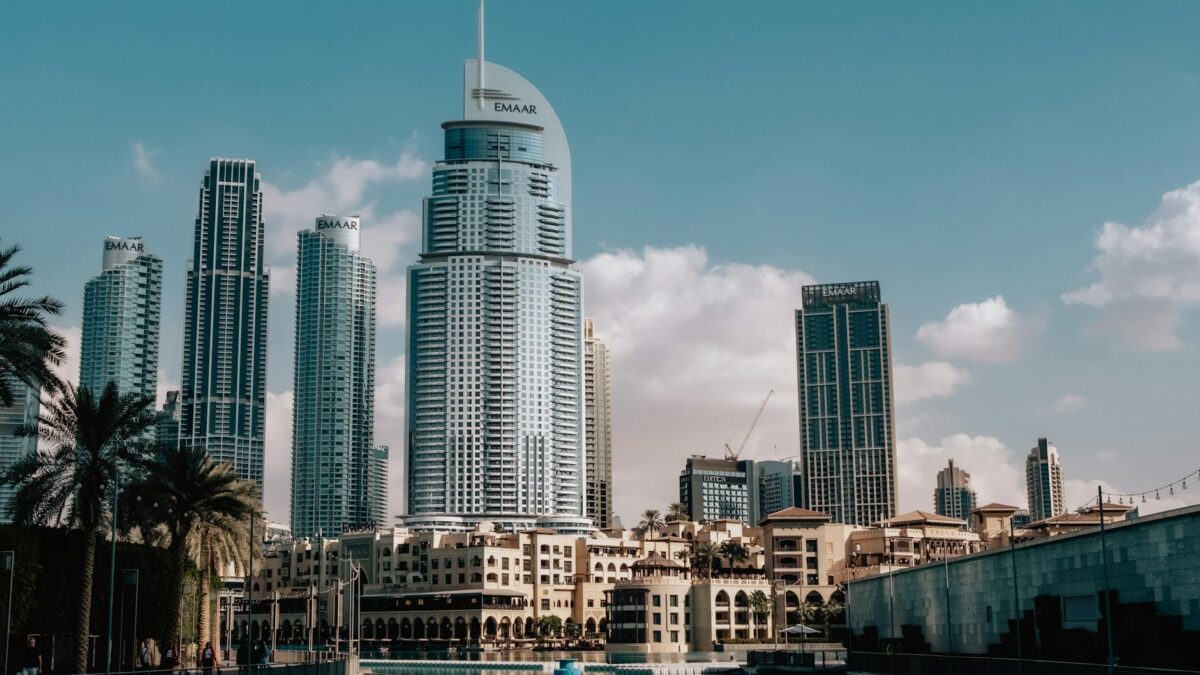
Downtown Dubai — the Burj Khalifa cluster — anchors the premium segment at AED 1,800-2,400 per square foot for ready inventory, with gross yields around 5.0-5.5%. Tenant demand is split between corporate executives on company-paid housing budgets and high-end short-stay tourists. Capital-appreciation history is strong but vacancy risk on the absolute top end has crept up.
Dubai Marina remains the most liquid premium market. Ready 1-2 bedroom apartments trade AED 1,650-1,950 per square foot with yields of 5.8-6.5%. The waterfront walking strip, restaurant density, and Tram-Metro connectivity sustain a deep tenant pool of mid-to-senior expatriate professionals. JBR (Jumeirah Beach Residence) sits adjacent and pulls 6.5-7.0% yields on slightly older stock with strong holiday-let economics.
Palm Jumeirah is the ultra-premium segment. Apartments trade AED 3,200-4,500+ per square foot; signature villas have crossed AED 8,000-10,000 per square foot in 2025. Yields are lower (4.5-5.2%) because the asset is bought largely for trophy appeal and capital preservation rather than cash flow.
DIFC functions as the financial-district premium — small apartment stock, very tight rental supply, tenants drawn from finance and law. Business Bay sits adjacent to Downtown with newer towers, AED 1,400-1,750 per square foot, yields 6.0-6.5%. JLT (Jumeirah Lake Towers) is mid-tier mature stock, 6.5-7.2% yields, and probably the best risk-adjusted central yield play.
Dubai Hills Estate serves the family-villa premium segment with townhouses and villas at AED 1,400-2,000 per square foot and yields of 5.5-6.2%. JVC (Jumeirah Village Circle), Arjan, Al Furjan, and Discovery Gardens form the affordable yield tier — apartment prices AED 900-1,200 per square foot, gross yields of 6.8-7.8%. These are the workhorses of foreign-buyer cash-flow portfolios. Our best Dubai areas under $500K 2026 guide breaks down the sub-$500K stock specifically.
Dubai South (the Expo legacy site) is the emerging frontier — lower entry prices, larger off-plan discounts, but longer time horizons before infrastructure matures. International City we flag with caution: nominal yields of 7.5-9% look attractive on paper, but vacancy risk and aging stock mean realised returns trail nominal yields by an uncomfortable margin.
Foreign Ownership: How It Actually Works
Dubai’s foreign-ownership framework was established in 2002 with the freehold designation system. Inside designated freehold zones — which now cover essentially every district a foreign investor would consider — non-Emiratis may hold 100% freehold title in their personal name with no nationality restriction. The Dubai Land Department records every transaction and issues an electronic title deed accessible through the Dubai REST mobile application.
Outside freehold zones — primarily older parts of Bur Dubai and Deira — leasehold structures of 30-99 years apply, and these are rarely the right vehicle for foreign-investor purposes. Practically every property a typical investor evaluates is freehold and will produce a clean title deed in personal name within four to six weeks of transaction completion.
Ownership can be held individually, jointly between spouses, by a UAE-registered LLC, or by an offshore holding company (Cayman, BVI, JAFZA Offshore, RAK ICC). For single-property buyers, individual ownership is simplest and cheapest. For investors building multi-property portfolios, an offshore or JAFZA holding structure can simplify estate planning and consolidate insurance.
Off-Plan Versus Ready: The Defining Choice
Off-plan property — purchased from the developer before construction is complete — represented 65% of 2025 transactions. Buyers receive a 15-30% discount to comparable ready stock, payment plans spread across 2-5 years, and the option to ride mid-construction price appreciation. The downside is construction risk: delays of 6-24 months are common, specifications can drift, and market conditions during the multi-year construction window can shift adversely.
Ready property settles in 2-4 weeks, produces rental income from day one, and lets the buyer physically inspect the asset and verify actual service charges. The price premium reflects that certainty. Our full piece on Dubai off-plan vs ready property 2026 walks the trade-off in detail. The headline guidance for 2026: first-time Dubai buyers should default to ready in mature districts; experienced investors with multi-year horizons can extract value from off-plan but only with top-tier developers (Emaar, Damac, Nakheel, Meraas, Sobha) and only after careful due diligence on the project-specific track record.
Mortgages for Foreign Buyers
UAE banking regulation caps loan-to-value at 80% for Emirati nationals on first homes, 75% for resident expats, and 50-75% for non-resident foreign buyers depending on property value, buyer profile, and lender. Headline mortgage rates in April 2026 sit at 5.0-6.5% for foreign buyers, with terms of 15-25 years. Emirates NBD, Mashreq, First Abu Dhabi Bank (FAB), and HSBC UAE are the dominant lenders to international buyers; Standard Chartered and Dubai Islamic Bank also have active foreign-buyer programmes. Our Dubai mortgage guide for foreigners 2026 lays out the documentation, salary multiples, and approval timelines.
Roughly 60% of Dubai property transactions still settle entirely in cash. Foreign cash buyers benefit from faster closings (2-4 weeks versus 4-8 weeks for mortgaged purchases), avoid valuation gaps, and tend to extract better negotiated terms. For non-resident buyers, the documentation burden of securing a UAE mortgage from outside the country is meaningful — three to six months of bank statements, salary verification with apostille, source-of-funds declaration — and many international buyers conclude that financing the deposit-equivalent at home and paying cash in Dubai is simpler than clearing UAE underwriting.
Service Charges and Hidden Costs
Headline yield numbers always overstate net economics. Real costs come from four buckets. First, annual service charges run AED 8-25 per square foot depending on district, building age, and amenity load — Palm Jumeirah and Downtown towers sit at the high end; JLT and JVC mid-tier; older Discovery Gardens and International City at the low end. A 1,000-square-foot apartment in Marina at AED 16 per square foot pays AED 16,000 annually in service charges before any other expense.
Second, the DLD transfer fee is 4% of purchase price, conventionally split between buyer and seller (2% each) on resale transactions but borne entirely by the buyer on developer purchases. Third, agent commission is typically 2% of purchase price plus 5% VAT. Fourth, there are NOC fees from the developer (AED 500-5,000), trustee fees at the DLD (AED 2,000-4,000 typical), and mortgage registration if applicable (0.25% of loan value plus AED 290 admin).
For ongoing operations, foreign owners should also model property management fees (5-10% of annual rent for full management), DEWA (utilities) connection deposits, and chiller/cooling charges — district cooling can add AED 5,000-15,000 annually for premium apartments and is sometimes contracted separately from the main electricity supply. None of this kills the investment thesis, but it converts a 7% gross yield in JVC into a 5.5-6% net yield, and a 5.5% gross yield in Downtown into a 4.0-4.5% net yield. Plan around the net number.
The Rental Market: Long, Short, and the RERA Calculator
Dubai’s residential rental market splits into three modes. Long-term annual leases — paid quarterly, sometimes biannually, occasionally with a single annual cheque for premium tenants — remain the default. Short-term licensed holiday rentals (Airbnb, Booking.com, Vrbo) are growing fast in Marina, Downtown, JBR, and Palm; they require a Dubai DET (Department of Economy and Tourism) holiday-home licence, which is permit-based and relatively straightforward but carries real compliance overhead. Corporate leases — typically 6-24 months for relocating executives — bridge the two.
Rent increases on existing tenancies are governed by the RERA Rental Index. The official rent calculator caps annual increases based on how far below market rent the existing rent sits — a tenant paying significantly below market can see legal increases of 10-20%, while a tenant near market is protected from any meaningful rise. This is critical for foreign owners who buy occupied property: the cap on rent increases binds even after change of ownership. Our RERA rent calculator 2026 explainer walks through how to model the cap before you bid on a tenanted unit.
Tenant rights in Dubai are significant by regional standards. Eviction requires either non-payment, owner self-occupation (with 12 months written notice), or sale to a third party who self-occupies (12 months notice). Speculative eviction to re-let at higher rent is not legal. Foreign landlords frustrated by Western standards of landlord control often underestimate the real friction in vacating an occupied unit.
The Golden Visa Pathway
The property-linked Golden Visa is the single most powerful demand driver for the AED 2 million-and-above price segment. The mechanics: purchase a property in personal name with declared value at or above AED 2 million (DLD valuation, not just contract price). One property or up to three properties summed. Mortgaged property qualifies provided buyer has paid in at least AED 2 million or owns the property free of encumbrance up to that threshold. Application is filed through the Federal Authority for Identity, Citizenship, Customs and Port Security (ICP) or the Dubai General Directorate of Residency and Foreigners Affairs (GDRFA).
The visa is 10 years renewable. Family sponsorship covers spouse, dependent children of any age (versus the standard residency cut-off at 18), and parents in some cases. There is no salary minimum once the visa is held, no minimum physical presence requirement (versus six-month rules under standard residence visas), and no path to citizenship — but no expectation of one either. For tax-residence planning, a Golden Visa holder can spend 90+ days physically in the UAE and break tax residence elsewhere with appropriate planning.
Recent 2025-2026 Cycle Dynamics
The pace of price growth has clearly moderated. The 2022-2023 surge of 20-25% year-over-year in prime districts has cooled to 4-8% in most of 2025 and into Q1 2026. The supply pipeline tells the story: roughly 90,000 units are scheduled for delivery between 2026 and 2028, the heaviest delivery wave Dubai has seen since 2019. New off-plan launches in Q1 2026 ran 22 projects versus 31 in Q1 2025 — developers themselves are pacing supply against absorption signals.
Affordability stress is the other visible feature. Local salaries have not kept pace with rental and purchase prices. Emirati and resident-expat first-time buyers in mid-tier districts increasingly find ownership economics challenging. The market remains supported, however, by net-positive international migration: Dubai’s population added more than 100,000 residents in 2025 alone, and the flow from Russia, India, the UK, and continental Europe shows no immediate sign of reversing.
Tax Considerations by Buyer Origin
The headline “no tax in Dubai” is true at the UAE end. The home-country tax position is far more nuanced.
U.S. buyers remain subject to worldwide taxation regardless of where they live or where the property sits. Rental income is U.S.-taxable; capital gains on sale are U.S.-taxable; the property itself triggers Foreign Bank Account Report (FBAR) and FATCA reporting if held through any foreign account or entity. Dubai property held in personal name does not trigger FBAR by itself, but rental-collection bank accounts in the UAE do once balances cross $10,000.
UK buyers face a more complex regime since the April 2025 abolition of the non-domiciled tax status. Foreign rental income is now UK-taxable for almost all UK residents; capital gains on UK-resident sellers are UK-taxable; inheritance tax on worldwide assets applies to UK domiciles. The Dubai dollar-yield advantage remains real, but the UK-tax overhead on the income stream is materially higher than it was pre-2025.
Singapore and Hong Kong buyers operate under territorial tax systems — foreign-sourced property income and capital gains are generally clean of home-country tax provided the income is not remitted in a tax-relevant manner. This makes Dubai property particularly efficient for Asia-Pacific HNW buyers, and it shows in the transaction data: Singaporean and Hong Kong-resident purchases have grown 35% year-on-year in 2025.
Indian buyers are bound by the Liberalised Remittance Scheme (LRS), which caps annual outward remittance at $250,000 per person, and by FEMA reporting requirements. Indian families typically structure Dubai purchases across multiple family members or over multiple years to stay within LRS limits, and disclose the foreign asset annually under the Black Money Act.
Russian buyers can still hold Dubai property post-2022 sanctions — the UAE has not joined the Western sanctions regime — but secondary banking scrutiny has tightened materially. UAE banks now apply enhanced due diligence on Russian-origin funds, source-of-wealth documentation requirements have lengthened, and some banks decline new accounts for sanctioned-jurisdiction clients altogether. The property itself is unaffected; the cash logistics around it are harder.
Risks the Consensus Underplays
Four risks deserve more weight than the optimistic side of the consensus assigns them.
First, late-cycle dynamics. Dubai property has now run hard for four straight years. Historical Dubai cycles have shown peak-to-trough drawdowns of 30-40% (2008-2011, 2014-2017). The current cycle has not corrected meaningfully. That does not guarantee a near-term correction, but it does mean late-2026 and 2027 buyers are less protected by trend than 2022 buyers were.
Second, supply-pipeline pressure. The 90,000-unit pipeline for 2026-2028 will arrive whether or not demand keeps pace. Districts with the heaviest pipeline (Dubai South, Mohammed Bin Rashid City, parts of Business Bay) face the most acute pricing risk; mature, supply-constrained districts (Downtown, Marina core, Palm) are more insulated.
Third, interest-rate volatility. UAE rates broadly track U.S. Fed policy through the dollar peg. A renewed U.S. tightening cycle — driven by inflation, fiscal pressure, or any factor not currently in consensus — would lift UAE mortgage rates and stress the sub-segment of the market that is genuinely leveraged.
Fourth, geopolitical tail risk. The UAE has navigated regional tensions (Iran, Houthi attacks on shipping, Israel-Hamas, Lebanon-Israel) with admirable composure, but the tail does exist. A serious Strait of Hormuz incident, a direct strike on UAE infrastructure, or a sustained escalation involving Iran would reprice Gulf real estate in ways that no spreadsheet model captures. The dirham-dollar peg has held since 1997 and the Central Bank’s reserves are ample, but theoretical de-peg risk is non-zero in true crisis scenarios.
Specific Scenarios for Typical Buyers
It helps to ground the abstract in concrete buyer profiles.
The $500,000 buyer is shopping JVC, Arjan, Al Furjan, or Discovery Gardens — studio or 1-bedroom apartments at AED 850-1,200 per square foot, 600-900 square feet of usable space, gross yields of 7.0-7.8%, net yields of 5.5-6.0%. This is the workhorse income-property tier. It does not qualify for Golden Visa solo, but two such properties summed do.
The $1 million buyer can choose between a Marina 1-bedroom (smaller but in a premium district), a Business Bay 2-bedroom (larger, slightly lower yield), or two affordable-tier units in JVC/Arjan diversified across two buildings. The Marina single unit has stronger capital-appreciation history; the JVC pair has stronger income economics.
The $2 million buyer sits at the Golden Visa threshold and now has the pathway tax-residence optionality on top of the property economics. Choices include a Downtown 2-bedroom with views, a Marina premium unit, a Dubai Hills townhouse, or a Palm Jumeirah apartment in a non-signature tower. The visa overlay typically shifts buyers toward the higher-quality end of comparable stock — better to be at the AED 2.2 million level than AED 1.95 million for clean visa qualification.
The $5 million-plus buyer enters Palm Jumeirah villa territory — the smaller signature-tower villas, the larger non-signature villas, or the emerging Tilal Al Ghaf and Damac Hills 2 luxury inventory. A Downtown 4-bedroom penthouse with Burj views also sits at this level.
The $10 million-plus buyer shops the Palm Jumeirah signature villas (Frond M, Frond N, the Atlantis-side fronds), the Bvlgari Resort & Residences on Jumeira Bay Island, the Bulgari villas on Jumeirah Bay, the One&Only Royal Mirage residences, and the emerging Como and Ritz-Carlton branded residences. These trade as much for trophy value as for property fundamentals.
The Foreign-Buyer Process, Step by Step
The actual transaction process for a foreign buyer is more transparent than most international markets. The steps:
1. Pre-research. Property Finder, Bayut, and dubizzle aggregate listings; Bloomberg’s Middle East coverage and Reuters markets provide macro context; the Dubai REST app gives DLD-verified data on every registered building.
2. Visit Dubai. Strongly recommended. Fly in for 4-7 days, view 15-25 properties across 3-5 districts, attend at least two new-launch off-plan presentations to calibrate developer pricing.
3. Engage a RERA-licensed agent. Verify the broker’s RERA card on the Dubai REST app. The agent fee (2% plus VAT) is universal; there is no benefit to working with non-licensed brokers.
4. Select property and submit Form F (the offer-to-purchase document). A small deposit (AED 10,000-50,000 typical) is held in trust during due diligence.
5. Developer NOC (No Objection Certificate). For resale transactions, the developer issues an NOC confirming service charges are clear and there are no outstanding liens.
6. DLD registration appointment. Both parties or their authorised representatives attend a DLD trustee office. The transfer fee is paid; the title deed is issued electronically.
7. Title transfer. For ready property, the new title deed is issued in 24-72 hours. For off-plan, the buyer initially receives an Oqood (initial registration), upgraded to a full title deed at completion.
8. Move in or rent out. DEWA connection (utilities), Ejari registration (the rental-contract registry for tenants), property management engagement if absentee.
Essential Resources
Every Dubai foreign buyer should bookmark: the Dubai Land Department (DLD) main site for transaction-data transparency; RERA for broker verification and rental-index data; the Dubai REST app (mobile) for title-deed lookup, building data, and DLD service requests; Property Finder, Bayut, and dubizzle for live listings; the DLD’s approved valuers list for independent property valuation. For ongoing market intelligence, Reuters at reuters.com/markets, Bloomberg Middle East, the Financial Times property desk, and Arabian Business real estate are the four sources every serious Dubai investor reads weekly.
The 2026 Bottom Line
Dubai real estate in April 2026 sits in a defensible mid-to-late-cycle position. Price growth has moderated from unsustainable 2022-2023 levels to a healthier 4-8% pace. Yields remain among the highest in any global tier-one property market. Foreign-ownership rules are clear, the transaction infrastructure is digital and transparent, and the Golden Visa overlay continues to import demand at the AED 2 million-and-above tier. The market is not cheap — but it is not euphoric either.
For first-time foreign buyers, the playbook is unchanged: ready property in mature districts, conservative leverage, mature-developer credit, and a holding period long enough to ride through any cyclical correction. JVC, JLT, Marina, and Dubai Hills offer the cleanest entry points. Palm Jumeirah and Downtown remain the trophy plays for buyers prioritising capital preservation over yield. Off-plan opportunity exists but should be approached with sharper due diligence than was needed in 2022-2023, when the rising tide forgave a great many imperfect decisions.
The structural argument — zero income tax, dollar peg, Golden Visa optionality, deep tenant pool, transparent legal infrastructure — has not weakened. The cyclical argument — entering year four of growth with a heavy supply pipeline ahead — argues for selectivity. Buy good assets, in good districts, from good sponsors, at sensible prices. That has always been the formula. In Dubai 2026, it matters more than it did in 2022.
How Dubai Compares With Other Global Property Hubs
The case for Dubai real estate is sharpest when set against the alternatives international capital actually considers. London prime central yields have compressed to 2.5-3.0% gross, and post-2025 non-dom changes have lifted the UK tax overhead on foreign-resident landlords. New York condo yields run 2.5-3.5% with high property tax and the perpetual question of city fiscal health. Paris and Lisbon yield 3-4% with strict rent regulation. Singapore and Hong Kong, the closest comparable Asian hubs, deliver 2.5-3.0% with cooling-measure stamp duties of 30-65% on foreign buyers. Against this backdrop, a 5-7% Dubai gross yield in a freehold zone with no foreign-buyer surcharge and a dollar-pegged currency is genuinely differentiated.
The closest like-for-like rival is Miami, which offers comparable tax efficiency for non-U.S. residents under specific structures, similar climate, and similar luxury-branded residence inventory. Miami yields run 4-5% on prime stock, slightly behind Dubai, with hurricane-insurance and HOA-fee structures that are roughly the equivalent of Dubai service charges in cost terms. The choice between Miami and Dubai is increasingly a choice between U.S. legal infrastructure with U.S. tax exposure for resident buyers, versus UAE infrastructure with cleaner home-country tax outcomes for most non-U.S. residents.
Currency Mechanics and the Dollar Peg
The AED-USD peg at 3.6725 has held since November 1997. The UAE Central Bank maintains the peg through active intervention and substantial foreign-currency reserves — over $200 billion as of late 2025. The peg has weathered the 2008 global financial crisis, the 2014-2016 oil collapse, the 2020 pandemic, and the 2022 dollar-strength cycle. For foreign buyers thinking in dollars, this means the dirham property purchase is functionally a dollar property purchase. For buyers thinking in euros, sterling, or yen, currency risk runs through the dollar leg, not the dirham leg.
Theoretical de-peg risk exists but is small. Saudi Arabia, Bahrain, Qatar, and Oman maintain similar dollar pegs and would face equivalent pressure simultaneously. The political commitment to the peg is exceptionally durable. The most plausible scenario for de-pegging would be a multi-year U.S. inflation shock so severe that the peg becomes domestically inflationary for the UAE — a scenario that has not yet materialised in any cycle since 1997.
The Property Management and Absentee-Owner Reality
For foreign buyers who do not relocate to Dubai, property management is the most underestimated practical issue. Full-service management runs 5-10% of annual rent, covers tenant placement, rent collection, maintenance coordination, and DLD-Ejari compliance. Lighter packages — tenant placement only, or rent collection only — run 4-6 weeks of annual rent as one-off fees. Self-management from abroad is technically possible but rarely advisable; the time-zone mismatch, language frictions, and physical-presence requirements for some maintenance and DEWA issues make it operationally difficult.
Quality of management firms varies widely. Top-tier firms (Asteco, CBRE, Savills, Better Homes, JLL Residential) offer institutional-grade reporting, English and Arabic support, and direct relationships with the major developers for service-charge dispute handling. Smaller boutique firms can offer more responsive service but with thinner backstop when problems escalate. Reference-checking from prior owners is the single best diligence step for selecting a manager.
Specific 2026 Headwinds Worth Watching
Three specific 2026 dynamics deserve close monitoring beyond the structural points already covered. First, the Federal Tax Authority’s corporate-tax regime, fully effective from June 2023, is in its third year of practical application. Foreign property holding through UAE LLC structures now triggers UAE corporate tax exposure on rental income above the AED 375,000 threshold. Personal-name ownership remains tax-free, but portfolio investors using corporate structures are seeing tax overhead they did not face in 2022.
Second, mortgage-rate dispersion is rising. The headline 5.0-6.5% range hides material variation by buyer profile. Top-tier resident expat buyers with strong UAE banking relationships can secure 4.5-5.0%; non-resident foreign buyers without local banking history pay 6.0-7.0%. The gap matters for the leverage-economic decision and is widening as banks differentiate risk more sharply.
Third, the secondary-market resale dynamics in 2026 are showing earlier signs of bifurcation. Premium districts continue to clear at or above asking. Mid-tier districts are seeing extended marketing periods (60-90 days versus 30-45 days in 2024) and occasional price reductions of 3-7% on resale. Affordable-tier districts remain liquid but sellers are no longer holding out for the full 2025 peak prices. This is normal late-cycle behaviour and should be priced into purchase decisions accordingly.