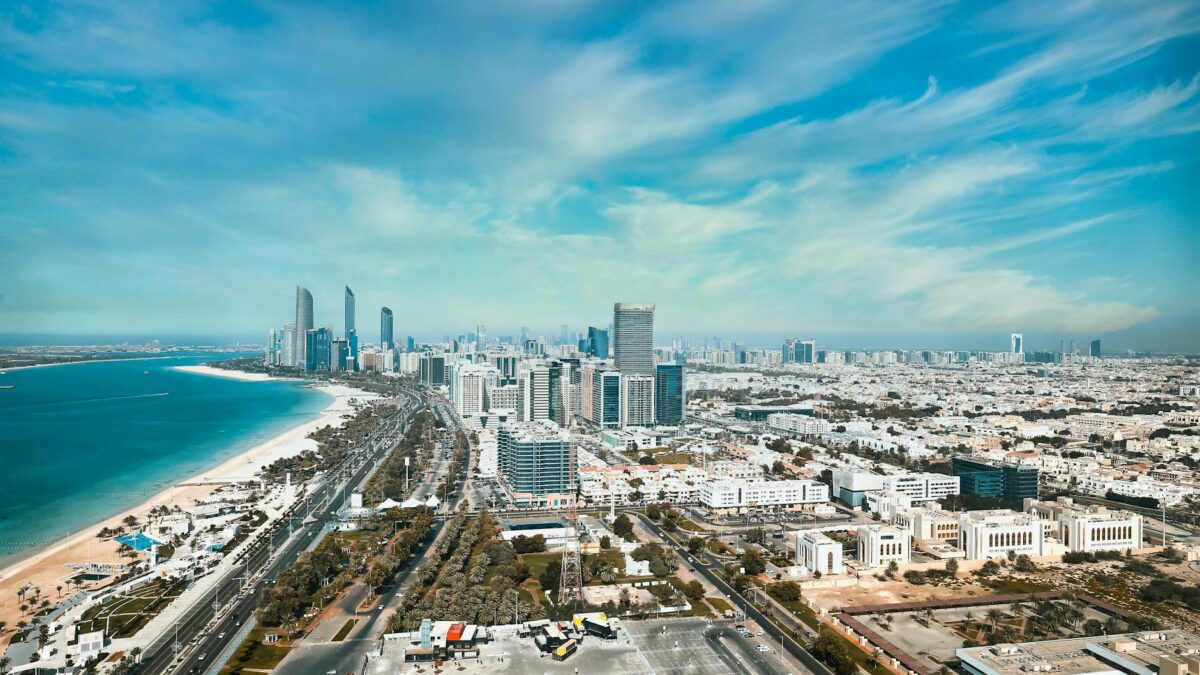
Abu Dhabi in April 2026 is no longer Dubai’s quieter neighbour. The capital’s residential property market is running through a real acceleration — roughly 8,000 units are scheduled for delivery by Aldar Properties alone during 2026 according to the developer’s Q4 2025 investor day, another 12,000 are locked in for 2027, and foreign buyer participation inside the designated Investment Zones has climbed materially since the emirate opened full freehold ownership to non-Emiratis under Law No. 13 of 2019. The headline numbers still sit below Dubai, but that is precisely the point. For American, British, Singaporean, Hong Kong, and Gulf buyers who have spent the past three years watching Dubai compound at 15-25 percent annual capital gains and who are now staring at a mature, cooling Dubai market, Abu Dhabi is the call option the Gulf property story has kept in reserve.
This guide maps every meaningful foreign-ownership freehold zone in Abu Dhabi as of April 2026 — price per square foot, rental yield, supply pipeline, developer concentration, Golden Visa qualification, and the honest risks buyers should pressure-test before wiring funds. It is written for the non-resident investor deciding whether to deploy into Saadiyat Island, Yas Island, Al Reem Island, Al Raha Beach, Al Maryah Island, or one of the emerging value zones further out from the CBD. The comparison against Dubai is explicit, the approved-developer concentration risks are flagged, and the mortgage and tax mechanics are laid out at the level a foreign buyer actually needs.
The Legal Framework: Law No. 13/2019 and the Investment Zones
Before 2019, foreign property ownership in Abu Dhabi was structurally narrower than in Dubai. Non-GCC nationals could lease for up to 99 years inside a small number of Investment Zones, could hold musataha (usufruct) rights allowing them to build and occupy for a defined term, and could take surface rights on specific plots — but the underlying freehold title stayed in Emirati hands. Dubai, by contrast, had opened true foreign freehold back in 2002 via Regulation No. 3/2006 and the freehold regime had been the backbone of its twenty-year property boom.

Abu Dhabi Law No. 13 of 2019 closed that gap. The law, expanded by amendments in 2022, established that non-UAE nationals can hold full freehold title inside designated Investment Zones — meaning full ownership of the unit and its share of the land, with no time limit, transferable, mortgageable, and inheritable under standard UAE succession rules. Outside Investment Zones, the 99-year leasehold and musataha regimes remain the only foreign entry. Within them, foreign buyers have the same ownership rights as Emirati citizens with minor administrative differences.
Reporting by Reuters Middle East tracked the 2019 opening as a structural pivot for the emirate, and subsequent Bloomberg Middle East coverage has chronicled how Aldar Properties — the dominant master developer in Abu Dhabi — has concentrated new residential launches almost entirely inside Investment Zones to capture the foreign-buyer mix. Analysis from the Financial Times Middle East and the Arabian Business real estate desk has noted that the foreign share of transactions inside Al Reem Island and Saadiyat has risen above 50 percent of recorded deal value since 2022.
Thirteen Investment Zones are currently active for foreign freehold in Abu Dhabi. The most relevant residential zones for foreign buyers are Saadiyat Island, Yas Island, Al Reem Island, Al Raha Beach, Al Maryah Island, Al Reef, Hydra Village, Al Ghadeer, Masdar City, Al Raha Gardens, Sas Al Nakhl, Jubail Island, and Nurai Island. Additional specialised zones (Khalifa Industrial Zone Abu Dhabi, Kizad residential pockets) carry more niche use-cases. The balance of this guide walks through the zones that matter for a foreign residential buyer in April 2026, in rough order of foreign-buyer volume.
Saadiyat Island: The Cultural Premium Play
Saadiyat Island is Abu Dhabi’s premium cultural district and the closest structural equivalent to Downtown Dubai in positioning. It houses the Louvre Abu Dhabi (opened 2017), NYU Abu Dhabi’s main campus, the Cranleigh and Redwood Montessori schools, and, from late 2026, the Guggenheim Abu Dhabi — a Frank Gehry-designed museum that will anchor the island’s Saadiyat Cultural District alongside the Zayed National Museum and the forthcoming Abrahamic Family House extension. Saadiyat Grove, a new mixed-use urban core launched in 2025 with completion phasing into 2026, adds a walkable retail, dining, and residential spine that Saadiyat’s original masterplan lacked.
Prices in April 2026 sit in the AED 1,600-3,500 per square foot band for apartments and AED 12 million to AED 80 million-plus for premium villas along Saadiyat Beach and Mamsha Al Saadiyat. The developer concentration is heavy: Aldar Properties controls most of the island’s residential inventory through projects including Mamsha Al Saadiyat, Saadiyat Beach Residences, Saadiyat Lagoons, Nobu Residences Saadiyat, and the new Fahid Island extension announced in Aldar’s 2025 investor updates. TDIC holdings and a handful of boutique developers fill in the balance.
Gross rental yield runs 5.5-6.5 percent for well-specified apartments and compresses to 4.8-5.5 percent for premium beachfront villas — typical premium-market yield compression where capital appreciation carries the return and running yield is a secondary variable. The tenant base is the best in Abu Dhabi by quality: diplomatic postings attached to the UAE’s foreign-affairs network, NYU Abu Dhabi senior faculty, regional heads of multinational firms with Abu Dhabi bases, and senior sovereign-wealth-fund staff (ADIA, Mubadala, ADQ) who want to live close to the cultural district. Void rates are structurally low.
Who Saadiyat suits: long-horizon capital preservation buyers, cultural-lifestyle buyers, American and European academics and arts-adjacent professionals with UAE employment, and Gulf buyers seeking a quieter, lower-density premium address than Dubai’s Palm Jumeirah or Emirates Hills. Saadiyat does not suit pure yield buyers or short-horizon flippers — the capital base is too large and the resale market, while active, is thinner than Dubai’s premium inventory.
Yas Island: Entertainment, F1, and the Short-Term Rental Angle
Yas Island is Abu Dhabi’s entertainment and leisure district, anchored by the Yas Marina Circuit (host of the Abu Dhabi Grand Prix every November-December), Ferrari World, Warner Bros. World, Yas Waterworld, SeaWorld Abu Dhabi, Yas Mall, and the CLYMB indoor skydiving facility. The concentration of attractions gives the island an unusual tenant overlay: beyond the standard long-term residential base, there is a substantial short-term and serviced-apartment market tied to the tourism and events calendar.
Prices in April 2026 sit in the AED 1,200-1,900 per square foot band for apartments and AED 3 million to AED 15 million for villas across the main residential communities — Yas Acres, Yas Bay (the newest high-density waterfront development), Ansam, and West Yas Village. Aldar is again the dominant developer, with a handful of boutique projects layered on top. The newer Yas Bay developments carry the highest per-sqft prices because they sit directly on the water with close-in views of Yas Marina.
Gross rental yield runs 6.0-7.0 percent on standard long-term leases, with the short-term rental channel lifting effective yield closer to 7-8 percent for well-managed units during the peak events calendar (October through April) and softening outside the main season. The F1 weekend alone generates short-term rental premiums of 3-5x normal rates for units within walking distance of the circuit, and major concert residencies at Etihad Arena (the 18,000-seat venue on Yas Bay) sustain premium pricing through the winter. Coverage in Arabian Business and CNBC Middle East has tracked the maturation of Yas short-term yields.
Who Yas suits: yield-focused buyers comfortable managing short-term rental exposure, buyers with a dual-use intent (own-use part of the year, rent balance), and buyers who value a more relaxed, island-based lifestyle over the CBD-adjacent density of Al Reem. Yas does not suit buyers who want diplomatic or academic tenant quality — the tenant mix is closer to hospitality and events-driven professionals plus tourist short-term demand.
Al Reem Island: CBD-Adjacent, Highest Foreign-Buyer Volume
Al Reem Island is Abu Dhabi’s most active foreign-buyer zone by transaction volume. It sits immediately adjacent to the main Abu Dhabi CBD, a ten-minute drive from the main downtown corridor, and provides the bulk of residential inventory for the finance, ADGM, and professional-services workforce. Unlike Saadiyat and Yas, which are master-developed primarily by Aldar, Al Reem has a more mixed developer landscape — Aldar, Reem Hills developer, the Makers District consortium, Shams Abu Dhabi developer group, and a handful of boutique players.
Prices in April 2026 sit in the AED 1,100-1,700 per square foot band for apartments, making Al Reem materially cheaper than Saadiyat and directly competitive with mid-tier Dubai districts (JVC, JVT, Al Furjan). Gross rental yield runs 6.5-7.5 percent — the highest of any CBD-adjacent zone in Abu Dhabi — driven by stable long-term tenant demand from finance professionals working at ADGM, First Abu Dhabi Bank headquarters, ADIB, ADCB, and related institutions.
The island has five main sub-districts: Shams Abu Dhabi (the original high-density residential core), Najmat Abu Dhabi (premium mid-rise on the waterfront), Reem Hills (a new master-planned villa and apartment community with landscaped elevation), Makers District (a creative-industry-branded waterfront development with co-working, retail, and residential layers), and the Aldar-developed Reem Central Park precinct. Each sub-district has its own price and yield profile — Shams is the oldest and highest-volume resale market, Reem Hills carries the newest-build premium, and Makers District has the most active short-term rental demand.
Who Al Reem suits: yield-first buyers, finance and ADGM-employed residents who want proximity to work, and foreign buyers making their first Abu Dhabi purchase because the market is the most liquid in the emirate and the price-to-yield profile is the cleanest. Our Dubai rental yield by district analysis provides a direct comparison — Al Reem yields comfortably exceed JVC and Dubai South.
Al Raha Beach: Waterfront Family Housing
Al Raha Beach is a master-planned waterfront development along the Abu Dhabi-Dubai highway corridor, developed primarily by Aldar across three main residential communities: Al Bandar (the original phase), Al Muneera (the middle phase with a family-oriented amenity package), and Al Zeina (the newest phase with closer-in beach access and landscaped courtyards). The development emphasises low-rise waterfront townhouses, mid-rise apartments, and a handful of villa clusters, with a strong family orientation in tenant demographics.
Prices in April 2026 sit in the AED 1,400-2,200 per square foot band for apartments and AED 4 million to AED 18 million for townhouses and villas. Gross rental yield runs 5.5-6.5 percent — softer than Al Reem but supported by stable long-term family tenancy with low churn. The Al Raha International School, Raha Gardens sister communities, and proximity to Yas Island tourist infrastructure round out the amenity package.
Who Al Raha Beach suits: family buyers seeking waterfront or near-waterfront master-planned community, buyers who value low turnover and stable rental income over peak yield, and buyers exiting compact Dubai apartments for larger Abu Dhabi family space. The development is the clearest Abu Dhabi counterpart to Dubai’s Al Furjan or Arabian Ranches waterfront pockets but with genuine beach proximity that those Dubai zones lack.
Al Maryah Island: ADGM-Adjacent Financial District
Al Maryah Island is Abu Dhabi’s primary financial district, hosting the Abu Dhabi Global Market (ADGM) free zone, The Galleria at Al Maryah (the island’s main retail and dining anchor), the Rosewood Abu Dhabi, Four Seasons Abu Dhabi, and Cleveland Clinic Abu Dhabi. The residential component is small relative to the commercial base — Al Maryah is business-heavy by design — but what exists commands premium pricing because of the ADGM proximity and the concentration of financial-services professionals.
Prices in April 2026 sit in the AED 1,800-2,800 per square foot band for apartments, with the newest luxury residential towers at the top of that range. Gross rental yield runs 5.0-6.0 percent — compressed by the high capital base and premium amenity overlay. Supply is structurally limited (the island’s land allocation is weighted toward commercial and hospitality), which supports capital value but caps the volume of transactions.
Who Al Maryah suits: senior finance professionals working inside ADGM, high-net-worth buyers who value concierge-grade residential amenities and direct access to The Galleria and premium hospitality, and capital-preservation buyers willing to accept lower yield in exchange for the tightest-supply premium address in Abu Dhabi. Our DIFC vs ADGM 2026 comparison provides the regulatory and workforce context that drives Al Maryah demand.
Al Ghadeer: The Entry-Level Border Play
Al Ghadeer sits on the Abu Dhabi-Dubai emirate border along the E11 corridor, a master-community developed by Aldar with a clear affordable-housing positioning. Prices in April 2026 sit in the AED 750-1,100 per square foot band — the cheapest freehold inventory in any Abu Dhabi Investment Zone by a clear margin — and gross rental yield runs 7.0-8.0 percent on modest-specification one- and two-bedroom apartments plus a small allocation of townhouses.
The catch is liquidity. Al Ghadeer is further from both Abu Dhabi and Dubai CBDs than any other Investment Zone, and the resale market is thinner as a result. Time-to-sell runs materially longer than Al Reem or Saadiyat, and buyers should treat the zone as a yield play with capital-appreciation optionality rather than a core capital-value holding. The growth thesis — continued urbanisation along the E11 corridor, a new planned highway node, and continued infrastructure build-out — is credible but not bankable within a three-to-five-year horizon.
Who Al Ghadeer suits: yield-maximising buyers comfortable with thinner liquidity, buyers on smaller budgets (AED 500,000 to AED 1 million) who want any Abu Dhabi freehold exposure rather than extending into Dubai’s cheapest pockets, and buyers who want a Dubai-commute option for staff housing purposes. Al Ghadeer does not suit capital-preservation buyers or those who expect to sell quickly into a soft market.
Al Reef, Hydra Village, Masdar City, and the Remaining Investment Zones
Al Reef is a suburban master-community developed by Manazel with a villa-and-townhouse focus. Prices run AED 800-1,200 per sqft with gross yields 6.5-7.5 percent. Tenant base is family-oriented long-term residential. Hydra Village (Bawabat Al Sharq) has a similar profile at slightly lower absolute prices and slightly higher yields, with a smaller inventory and thinner resale market.
Masdar City combines a clean-tech free zone with residential inventory. Most of the earliest-phase units are leasehold under the zone’s original framework, but a growing portion of newer launches are freehold. Prices AED 900-1,400 per sqft, gross yields 6.0-7.0 percent, with a specialised tenant base skewed toward clean-tech firms, the International Renewable Energy Agency, and Khalifa University academic staff.
Al Raha Gardens is a gated villa community developed by Aldar with a family orientation and school proximity. Prices AED 1,200-1,800 per sqft, yields 5.5-6.5 percent. Sas Al Nakhl is an older premium villa community with limited inventory and thin resale — prices vary widely based on unit condition and plot. Jubail Island is a newer premium master-community focused on low-density mangrove-edge living, with pricing toward the Saadiyat end of the spectrum. Nurai Island is an ultra-premium private-island development with prices well above AED 4,000 per sqft for a small number of ultra-luxury residences and very limited liquidity.
Price Per Square Foot — The Complete Abu Dhabi Zone Table
| Investment Zone | AED/sqft (Apr 2026) | USD/sqft | YoY change | Gross yield | Dominant developer |
|---|---|---|---|---|---|
| Saadiyat Island | 1,600-3,500 | 436-953 | +5.8% | 5.5-6.5% | Aldar / TDIC |
| Al Maryah Island | 1,800-2,800 | 490-762 | +4.2% | 5.0-6.0% | Mubadala-linked |
| Al Raha Beach | 1,400-2,200 | 381-599 | +6.1% | 5.5-6.5% | Aldar |
| Yas Island | 1,200-1,900 | 327-517 | +7.4% | 6.0-7.0% | Aldar |
| Al Reem Island | 1,100-1,700 | 300-463 | +8.9% | 6.5-7.5% | Aldar / Multiple |
| Al Raha Gardens | 1,200-1,800 | 327-490 | +4.8% | 5.5-6.5% | Aldar |
| Masdar City | 900-1,400 | 245-381 | +6.5% | 6.0-7.0% | Masdar / Aldar |
| Al Reef | 800-1,200 | 218-327 | +5.4% | 6.5-7.5% | Manazel |
| Hydra Village | 780-1,150 | 212-313 | +6.0% | 6.8-7.6% | Bawabat Al Sharq |
| Al Ghadeer | 750-1,100 | 204-300 | +9.2% | 7.0-8.0% | Aldar |
| Sas Al Nakhl | 1,100-2,000 | 300-545 | +3.5% | 5.0-6.0% | Multiple boutique |
| Jubail Island | 1,900-3,200 | 518-872 | +7.8% | 5.0-5.8% | Jubail Island Investment |
| Nurai Island | 4,200-6,500 | 1,144-1,770 | +4.0% | 3.5-4.5% | Zaya |
Exchange rate at AED 3.6725 per USD (permanent peg). Yield figures are gross of service charges, maintenance, and management fees — net yields typically run 1.0-1.5 percentage points below gross for well-managed properties. Year-on-year figures are DMT transaction-weighted averages for standardised unit types.
Rental Yield Detail: The Honest Breakdown
| Zone | Long-term gross yield | Short-term overlay? | Net yield band | Service-charge load |
|---|---|---|---|---|
| Al Ghadeer | 7.0-8.0% | Limited | 5.8-6.8% | Moderate |
| Al Reem (Shams) | 6.8-7.5% | Moderate | 5.5-6.3% | Moderate-high |
| Al Reef villas | 6.5-7.5% | Very limited | 5.3-6.3% | Low |
| Yas Island | 6.0-7.0% | Strong (F1/events) | 5.0-8.0%* | Moderate |
| Al Raha Beach | 5.5-6.5% | Low | 4.3-5.3% | High |
| Saadiyat Island | 5.5-6.5% | Moderate (beach) | 4.2-5.2% | High |
| Al Maryah Island | 5.0-6.0% | Low | 3.8-4.8% | High |
| Nurai Island | 3.5-4.5% | Strong (luxury) | 2.0-3.5% | Very high |
* Yas net yield range widens materially depending on short-term rental mix and management. Well-managed short-term units during the full October-April events season have delivered net yields above 8 percent, while units that stay on long-term leases cluster around 5.0-5.5 percent net.
Supply Pipeline: What’s Coming 2026-2028
Aldar Properties’ Q4 2025 investor day laid out roughly 8,000 units scheduled for handover during 2026 and another 12,000 for 2027, with 2028 guidance holding near 10,000-11,000 units. The named projects driving the pipeline include Saadiyat Lagoons (the first large villa community on Saadiyat’s interior), Nobu Residences Saadiyat (a boutique branded-residence launch on Saadiyat Beach), Ramhan Island (a new master-community announced 2024 and scheduled for first handovers in 2027), and Fahid Island (the newest Saadiyat extension announced in 2025 investor updates).
Yas Island’s pipeline is dominated by continued Yas Bay densification and new Yas Acres villa phases. Al Reem’s pipeline is more distributed across developers — the Makers District build-out continues, Reem Hills’ remaining villa phases deliver through 2026-2027, and several mid-sized Shams Abu Dhabi apartment launches round out the mix. Al Raha Beach has limited new Aldar supply (the main phases have largely delivered) but continues to see boutique infill.
The pipeline matters for pricing because the 2027 delivery cohort is materially larger than the 2026 cohort, and buyers should expect modest absorption friction in late 2027 and early 2028 in zones with the heaviest delivery concentration — Yas Bay and Saadiyat Lagoons in particular. Aldar’s track record on incentive structuring (extended payment plans, service-charge waivers, limited price concessions) has historically smoothed these absorption moments without triggering broad price declines, but buyers entering in 2026 should pressure-test their holding-period assumption against the delivery calendar.
Abu Dhabi vs Dubai: The Practical Comparison
| Dimension | Abu Dhabi | Dubai |
|---|---|---|
| Average price per sqft (city-wide) | AED 1,450 | AED 1,918 |
| Premium zone price | AED 2,800-3,500 (Saadiyat) | AED 3,450-4,820 (Downtown/Palm) |
| Mid-tier yield | 6.5-7.5% (Al Reem) | 7.0-7.8% (JVC, Dubai South) |
| Premium yield | 5.5-6.5% | 4.5-5.2% |
| Transfer fee | 2% (DMT) | 4% (DLD) |
| Mortgage LTV (foreign) | 60-75% | 60-75% |
| Resale liquidity | Thinner, longer TOM | Deeper, faster TOM |
| Short-term rental overlay | Strong on Yas only | Broad (Marina/JBR/Downtown) |
| Developer concentration | Heavy (Aldar dominant) | Distributed (Emaar/DAMAC/Sobha/Meraas) |
| Traffic/density | Lower | Higher |
| School density | Higher per capita | Broader absolute count |
The pricing gap is the headline. Abu Dhabi trades at roughly 25-35 percent discount to Dubai for comparable specification. A Saadiyat Beach apartment at AED 2,800/sqft sits at a meaningful discount to a comparable Palm Jumeirah or Downtown Dubai apartment. An Al Reem mid-tier apartment at AED 1,400/sqft trades a clear step below the JVC-JVT Dubai comparables. For yield buyers the gap narrows — Dubai’s emerging mid-tier zones (JVC, Dubai South, Arjan) deliver yields at or above Al Reem’s best levels, and Dubai’s short-term rental breadth gives it an edge outside of Yas-specific exposure.
The liquidity gap is the second honest point. Dubai’s resale market is deeper than Abu Dhabi’s by roughly 4-5x on transaction volume, and time-on-market in Dubai is typically 45-90 days for a well-priced property against 90-180 days in Abu Dhabi outside of Al Reem. For buy-and-hold investors with multi-year horizons the gap is not decisive. For buyers who may need to exit quickly, it matters.
Our Dubai property price per sqft by district analysis and Dubai off-plan vs ready property comparison provide the Dubai-side numbers buyers should read in parallel to make an informed Abu Dhabi-vs-Dubai call.
Mortgage Specifics: LTV, Rates, Registration Fees
Mortgage mechanics for foreign buyers in Abu Dhabi closely track Dubai’s framework with a few specific differences. Loan-to-value for non-resident foreign buyers runs 60-70 percent on ready properties and 50-60 percent on off-plan, with a handful of banks willing to stretch to 75 percent for properties priced below AED 5 million and for buyers with existing UAE banking relationships. Residents with UAE salaries can access 80 percent LTV on ready properties, mirroring Dubai.
Interest rates as of April 2026 cluster in the 5.0-6.5 percent band for standard variable-rate products priced off EIBOR plus a 2.0-3.0 percent margin, with fixed-rate options running 5.5-6.8 percent depending on lock term and LTV. Dominant mortgage lenders for foreign buyers are First Abu Dhabi Bank (FAB — the capital’s largest bank, with the deepest non-resident programme), Abu Dhabi Commercial Bank (ADCB), Abu Dhabi Islamic Bank (ADIB — for Shariah-compliant buyers), HSBC UAE (for buyers with existing HSBC banking relationships elsewhere), and Emirates NBD (Dubai-headquartered but active in Abu Dhabi lending). Our Dubai mortgage guide for foreign buyers covers the broader UAE mortgage structure in detail — the Abu Dhabi variations sit within that framework.
The Abu Dhabi Department of Municipalities and Transport (DMT) handles title registration and mortgage recording, and the transfer fee is 2 percent of the property value — a material 200 basis points lower than Dubai’s 4 percent Dubai Land Department fee. The fee differential is enough to change the break-even on a short-hold investment case and should factor into buyer financial modelling. Additional fees include a roughly AED 5,000 mortgage registration fee, roughly AED 2,000 in admin and NOC fees, and agent commission typically 2 percent of property value.
Golden Visa Qualification: AED 2M Threshold
Any Abu Dhabi freehold purchase with a registered contract value of at least AED 2 million qualifies the buyer for the ten-year UAE Golden Visa under the federal property-investment route. The mechanics are identical to Dubai: the property may be cash-bought, mortgaged (with at least 50 percent of value paid), off-plan (with at least 50 percent of contract paid and the developer on the DMT approved list), or aggregated across multiple qualifying units inside Investment Zones.
The DMT handles title verification, the Federal Authority for Identity, Citizenship, Customs and Port Security (ICP) processes the Emirates ID and residence visa, and the Abu Dhabi General Directorate of Residency endorses the ten-year visa. Processing time for a clean documentation package runs five to seven weeks end-to-end, similar to Dubai. ADGM-linked structures — where the buyer is also a shareholder or employee of an ADGM-licensed entity — can compress processing slightly through the ADGM’s own streamlined visa channels.
Our dedicated UAE Golden Visa property guide covers the full qualification framework, family-sponsorship provisions, renewal mechanics, and the five-year AED 750,000 alternative visa. For Abu Dhabi buyers specifically, the DMT-processed variant of the visa is functionally identical to the DLD-processed Dubai variant — the benefits and obligations are federally identical.
Tax Treatment: What Foreign Buyers Actually Pay
UAE tax treatment is the structural draw for foreign property buyers, and Abu Dhabi mirrors Dubai exactly. There is no personal income tax on rental income at the individual level. There is no capital gains tax on property sale proceeds at the individual level. There is no property tax, no wealth tax, no inheritance tax under UAE civil law (Shariah succession rules apply by default but can be overridden via DIFC Wills or ADGM Wills jurisdiction elections for foreign buyers). The 9 percent Corporate Tax introduced in 2023 applies to commercial activity and to natural persons earning more than AED 1 million in business income, but personal rental income from a limited number of residential units is explicitly excluded from the 9 percent tax net.
VAT at 5 percent applies to commercial property sales and to most service transactions — real estate agent fees, management fees, maintenance contracts — but the sale of residential property itself is either zero-rated (first supply within three years of construction) or exempt (subsequent supplies). The practical effect is that VAT is a minor friction on management costs rather than a material cost on property ownership or transfer.
Home-country tax obligations continue to apply for non-resident buyers. US taxpayers owe US federal income tax on worldwide rental income and capital gains subject to foreign tax credit calculations. UK buyers must report foreign rental income under standard HMRC rules. Singaporeans, Hong Kong residents, and Gulf neighbours face country-specific treatments. The UAE’s zero-tax regime shifts the burden to home-country compliance — it does not eliminate it. Buyers should obtain proper home-country tax advice before purchase.
Who Should Buy Abu Dhabi Rather Than Dubai
The Abu Dhabi-vs-Dubai question has become the most common property consultation request the MEI research desk receives. The honest answer varies with buyer profile.
Family-oriented buyers prioritising schools and lifestyle. Abu Dhabi wins. Higher per-capita school density, lighter traffic, stronger family-community feel in zones like Al Raha Beach and Al Reef, and a less frenetic pace than Dubai. For families relocating with school-age children and multi-year horizons, Abu Dhabi delivers a materially better lifestyle package at a lower price.
Yield-seeking investors in mid-tier zones. Close call, tilts Abu Dhabi. Al Reem at 6.5-7.5 percent and Al Ghadeer at 7.0-8.0 percent compete directly with Dubai’s JVC and Dubai South. Abu Dhabi’s lower transfer fee (2% vs 4%) supports the yield case. Dubai’s broader yield inventory and deeper resale market partially offset.
Cultural, arts, or academic lifestyle buyers. Abu Dhabi wins decisively. Saadiyat’s cultural district — Louvre, Guggenheim, NYU Abu Dhabi, Zayed National Museum — has no direct Dubai equivalent. Dubai’s cultural infrastructure is thinner and more commercial in orientation.
Business owners with ADGM ties. Abu Dhabi wins by definition. Al Maryah Island proximity to ADGM and Al Reem proximity to the finance workforce are structural advantages.
Gulf-neighbour buyers preferring lower density. Abu Dhabi wins. The capital’s planning framework is less dense, the beachfront is less built-out, and the residential rhythm is quieter than Dubai.
Buyers prioritising liquidity and resale speed. Dubai wins. The deeper market and faster time-on-market matter for buyers with potential exit scenarios on shorter horizons.
Short-term rental-focused investors. Dubai wins broadly, with Yas Island as the single Abu Dhabi exception where short-term demand is genuinely deep.
Flippers and cycle traders. Dubai wins. Faster price appreciation in hot cycles, broader developer mix, deeper off-plan launch calendar. Abu Dhabi’s market cycles more gradually.
The Risks Foreign Buyers Should Pressure-Test
Three specific risks deserve explicit treatment for any foreign buyer entering Abu Dhabi in 2026.
Thinner resale market than Dubai. Transaction volume in Abu Dhabi Investment Zones runs roughly 20-25 percent of Dubai’s freehold volume. For buyers who may need to exit in a soft market, the time-on-market penalty can be 60-90 days longer than a comparable Dubai position and the price-realised penalty can be 3-5 percent. This is a real cost and should factor into holding-period assumptions.
Aldar developer-concentration risk. Aldar Properties controls or substantially dominates residential supply in Saadiyat, Yas, Al Raha Beach, Al Ghadeer, Al Raha Gardens, and parts of Al Reem. The concentration makes the Abu Dhabi foreign-buyer market partially a bet on one developer’s continued execution quality, financial health, and delivery discipline. Aldar’s track record has been strong, the parent Mubadala-adjacent ownership structure is supportive, and the developer’s balance sheet is robust — but buyers should recognise the concentration for what it is.
Supply absorption risk 2027-2028. The delivery calendar for 2027 exceeds 2026 by roughly 50 percent in Aldar’s current guidance. If demand absorption softens — from a broader Gulf economic slowdown, a shift in regional migration patterns, or a pullback in the Golden Visa-driven foreign-buyer wave — late 2027 and 2028 pricing could come under pressure. The base case is orderly absorption with modest price moderation; the downside case is a sharper correction in heavy-delivery sub-zones.
The Bottom Line
Abu Dhabi in April 2026 offers foreign buyers a coherent set of propositions across the freehold zones. Saadiyat Island for cultural and capital-preservation exposure. Yas Island for entertainment-driven yield with strong short-term rental upside. Al Reem Island for CBD-adjacent mid-tier yield and the emirate’s deepest foreign-buyer liquidity. Al Raha Beach for family-oriented waterfront living. Al Maryah Island for ADGM-linked premium. Al Ghadeer, Al Reef, and Hydra Village for yield-first budget deployment. The emirate trades 25-35 percent below Dubai for comparable specification, offers higher yields in most mid-tier zones, carries a lower 2 percent transfer fee, and qualifies the same AED 2 million threshold for the ten-year Golden Visa.
The honest caveats — thinner resale liquidity, Aldar developer concentration, and a 2027-2028 supply peak worth pressure-testing — do not invalidate the case but do shape the buyer profile. Families, yield-seekers, cultural-lifestyle buyers, and ADGM-linked professionals get a better deal in Abu Dhabi than in Dubai. Liquidity-first flippers and short-term rental investors get a broader playbook in Dubai. The Middle East Insider’s continued real-estate coverage tracks both markets in parallel because they are not substitutes — they are two distinct flavours of the same structural Gulf freehold story, and the right answer for most foreign buyers is an allocation across both rather than a single-emirate bet. Supporting coverage from Reuters Middle East, Bloomberg Middle East, Financial Times Middle East, and Arabian Business continues to track the foreign-buyer flows, the Aldar pipeline execution, and the absorption dynamics that shape the next eighteen months for the capital’s property market.