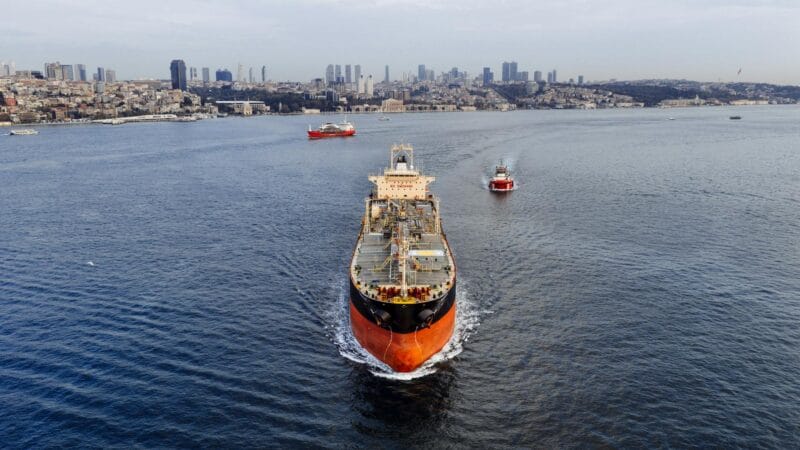
Most analysis of Middle East chokepoint risk focuses on the Strait of Hormuz — and for good reason, given its role as the primary exit valve for Gulf oil. But there is a second maritime bottleneck that receives far less attention and poses equally severe risks to global trade: the Strait of Bab al-Mandeb, the narrow passage between Yemen and Djibouti that connects the Red Sea to the Gulf of Aden and, beyond it, to the Indian Ocean and global shipping lanes.
Key Takeaways
- 4.8M bpd — Oil volume transiting Bab al-Mandeb daily (northbound + southbound)
- 12% of global trade — Share of world trade volume passing through the strait annually
- 18 miles wide — Narrowest point of Bab al-Mandeb; narrower than Hormuz at its tightest
- $10 billion/day — Estimated value of trade at risk from a full closure
- Combined scenario — Hormuz + Bab al-Mandeb closure would block ~30% of global container shipping
- No bypass — Unlike Hormuz (Saudi pipeline), there is no viable land alternative to Bab al-Mandeb
What Is Bab al-Mandeb and Why Does It Matter?
Bab al-Mandeb — literally “Gate of Grief” in Arabic, a name that has proven grimly prescient — is an 18-mile-wide strait at the southern end of the Red Sea, separating Yemen on the Arabian Peninsula from Djibouti and Eritrea on the African coast. At its narrowest navigable channel, effective width for large vessels is closer to 12 miles, making it one of the tightest maritime passages on earth for supertankers and ultra-large container vessels.
The strait’s strategic importance is multidimensional:

For oil: An estimated 4.8 million barrels per day transit Bab al-Mandeb — roughly 5.5% of global oil consumption. This includes northbound crude from the Gulf heading to Europe via the Suez Canal, and southbound refined products heading to Asian markets.
For container shipping: The strait is the southern gateway of the Suez Canal route, which carries approximately 12-13% of global trade by value. Everything from European manufactured goods to Asian electronics to agricultural commodities travels this route. In volume terms, this is approximately 19,000 vessels per year.
For LNG: Qatari LNG destined for European markets must transit Bab al-Mandeb southbound before heading north through the Red Sea and Suez Canal. Qatar’s LNG exports to Europe — approximately 30 million tonnes per year — are entirely dependent on this route remaining open.
The Houthi Threat: From Harassment to Blockade
Yemen’s Houthi forces began targeting commercial shipping in the Red Sea in late 2023, initially framing attacks as solidarity with Gaza. By early 2026, the operational picture has evolved significantly. Houthi capabilities have expanded — they now possess Iranian-supplied anti-ship ballistic missiles with 200-km range, sea-skimming cruise missiles, and one-way attack drones capable of hitting vessels anywhere in the southern Red Sea and approaches to Bab al-Mandeb.
The attack pattern through Q1 2026 shows a disturbing escalation in ambition. Early attacks targeted specific vessel types (Israeli-linked, U.S.-flagged). By March 2026, Houthi targeting criteria have effectively broadened to any vessel not explicitly coordinated through their maritime notification system — a development that has pushed major carriers including Maersk, MSC, and CMA CGM to maintain their Cape of Good Hope diversions established in late 2023.
The Cape diversion adds approximately 10-14 days and $1 million in fuel costs to a round-trip Asia-Europe voyage. Annualized across the global container fleet, this represents an estimated $7-9 billion in excess shipping costs in 2025-2026, absorbed partly by carriers as margin compression and partly passed on to consumers as embedded inflation in traded goods prices.
For context on how Hormuz disruptions are interacting with this dynamic, see our analysis of Hormuz shipping disruptions and insurance costs in March 2026.
The Nightmare Scenario: Dual Chokepoint Closure
The scenario that keeps shipping analysts and defense planners up at night is a simultaneous major disruption at both Bab al-Mandeb and the Strait of Hormuz. Under this scenario:
- ~30% of global container shipping would be blocked from normal routing
- ~22% of global oil supply (combining Hormuz’s ~20% and Bab al-Mandeb’s ~5.5%, with some overlap for Gulf producers) would face transit disruption
- European energy security would be critically threatened, given dependence on both Gulf oil and Qatari LNG transiting both straits
- Global container spot rates, which already spiked 400-600% during the 2021 supply chain crisis and 200-300% during early 2024 Red Sea disruptions, would face another severe shock
The $10 billion per day at-risk figure represents the combined value of trade that would be either blocked, significantly delayed, or forced onto massively more expensive alternative routes. This is not a theoretical number — it is derived from Lloyd’s List shipping data on daily cargo values transiting the two straits.
Why There Is No Good Bypass for Bab al-Mandeb
Unlike the Strait of Hormuz — where Saudi Arabia’s East-West Pipeline provides partial relief with 5 million barrels per day capacity bypassing Hormuz entirely — Bab al-Mandeb has no viable land bypass for its container shipping volumes. The Suez Canal-Red Sea-Bab al-Mandeb route cannot be replaced by any land or pipeline alternative at scale.
The only practical diversion is the Cape of Good Hope — adding 3,500 miles and 10-14 days to Asia-Europe voyages. This rerouting is expensive and capacity-consuming (vessels in transit are not available for loading), but it works. The problem is that Cape diversion is already happening at scale for most major carriers due to Houthi activity. A further escalation that makes even Cape-routed vessels targets (Houthi capabilities now theoretically reach into the Gulf of Aden approaches) would create a genuine shipping crisis with no viable mitigation.
Military Response and Its Limits
The U.S.-led Operation Prosperity Guardian has maintained a naval presence in the Red Sea since late 2023, conducting strikes against Houthi launch sites. The strikes have degraded but not eliminated Houthi maritime attack capabilities. The fundamental problem is asymmetric: Houthi drones and missiles cost $20,000-$100,000 each; the interceptor missiles used to shoot them down cost $1-4 million each. Iran’s continuous resupply of Houthi capabilities has sustained the threat despite significant attrition.
A comprehensive military solution would require either a ground campaign in Yemen (politically and logistically implausible), a complete naval blockade of Houthi-controlled coastline (requiring massive sustained resources), or a direct strike on Iran’s missile supply chains (escalation risk too high). None of these options are on the table in the current political environment.
The Iran conflict dynamic is explored in detail in our analysis of Iran’s war and its economic impact on Gulf states.
Economic Impact on the GCC and Beyond
For Gulf states, the Bab al-Mandeb disruption cuts both ways. On one hand, elevated shipping costs inflate the price of imported goods — the Gulf imports a very high proportion of its food, consumer goods, and industrial inputs, making it unusually exposed to shipping cost inflation. On the other hand, higher oil prices driven by supply chain anxiety benefit Gulf producers’ export revenues.
The UAE’s position is particularly complex. Dubai’s Jebel Ali Port — the largest port in the Middle East and 9th largest globally by container volume — has seen a significant shift in traffic patterns as vessels avoid the Red Sea. Some transshipment volume has actually increased at Jebel Ali as shippers use it as a staging point for Cape-routed cargo, partially offsetting the losses from reduced Red Sea throughput. For Dubai’s broader economic navigation of the conflict period, see our coverage of Dubai tourism and the Iran war’s impact in 2026.
What This Means for US Investors
Bab al-Mandeb risk has two direct investment implications for U.S. portfolios. First, shipping and logistics: the prolonged Cape diversion has been a windfall for bulk carriers and tanker owners operating longer route voyages (more vessel-days per voyage = more revenue per vessel). Stocks like Frontline (FRO), Nordic American Tankers (NAT), and container leasing companies have benefited from elevated rate environments. Second, the inflation transmission: embedded shipping cost inflation adds 0.2-0.5 percentage points to core goods inflation globally, complicating the Fed’s rate path. Investors should treat persistent Bab al-Mandeb disruption as a structural inflation input, not a transitory one. For broader context on Middle East investment risk, our guide to Middle East ETFs for US investors covers the key exposure vehicles.
Frequently Asked Questions
Where is the Strait of Bab al-Mandeb?
The Strait of Bab al-Mandeb is located at the southern end of the Red Sea, between Yemen on the Arabian Peninsula and Djibouti and Eritrea on the African coast. It connects the Red Sea to the Gulf of Aden and is approximately 18 miles wide at its broadest navigable point.
How much trade passes through Bab al-Mandeb?
Approximately 12% of global trade by value transits Bab al-Mandeb annually — roughly 19,000 vessels per year. The strait carries an estimated 4.8 million barrels of oil per day and serves as the southern gateway for the Suez Canal route connecting Europe and Asia.
How are the Houthis threatening shipping at Bab al-Mandeb?
Houthi forces in Yemen have been attacking commercial shipping since late 2023 using Iranian-supplied anti-ship ballistic missiles, cruise missiles, and one-way attack drones. By March 2026, their capabilities include weapons with 200-km range, effectively threatening all vessels in the southern Red Sea and approaches to the strait. Major carriers have rerouted via the Cape of Good Hope as a result.
What would happen if both Hormuz and Bab al-Mandeb were disrupted simultaneously?
A combined Hormuz and Bab al-Mandeb disruption would block approximately 30% of global container shipping from normal routing and threaten roughly 22% of global oil supply. The combined trade at risk is estimated at $10 billion per day. European energy security would be critically exposed, and global shipping rates would face a severe inflationary spike.
Is there a bypass for Bab al-Mandeb like there is for Hormuz?
No viable bypass exists for Bab al-Mandeb’s container shipping volumes. Unlike Hormuz — where Saudi Arabia’s East-West Pipeline provides 5 million bpd of bypass capacity — the only alternative to the Red Sea-Bab al-Mandeb route for container vessels is the Cape of Good Hope diversion, which adds 10-14 days and approximately $1 million in fuel costs per round trip.