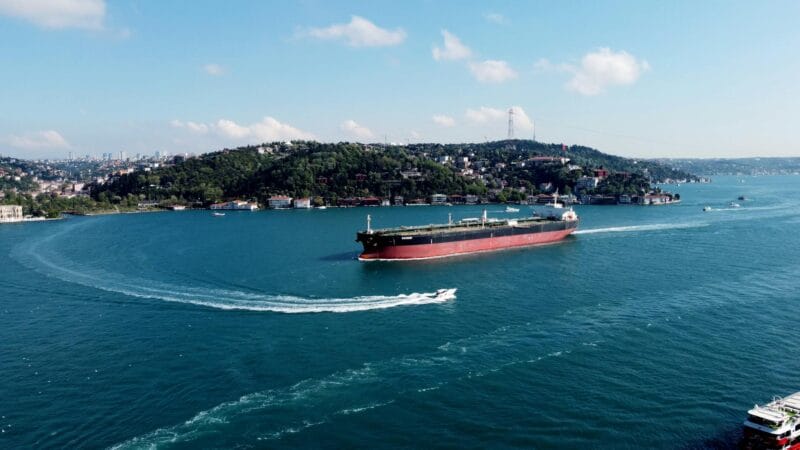
The Strait of Hormuz — the 21-mile-wide chokepoint through which 17.8 million barrels of oil transit daily, representing roughly 20% of global oil supply — has effectively become a toll road. Tehran, in a move that has drawn little Western media attention but is reshaping global energy flows, is operating a de facto passage fee system that accepts only Chinese yuan, grants preferential access to Chinese and Indian carriers, and leaves Western-flagged vessels with no viable transit option.
Key Takeaways
- 17.8M bpd — Daily oil volume that normally transits the Strait of Hormuz
- Chinese yuan only — Iran’s fee system rejects dollars and euros entirely
- Two-tier market — China and India get access; Western carriers are blocked
- De-dollarization in practice — The first major real-world application of yuan in energy transit fees
- Legal grey zone — Iran’s fees have no basis in international maritime law
- $3-8/barrel premium — Estimated cost differential between yuan-cleared and dollar-cleared oil
How the System Works
Iran’s toll arrangement is not a formal, publicly announced policy. It operates through a network of intermediaries — primarily Kish Island-based trading companies with established relationships with the Islamic Revolutionary Guard Corps Navy (IRGCN), which controls Hormuz access. Here is the reported mechanics:
Vessel operators seeking Hormuz passage contact designated intermediaries, typically 72 to 96 hours in advance. A fee — estimated at $0.50 to $1.20 per barrel of cargo — is negotiated and paid in Chinese yuan via accounts held at Kunlun Bank, the Chinese bank that has historically processed Iran-China transactions outside the SWIFT system. Upon confirmation of payment, vessels receive safe passage coordinates and are escorted by IRGCN patrol boats through the strait.

Western carriers — those flagged under U.S., EU, or UK registry, or those insured by Lloyd’s of London and other Western P&I clubs — are systematically excluded from this arrangement. Their vessels face either direct interdiction or are simply never given passage coordinates, effectively blocking transit.
Who Gets Access: The China and India Preference
The arrangement creates a visible hierarchy. Chinese state-owned carriers — COSCO Shipping, China Merchants Energy Shipping — transit with the lowest friction and most favorable fee structures. Indian carriers, particularly those serving state-owned HPCL and IOC refineries, access a second tier with slightly higher fees but reliable passage.
This is not accidental. Both China and India have maintained energy trade with Iran throughout the sanctions era, and both have deepened those ties since the conflict began. China now purchases an estimated 1.6 million barrels per day of Iranian crude, typically at a 15-20% discount to Brent, making Iranian oil a critical cost advantage for Chinese refiners competing in the global petrochemicals market.
India’s position is more nuanced. New Delhi has historically balanced U.S. and Iran relationships carefully, and Indian refiners are now benefiting from both the discounted Iranian crude and the relative Hormuz access their carrier relationships provide. This dynamic is accelerating India’s de facto drift away from dollar-denominated energy trade, a trend that has significant long-term implications for U.S. financial dominance.
The Yuan Dimension: More Than Just Payment
The insistence on yuan payment is the most strategically significant element of Iran’s toll system. It is not merely a practical workaround to sanctions — it is the first large-scale, operationally consistent use of the yuan as the settlement currency for a critical infrastructure access fee in global energy markets.
The volumes are not trivial. If Chinese and Indian carriers are collectively transiting 8-10 million barrels per day through the arrangement, and fees average $0.75/barrel, that represents $2.2-2.7 billion per year in yuan-denominated transactions bypassing the dollar system entirely. That is a rounding error in global trade terms, but the precedent is what matters.
Beijing has explicitly encouraged yuan settlement for energy transactions as part of its petro-yuan initiative launched after Russia’s 2022 invasion of Ukraine. The Hormuz toll arrangement is the most concrete proof-of-concept that the system can work at scale under real-world pressure conditions — including the threat of U.S. sanctions enforcement.
For context on how Iran’s economic maneuvering is affecting the broader Gulf region, see our analysis of Iran’s war and its economic impact on Saudi Arabia, UAE, and Qatar.
The Two-Tier Oil Market: What It Means Practically
The Hormuz toll system is accelerating the bifurcation of the global oil market into two distinct circuits. The first circuit — call it the yuan circuit — includes Iran, Russia, Venezuela, and increasingly Gulf producers like Iraq, who are routing growing volumes through Chinese and Indian intermediaries with yuan settlement. The second circuit — the dollar circuit — covers the Atlantic Basin, Japan, South Korea, and Australia, where WTI and Brent remain the pricing benchmarks and dollar settlement is standard.
The price differential between these circuits has become measurable. Oil flowing through the yuan circuit commands a $3-8 per barrel discount versus dollar-circuit oil, reflecting the sanctions risk premium, the limited refinery compatibility (many yuan-circuit barrels are Iranian heavy crude requiring specialized cracking), and the reduced liquidity of yuan settlement.
But that discount is also an opportunity. Asian refiners with the technical capability to process Iranian heavy crude are earning an enormous crack spread advantage. Chinese refining margins have been running 40-60% above their pre-conflict averages, directly attributable to access to discounted Hormuz-transit crude.
This structural dynamic is addressed in our broader coverage of how Strait of Hormuz disruptions are reshaping global shipping insurance costs.
The Legal Void and International Response
Iran’s toll system has no basis in international maritime law. Under the United Nations Convention on the Law of the Sea (UNCLOS), all vessels have the right of transit passage through international straits. Iran is not a party to UNCLOS, but the customary international law principle of free transit is nearly universally recognized.
The U.S. Navy’s Fifth Fleet, based in Bahrain, has nominally maintained a presence in the region but has not physically interdicted the toll system’s operations. The political calculus is difficult: physically blocking the yuan payment arrangement would require intercepting Iranian patrol boats and potentially Chinese commercial vessels — an escalation neither Washington nor Beijing is prepared to risk in the current environment.
The EU has condemned the arrangement diplomatically but has no enforcement mechanism beyond existing sanctions, which Iran is already circumventing. Lloyd’s of London has updated its war risk coverage maps to reflect Hormuz as a declared exclusion zone for Western-registered vessels, effectively codifying the market separation that Iran’s system has created.
Saudi Arabia and Gulf State Reactions
Riyadh’s response has been notably measured. Saudi Arabia ships the bulk of its oil exports through Hormuz, and while Saudi Aramco tankers operate under arrangements that nominally exempt them from Iran’s toll system — Riyadh and Tehran have back-channel agreements governing Saudi transit — the market uncertainty is real. Saudi Arabia has been quietly accelerating pipeline capacity on the East-West Crude Oil Pipeline, which bypasses Hormuz entirely and terminates at Yanbu on the Red Sea. That pipeline has a 5 million barrel per day capacity, but currently handles far less.
For a deeper look at Saudi Arabia’s economic navigation of this period, see our analysis of Saudi Arabia’s GDP, TASI recovery, and oil windfall in March 2026.
What This Means for US Investors
Iran’s Hormuz toll system has three direct implications for U.S. investors. First, it creates a structural oil price floor: as long as Western carriers cannot freely transit Hormuz, global oil supply remains artificially constrained, supporting higher crude prices. Second, the yuan payment mechanism accelerates de-dollarization in energy markets — a slow-moving but genuine threat to U.S. dollar hegemony and, by extension, U.S. borrowing costs. Third, it creates a competitive disadvantage for U.S. and European refiners versus Asian competitors who access cheaper yuan-circuit crude. Investors in U.S. refining stocks — VLO, MPC, PSX — should monitor Asian refining margin data as a leading indicator of competitive pressure. Conversely, investors in U.S. oil producers benefit from the higher WTI prices that Hormuz constraints support. Middle East energy ETFs are discussed in our guide to Middle East ETFs for US investors.
Frequently Asked Questions
Is Iran’s Hormuz toll system legal under international law?
No. Under customary international maritime law and UNCLOS principles, all vessels have the right of transit passage through international straits. Iran’s toll system has no legal basis, but enforcement requires physical interdiction that no major power has been willing to attempt given escalation risks.
Why is Iran charging fees in Chinese yuan instead of dollars?
Yuan payment serves two purposes: it bypasses the U.S. dollar financial system (and thus U.S. sanctions enforcement mechanisms), and it advances the broader China-Iran strategic relationship by creating yuan demand and demonstrating yuan utility as a reserve currency alternative in energy markets.
How much oil transits the Strait of Hormuz each day?
Under normal conditions, approximately 17.8 million barrels per day transit Hormuz — roughly 20% of global oil supply. Current conditions have reduced Western carrier volumes to near zero, with total transit estimated at 10-12 million bpd as Chinese and Indian carriers fill the gap.
What is the price difference between yuan-circuit and dollar-circuit oil?
Estimates suggest a $3-8 per barrel discount for yuan-circuit oil versus equivalent dollar-circuit benchmarks, reflecting sanctions risk premium, refinery compatibility constraints, and yuan liquidity limitations. This discount represents a significant competitive advantage for Asian refiners.
Could the Strait of Hormuz be fully closed?
A full closure would require Iran to physically block all vessel traffic — an act of war that would almost certainly trigger U.S. military response. The current partial-access toll system is Iran’s way of exerting maximum economic pressure while staying below the threshold that would force a direct U.S. military response.