Key Takeaways
- Qatar #1 — GDP per capita of $87,661 (nominal), the highest in the GCC and among the top 5 globally
- UAE #2 — $53,916 per capita with the most diversified economy and highest foreign investor access
- Saudi Arabia #3 — $28,457 per capita but largest total economy ($1.1T GDP) and most liquid equity market (TASI)
- Kuwait, Bahrain, Oman round out the ranking at $27,345, $26,562, and $21,897 respectively
- For US investors, the UAE offers the broadest access via free zone structures, ETFs, and real estate — Qatar restricts foreign ownership most tightly
The question of which Gulf state is richest sounds simple. The answer is not. Depending on whether you measure nominal GDP per capita, purchasing power parity, sovereign wealth fund assets, or net household wealth, the ranking shifts substantially. And for American investors trying to allocate capital to the region, the more important question is not just which country is richest — but which is most investable.
This analysis ranks all six GCC member states across multiple dimensions, using 2026 data from the IMF, World Bank, and regional central banks, to give the most complete picture available.
The 2026 GCC Wealth Rankings: Core Data
1. Qatar — GDP Per Capita: $87,661
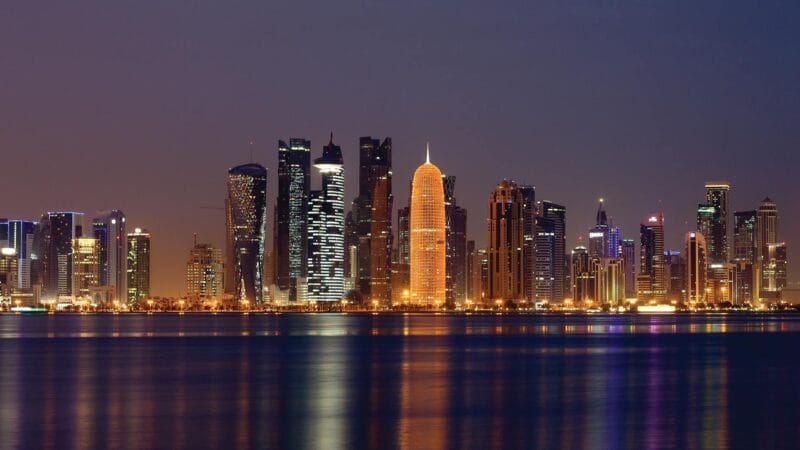
Qatar has been the world’s wealthiest country on a per-capita basis for much of the past two decades, and that position remains intact in 2026. With a population of approximately 2.9 million (only 300,000 of whom are Qatari nationals) and a GDP approaching $254 billion, the math produces extraordinary per-capita figures.

The foundation is natural gas. Qatar controls the world’s largest single natural gas field (shared with Iran), operates a fleet of LNG tankers that delivers to customers across Asia and Europe, and earns royalties structured to generate fiscal surpluses even at depressed commodity prices. As we reported on Gulf tourism and regional conflict dynamics, Qatar’s insulated geography and diplomatic hedging have kept it relatively protected from the current regional tensions.
Qatar Investment Authority (QIA) manages approximately $475 billion in assets — one of the world’s five largest sovereign wealth funds — including significant positions in Volkswagen, Harrods, Credit Suisse (prior to its collapse), and multiple US private equity funds. On a per-citizen basis, QIA assets represent roughly $1.58 million per Qatari national — a staggering backstop of sovereign wealth.
PPP-adjusted GDP per capita: approximately $119,000, second globally only to Luxembourg.
HDI score: 0.855 (very high human development).
Diversification index: Moderate — hydrocarbons still dominate at roughly 55% of GDP despite significant investment in finance and logistics.
2. UAE — GDP Per Capita: $53,916
The United Arab Emirates is the most economically diverse GCC state — and arguably the most important for international investors. With a population of approximately 10.3 million and total GDP of roughly $555 billion, the UAE has successfully built financial services, logistics, tourism, and technology sectors that now collectively represent more than 70% of GDP.
Abu Dhabi holds the hydrocarbons and the sovereign wealth. The emirate controls three major SWFs: ADIA ($1.1 trillion), Mubadala ($302 billion), and ADQ ($157 billion) — a combined firepower of over $1.5 trillion that dwarfs any other Middle Eastern state. Dubai, by contrast, generates wealth through commerce, real estate, and financial services.
For US investors, the UAE offers unmatched access. Dubai real estate is available to foreign buyers freehold in designated zones. Abu Dhabi and Dubai free zones allow 100% foreign ownership of companies. The Abu Dhabi Securities Exchange (ADX) and Dubai Financial Market (DFM) are accessible via international brokers and through Middle East ETFs available to US investors.
PPP-adjusted GDP per capita: approximately $88,000.
HDI score: 0.911 (very high).
Diversification index: High — non-oil GDP exceeds 70%.
3. Saudi Arabia — GDP Per Capita: $28,457
Saudi Arabia’s per-capita figure appears modest compared to its northern Gulf neighbors, but context matters enormously. The kingdom has a population of approximately 36.5 million — larger than all other GCC states combined — making its total GDP of roughly $1.04 trillion the region’s largest by a wide margin.
The Tadawul All Share Index (TASI) is the region’s deepest and most liquid equity market, with a free-float market cap above $800 billion. Saudi Aramco — the world’s most profitable company — alone accounts for a significant portion of that market cap. US institutional investors can access TASI-listed equities through international brokers and ETFs following the kingdom’s inclusion in MSCI Emerging Markets in 2019.
The Public Investment Fund (PIF), with $700+ billion in assets, is actively pursuing a 40% international allocation — making Saudi Arabia a major capital exporter to US markets, not just an investment destination. As our analysis of the richest countries in the Middle East shows, Saudi Arabia’s total wealth and strategic weight exceed what per-capita figures suggest.
PPP-adjusted GDP per capita: approximately $55,000.
HDI score: 0.875 (very high).
Diversification index: Moderate-Low — oil remains ~60% of government revenue despite Vision 2030 progress.
4. Kuwait — GDP Per Capita: $27,345
Kuwait occupies a peculiar position in the GCC wealth hierarchy: among the wealthiest nations on Earth in terms of per-capita hydrocarbon reserves, yet consistently underperforming its wealth potential in economic diversification.
The Kuwait Investment Authority (KIA) — the world’s oldest sovereign wealth fund, established in 1953 — manages approximately $900 billion in assets, including the General Reserve Fund and the Future Generations Fund. On a per-citizen basis (Kuwaiti nationals number roughly 1.5 million out of a total population of 4.9 million), KIA assets represent extraordinary backstop wealth.
Kuwait’s political structure — a functioning parliament with genuine legislative power, unique among GCC states — has produced recurring budget deadlocks that have slowed economic reform. Foreign ownership restrictions remain among the most stringent in the region, making Kuwait relatively inaccessible for direct international investment compared to the UAE or Bahrain.
PPP-adjusted GDP per capita: approximately $52,000.
HDI score: 0.847 (very high).
Diversification index: Low — oil represents ~90% of government revenue.
5. Bahrain — GDP Per Capita: $26,562
Bahrain is the GCC’s most liberal economy and its most financially stressed. The island kingdom has the lowest oil reserves of any GCC state — its offshore fields produce less than 50,000 barrels per day — and has compensated by building one of the region’s most developed financial services and logistics sectors.
The Bahrain Financial Harbour hosts hundreds of international banks and financial institutions. The kingdom was the first GCC state to sign a Free Trade Agreement with the United States (2006), creating preferential trade and investment terms that remain in force. For US businesses seeking a regional hub with bilateral treaty protection, Bahrain offers legal frameworks unavailable elsewhere in the Gulf.
Fiscal stress is real: Bahrain’s deficit runs at approximately 10–12% of GDP, and the kingdom was bailed out by a $10 billion GCC support package in 2018. Saudi Arabia’s implicit backing remains the ultimate guarantee of Bahraini sovereign solvency.
PPP-adjusted GDP per capita: approximately $46,000.
HDI score: 0.888 (very high).
Diversification index: High — non-oil GDP exceeds 80%.
6. Oman — GDP Per Capita: $21,897
Oman is the GCC’s hidden gem for lifestyle and the ranking’s most underrated investment destination. With a total population of approximately 4.5 million and GDP of roughly $99 billion, Oman is the smallest GCC economy by output — but has executed arguably the most disciplined fiscal reform program of any Gulf state over the past five years.
Under Sultan Haitham bin Tariq (who assumed power in 2020), Oman has cut subsidies, introduced income tax for high earners, expanded VAT to 5%, and reduced its deficit from double digits to roughly 2–3% of GDP in 2026. Oman Vision 2040 targets tourism and logistics as primary diversification pillars — the country’s Indian Ocean coastline, UNESCO World Heritage sites, and political neutrality make it genuinely competitive in those sectors.
PPP-adjusted GDP per capita: approximately $37,000.
HDI score: 0.816 (high).
Diversification index: Moderate and improving.
Sovereign Wealth Fund Rankings: Where the Real Money Is
GDP per capita measures current income. Sovereign wealth fund assets measure accumulated wealth — and on that measure, the ranking shifts considerably:
- UAE (combined ADIA + Mubadala + ADQ + L’imad): $1.56 trillion+
- Kuwait (KIA): ~$900 billion
- Qatar (QIA): ~$475 billion
- Saudi Arabia (PIF + SAMA reserves): ~$1.13 trillion combined
- Oman (OIA): ~$18 billion
- Bahrain (Mumtalakat): ~$22 billion
On this measure, the UAE and Saudi Arabia are in a separate tier from Qatar and Kuwait, with Bahrain and Oman far behind.
What This Means for US Investors
On pure investability, the UAE ranks first for Americans: real estate freehold access, 100% foreign company ownership in free zones, bilateral investment protections, ADX and DFM market access, and the world’s most accessible golden visa program. Saudi Arabia is the most liquid equity market (TASI) with deepest US institutional participation. Qatar offers the highest per-capita wealth but the most restricted foreign investment environment. Bahrain has the best legal framework and US FTA protections. Kuwait’s massive SWF wealth is largely inaccessible to foreign capital. Oman is emerging as a cost-effective logistics and tourism play. For diversified Gulf exposure, a combination of UAE real estate + TASI equities + Qatar bond exposure covers the region’s main investable assets.
Frequently Asked Questions
Which GCC country has the highest GDP per capita in 2026?
Qatar leads the GCC in nominal GDP per capita at $87,661 in 2026, more than 60% higher than the UAE in second place at $53,916. Qatar’s extraordinary per-capita figure reflects a combination of massive natural gas revenues and a small national population — with Qatari nationals numbering only about 300,000 out of a total population of 2.9 million.
Is the UAE or Saudi Arabia richer overall?
It depends on the metric. Saudi Arabia has a larger total economy — GDP of approximately $1.04 trillion versus the UAE’s $555 billion — and a much larger population. The UAE has a higher GDP per capita ($53,916 vs $28,457) and a more diversified economy with a larger proportion of non-oil GDP. In terms of sovereign wealth fund assets, the UAE’s combined SWFs ($1.56 trillion) exceed Saudi Arabia’s PIF ($700 billion), though SAMA reserves bring Saudi’s total closer to parity.
Which GCC country is best for foreign investment?
The UAE ranks first for foreign investor access: 100% company ownership in free zones, freehold real estate in designated areas, a Golden Visa program, no personal income tax, and deep capital markets. Bahrain ranks second due to its US Free Trade Agreement and liberal business environment. Saudi Arabia offers the region’s deepest equity market and largest consumer base but maintains more ownership restrictions, though Vision 2030 reforms are steadily relaxing these.
How does Kuwait’s KIA compare to other Gulf sovereign wealth funds?
The Kuwait Investment Authority (KIA), managing approximately $900 billion, is the world’s oldest sovereign wealth fund and one of its largest. It ranks second in the GCC by assets after the UAE’s combined funds. However, KIA’s returns and deployment have been more conservative than ADIA or Mubadala, and Kuwait’s political gridlock has limited domestic deployment of these resources for economic development purposes.
Is Oman poor compared to other GCC states?
On GDP per capita ($21,897), Oman ranks last among GCC states. However, Oman’s fiscal reform trajectory under Sultan Haitham is among the Gulf’s most impressive — the country has moved from a double-digit deficit to approximately 2–3% of GDP in under five years. Cost of living is significantly lower than the UAE or Qatar, and for expatriates, Oman offers one of the region’s most livable environments at a fraction of the price.