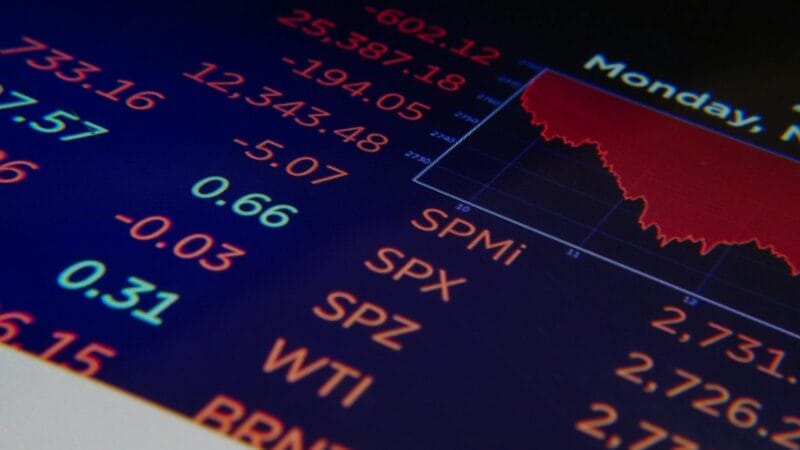
March 2026 will be recorded in financial history as the month the Middle East war reached Wall Street. The S&P 500 closed March 28 at 6,368 — down 1.67% on the day and on track for a monthly loss of approximately 6.8%, the index’s steepest monthly decline since the Federal Reserve’s aggressive rate hike cycle drove a 9.3% September 2022 collapse. The Dow Jones Industrial Average lost 793 points to close at 45,167, while the Nasdaq Composite shed 2.15% to settle at 20,948 — its worst March since 2020.
Key Takeaways
- S&P 500 -6.8% in March — Worst monthly performance since September 2022; closed March 28 at 6,368.
- Dow -793 pts to 45,167 — Blue-chip industrial index reflects broad economic growth fears.
- Nasdaq -2.15% to 20,948 — Tech names hit hardest as rate-cut expectations pushed back by oil-driven inflation.
- Amazon -3.85% — E-commerce giant faces dual headwinds of logistics cost inflation and consumer spending deceleration.
- Exxon +3.5% — Energy the market’s sole winning sector as geopolitical risk premium lifts oil names.
The Anatomy of a War-Driven Selloff
The March decline was not a panic-driven crash but a sustained, multi-week repricing of risk as the Iran-Israel conflict escalated in stages. The selloff can be divided into three distinct phases. The first phase — from March 1 to March 10 — saw the S&P 500 fall approximately 2.1% as initial Iranian Hormuz actions rattled oil markets and investors began pricing in an inflation risk premium. The second phase — March 11 to March 21 — added another 3.2% to the loss as Iran formally announced the yuan-toll mechanism and oil crossed $90, forcing the Federal Reserve to signal it was pausing its rate-cut cycle. The third phase — March 22 to March 28 — accounts for the final 1.5% of the monthly loss, driven by Houthi missile escalation and the Trump administration’s failure to reach a diplomatic resolution before its self-imposed March 28 deadline.
Sector Breakdown: A Market at War With Itself
The sectoral divergence in March 2026 was among the sharpest in recent memory. The energy sector (XLE) gained approximately 18% for the month, acting as a near-perfect hedge against geopolitical risk. Within energy, integrated oil majors outperformed pure-play producers, as their refining and chemical segments benefit from crack spread widening even as upstream margins expand.

Technology was the worst-performing major sector, declining approximately 9.8% for the month. The selloff had two drivers: first, rising oil prices push real yields higher as inflation expectations increase, compressing the discounted cash flow multiples that underpin high-growth tech valuations; second, several large-cap tech companies have significant data center supply chain exposure to Asia-Pacific manufacturers whose shipping costs have surged. Amazon (AMZN) fell 3.85% on March 28 alone, extending its monthly loss to approximately 12%, reflecting both AWS margin concerns and the company’s acute dependence on transoceanic shipping for its third-party seller ecosystem.
Consumer discretionary followed tech lower, declining 8.2% for the month. Nike, which sources the majority of its products from Vietnam and Indonesia — whose manufacturers ship primarily via Red Sea or Cape of Good Hope routes — was among the worst performers, shedding 11.4% in March. Luxury retailer Tapestry fell 9.1%.
The Fed’s Dilemma: Stagflation Specter Returns
The March equity decline is inseparable from a fundamental shift in Federal Reserve policy expectations. At the start of the month, futures markets were pricing in two 25-basis-point rate cuts by year-end 2026. As of March 28, those same markets are pricing in zero cuts in 2026 and a meaningful probability — approximately 18% — of a rate hike if oil-driven inflation proves persistent. Fed Chair’s public statements this week indicated the committee is watching oil prices “very carefully” and will not cut rates in an environment where energy inflation could re-accelerate headline CPI toward 4%.
This dynamic — rising prices and slowing growth simultaneously — is the definition of stagflation, a condition that equity markets historically handle poorly. The 1973–1974 oil shock, which also involved Middle East conflict and supply disruption, drove the S&P 500 down approximately 48% over 21 months. While most economists view a repeat of that magnitude as unlikely given the U.S. economy’s reduced oil intensity, the directional parallel is not lost on portfolio managers.
Credit Markets: The Less-Watched Warning Signal
While equity markets have grabbed headlines, the more analytically significant signal has come from credit markets. U.S. high-yield (junk bond) spreads have widened by approximately 145 basis points since March 1, with the energy-importing sector — airlines, retail, logistics — driving the widening. Investment-grade spreads have moved more modestly, up 42 basis points, but the direction is uniform. The ICE BofA U.S. High Yield Index option-adjusted spread reached 465 basis points on March 28, the widest since October 2023.
What This Means for US Investors
A 6.8% monthly loss in the S&P 500 is significant but not catastrophic — the index is still up approximately 8% from year-ago levels. The key question is whether this is a correction within a bull market or the beginning of a more sustained drawdown. The answer depends heavily on diplomatic developments in the Iran-US negotiations and oil price trajectory. Defensively, consider rotating toward energy (XLE), gold (GLD), and utilities (XLU) while reducing technology and consumer discretionary exposure. The CBOE Volatility Index (VIX) remains elevated at approximately 28; options strategies that benefit from continued volatility — such as long straddles on earnings-sensitive names — may be appropriate. Do not chase the Nasdaq selloff as a buying opportunity until there is diplomatic clarity on Iran.
Frequently Asked Questions
Why did the S&P 500 fall so much in March 2026?
The March 2026 selloff had three primary drivers: the Iran-Israel war raising oil prices and inflation expectations, the Federal Reserve pausing its rate-cut cycle in response, and deteriorating consumer and business confidence as supply chain disruption costs mounted. The war risk premium effectively repriced the equity risk premium across the market.
Is this the start of a bear market?
A bear market is technically defined as a 20% decline from recent highs. The S&P 500 is down approximately 6.8% in March but remains well above bear market territory. Most strategists view this as a geopolitically driven correction rather than a structural bear market, absent a broader economic recession signal.
Why did Amazon fall so much while Exxon rose?
The oil price surge creates opposite outcomes for energy companies and logistics-dependent businesses. Exxon directly profits from higher crude prices. Amazon faces higher jet fuel costs (for Prime Air), higher shipping costs for third-party sellers, and potential consumer spending cuts as energy inflation erodes household budgets.
What sectors are safe during a Middle East oil conflict?
Historically, energy majors, gold miners, defense contractors, and domestic utilities outperform during Middle East oil crises. Domestic energy producers with no export shipping exposure — Permian Basin E&P companies, for instance — are particularly well-positioned as they benefit from higher prices without the supply chain disruption risk.