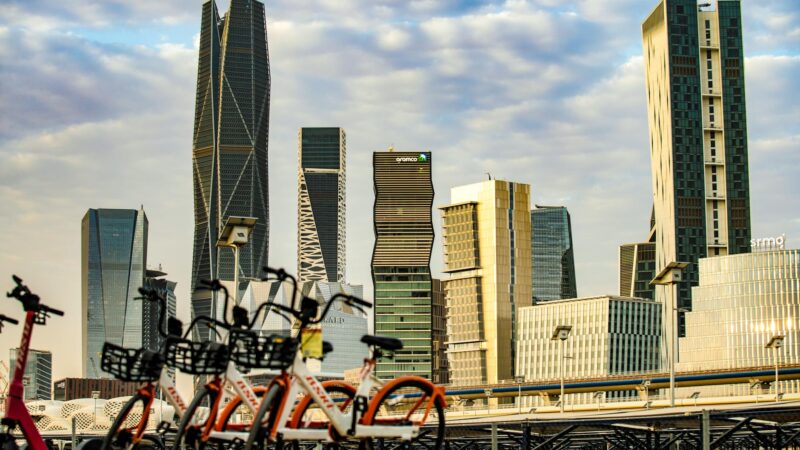
A decade ago, talk of a Saudi economy not dependent on oil was more wishful thinking than planning. Today, in March 2026, Vision 2030 has transformed from a slogan into a measurable economic reality. Saudi Arabia’s non-oil GDP grew by 5.4% in 2025 — the third consecutive year that non-oil growth exceeded 5% — while the oil sector contracted by 2.1% due to production cuts under OPEC+ agreements.
The most striking contrast: for the first time in the Kingdom’s history, the non-oil sector’s contribution exceeded 52% of real GDP in Q4 2025, according to the General Authority for Statistics. This structural shift warrants in-depth analysis.
Non-Oil Growth Drivers: The Sectors Leading the Transformation
Tourism: From Zero to SAR 150 Billion
Tourism stands as the most prominent success story of Vision 2030. Tourism revenues reached SAR 147 billion ($39.2 billion) in 2025, a 24% increase over 2024. Key figures:
- Total visitors: 115 million visitors in 2025 (domestic and international), up from 100 million in 2024
- International tourists: 35 million international tourists, a 30% year-on-year increase
- Riyadh Season 2025: Generated revenues exceeding SAR 18 billion with 22 million visitors
- AlUla: Welcomed 1.2 million visitors in 2025, with average daily spending of SAR 1,800 per international tourist
- Red Sea (Amaala + The Red Sea): Began receiving guests in 2024 and achieved 72% occupancy in its first full season
The 2030 target requires reaching 150 million annual visitors and a 10% GDP contribution. Current figures suggest the Kingdom is on track, possibly ahead of schedule.
Entertainment: An Industry That Did Not Exist 7 Years Ago
The General Entertainment Authority was established in 2016, when the sector was virtually nonexistent. In 2026, it contributes over SAR 20 billion annually to the economy:
- Cinemas: Exceeded 100 venues with over 650 screens, generating SAR 2.8 billion in ticket revenues in 2025
- Concerts and events: More than 5,000 entertainment events held in 2025, compared to zero in 2016
- Theme parks: The Qiddiya project with a capacity of 17 million annual visitors approaches its Phase 1 opening in 2026
- Sports: Hosting the 2027 Asian Cup and 2034 FIFA World Cup drives massive investment in sports infrastructure
Technology and Innovation
Saudi Arabia’s tech sector is experiencing rapid growth driven by massive government investments:
- AI investment: PIF allocated $40 billion for AI sector investment, including partnerships with Microsoft, Google, and Oracle to build hyperscale data centers
- Startups: Saudi startups raised SAR 3.2 billion in funding in 2025, a 45% increase over 2024
- Digital transformation: The digital economy contributed 19.2% of non-oil GDP in 2025
- Gaming: Savvy Games Group, owned by PIF, announced investments exceeding $38 billion in the gaming industry
The Public Investment Fund: The Primary Engine of Transformation
The Public Investment Fund (PIF) plays a pivotal role in economic diversification. The fund’s assets exceeded SAR 3.2 trillion ($853 billion) in March 2026, making it the world’s second-largest sovereign wealth fund after Abu Dhabi’s ADIA.
Key active PIF projects:
- NEOM: The futuristic city at a cost of $500 billion. The Line’s first 2.4-kilometer phase targets completion in 2028. Infrastructure work reached 35% completion in March 2026 with over 150,000 workers on site
- The Red Sea International: Features 50 resorts across 22 islands, with Phase 1 (16 hotels) complete
- Roshn: The residential real estate development arm targeting 300,000 housing units by 2030
- Riyadh Air: The new national airline targeting 100 destinations by 2030
Labor Market: Saudization Is Bearing Fruit
Among the most important indicators of economic transformation is labor market performance. In March 2026:
- Saudi unemployment rate: Dropped to 10.5%, down from 12.3% in 2023 and 15.4% in 2016
- Female labor force participation: Reached 35.5%, up from 17.4% in 2017, surpassing the Vision 2030 target of 30% ahead of schedule
- Private sector jobs: 380,000 jobs added for Saudis in the private sector during 2025
- Fastest-growing employment sectors: Technology (+28%), tourism and hospitality (+22%), entertainment (+19%), e-commerce (+17%)
Remaining Challenges
Despite tangible achievements, the diversification process faces structural challenges:
- Dependence on government spending: Approximately 60% of non-oil growth remains driven directly or indirectly by government spending and PIF investments
- Fiscal deficit: The budget recorded a deficit of 2.8% of GDP in 2025, relying on debt issuances to finance mega-projects
- Mega-project costs: The scope of some major projects like The Line has been reduced from 170 kilometers to a 2.4-kilometer first phase, raising questions about the economic viability of the original vision
- Labor productivity: Saudi worker productivity remains approximately 30% below the OECD average
- Real vs. accounting diversification: Some non-oil growth is linked to government contracts funded by oil revenues, meaning actual oil dependence is higher than the figures suggest
What Awaits the Saudi Economy for the Rest of 2026?
The Ministry of Finance projects overall GDP growth of 4.6% in 2026, driven by 5.8% non-oil sector growth and a slight recovery in oil production following the easing of OPEC+ restrictions. The IMF is more conservative, forecasting total growth of 3.8%.
Critical factors in the period ahead include OPEC+ production quota decisions and their impact on government revenues, the pace of mega-project execution, and the private sector’s ability to drive growth independently of government spending.
The essential truth to grasp: Saudi economic diversification is real and more sustainable than many skeptics anticipated. But it remains in its early stages, and the biggest bet is whether the private sector can gradually replace the government as the primary growth engine. That transition, not merely the numbers, is the real test of Vision 2030.