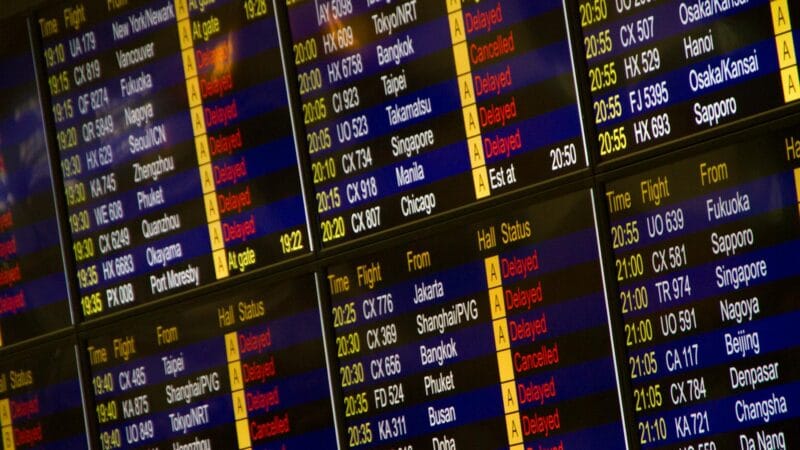
In just 11 days, the 2026 Iran war has turned the global aviation industry upside down. Over 23,000 flights have been cancelled across the region, Dubai International Airport has sustained direct damage, and millions of travelers are stranded or searching for alternatives. The $12 trillion global travel industry faces its most severe test since the COVID-19 pandemic.
Scale of the Catastrophe: Unprecedented Numbers
23,000+ Flights Cancelled in 11 Days
Since the outbreak of war on February 28, 2026, the number of cancelled flights has surpassed 23,000 across the Middle East and surrounding regions. This figure includes direct flights to and from the region, as well as transit flights that would have passed through the now-closed airspace. For comparison, during Iceland’s volcanic eruption crisis in 2010 — considered the worst aviation crisis in modern history — roughly 100,000 flights were cancelled over a full week across Europe. The current cancellation rate puts the Iran war on a similar trajectory if it continues.
Dubai International Airport: Direct Damage
Dubai International Airport (DXB), the third-busiest airport in the world with over 87 million annual passengers, has sustained direct damage during hostilities. Exact details of the damage remain limited, but aviation industry sources report that one runway has been taken out of service and some cargo facilities were hit. The airport is currently operating at reduced capacity, with delays of up to 8 hours for remaining flights.

The economic impact is enormous. Dubai Airport generates estimated daily revenue of over $100 million directly and indirectly. Every day of reduced operations costs Dubai’s economy tens of millions.
Status of Major Airlines: March 2026
Emirates
Emirates has suspended most regional flights and rerouted long-haul services via alternative paths that avoid Iranian and Iraqi airspace. Flights to Europe and Africa now take a route via the Red Sea and Egypt, adding 2-3 hours to flight time and additional fuel costs estimated at $15,000-$25,000 per flight.
Etihad Airways
Etihad Airways has announced the suspension of 60% of its flights and is using alternative routes for remaining services. Its Abu Dhabi hub is less affected than Dubai in terms of physical damage, but airspace restrictions impact all of the airline’s operations.
Qatar Airways
Qatar Airways is in a relatively better position due to Qatar’s geographic location south of the conflict zone. The airport is operating at full capacity, but many flights have been cancelled due to reduced demand and insurance restrictions. The airline is benefiting from some transit traffic diverting from Dubai to Doha.
International Carriers
Lufthansa, British Airways, and Air France have announced the suspension of all flights to the Arabian Gulf until further notice. Turkish Airlines continues some operations with modified routes. Asian carriers like Singapore Airlines and Cathay Pacific have diverted their routes southward over the Indian Ocean.
Airspace Closures: The Disruption Map
Airspace currently closed or restricted as of March 2026 includes:
- Iran: Fully closed to civilian aviation
- Iraq: Fully closed — US military routes only
- Parts of the Arabian Gulf: Restrictions changing daily
- Sea of Oman: No-fly zones around naval operations
- Eastern Syria: Security restrictions
- Western Afghanistan: Buffer zone
These closures mean that one of the world’s busiest air corridors — connecting Europe to Southeast Asia and Australia — is effectively disrupted. Every flight from London to Singapore or Sydney must take a longer, more expensive alternative route.
Tourism Losses: Billions Evaporating
UAE: The Hardest-Hit Sector
The UAE, which relies on tourism for 12% of its GDP, faces a severe crisis. Dubai hotels that previously recorded occupancy rates above 85% have seen a drop to below 30%. Expo City Dubai and entertainment projects on Yas Island are operating at near-empty capacity. Estimates suggest tourism losses exceeding $500 million per week for Dubai alone.
Saudi Arabia: Vision Projects Under Pressure
Saudi tourism projects under Vision 2030 — including NEOM, the Red Sea Project, and AlUla — face a slowdown in international tourist bookings. Although the Kingdom is not a party to the conflict, its geographic proximity is deterring many tourists from traveling to the entire region.
Egypt: Double Losses
Egypt’s tourism sector, which had been experiencing a strong recovery, is suffering a sharp decline in bookings. Losses estimated at $200 million per week threaten to wipe out the entire spring tourism season.
Is Dubai Airport Open Today? A Practical Guide for Travelers
For travelers wondering about flight status in March 2026:
Routes Still Operating
- Doha — Europe: Most Qatar Airways flights operating on modified routes
- Riyadh/Jeddah — Europe: Saudia flights operating via Red Sea corridor
- Cairo — Europe/Americas: Operating near-normally
- Amman — Europe: Operating with some delays
- Muscat — Asia: Operating on alternative southern routes
Advice for Travelers
- Check your flight status at least 24 hours before departure
- Keep alternatives ready — Doha, Riyadh, and Cairo as transit hubs
- Ensure your travel insurance covers war and civil unrest
- Expect delays even on confirmed flights due to alternative routing
Recovery Timeline: When Does Aviation Return to Normal?
The recovery of Middle East aviation depends on the duration of the conflict:
- Ceasefire within two weeks: Partial recovery within one month, full recovery within 3 months
- War lasting one month: Recovery needs 6-9 months with permanent market share losses
- War extending several months: Complete restructuring of regional aviation; some airlines may not survive
The Bottom Line: A $12 Trillion Industry in the Line of Fire
With 23,000 flights cancelled, Dubai Airport damaged, and airspace closed across half the Middle East in March 2026, the global aviation and tourism industry faces a crisis unseen since the pandemic. The difference is that COVID hit the entire world equally, while this crisis strikes the heart of one of the world’s most important aviation hubs. The repercussions will extend for months even after the war ends, and the airlines that survive will emerge with a fundamentally different operational structure.
Follow The Middle East Insider for the latest airport and flight status updates across the Middle East region.