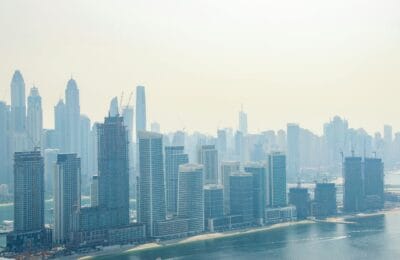
The Dubai real estate sector is experiencing an unprecedented boom driven by a global wave of wealth migration, as the emirate becomes the world’s top destination for high-net-worth individuals (HNWIs) seeking a safe haven for their capital. With the Dubai Land Department recording historic figures in transaction volumes and sales values throughout 2025, expectations are mounting that the market is entering a new upcycle that could extend for years, supported by massive capital inflows from Russia, India, and China, and a Golden Visa program that has fundamentally changed the rules of the luxury property market.
Wealth Migration to Dubai: The Numbers Redrawing the Property Map
According to the latest Henley & Partners reports on global wealth migration, Dubai ranked first globally as the top city attracting high-net-worth individuals in 2024 and 2025, surpassing Singapore, Miami, and Lisbon. Estimates indicate that more than 6,700 new millionaires relocated to Dubai in 2024 alone, with net positive inflows making the emirate the world’s largest wealth magnet.
This exceptional inflow is driven by several converging factors:

- Competitive tax environment: The absence of personal income tax and capital gains tax gives Dubai a tremendous advantage over London, Singapore, and Monaco, which impose increasing tax burdens.
- Security and political stability: In a world of rising geopolitical tensions, the United Arab Emirates provides the safe and stable environment investors seek.
- World-class infrastructure: International airports, advanced ports, sophisticated telecommunications networks, and globally ranked healthcare and education systems.
- Strategic geographic location: Dubai sits midway between Europe and Asia, making it an ideal hub for managing global business operations.
- Golden Visa program: Grants property investors of AED 2 million or more a long-term 10-year residency, significantly enhancing the real estate market’s appeal.
Data from Knight Frank confirms that Dubai recorded the highest growth rate in ultra-high-net-worth individuals (UHNWIs) — those with wealth exceeding $30 million — at 77% over the past decade, the highest growth rate among major global cities.
The Golden Visa: The Most Powerful Catalyst for Luxury Real Estate
The UAE government launched the Golden Visa program in 2019 and significantly expanded it in 2022, making it one of the most powerful tools for attracting foreign real estate investment. According to data from the Real Estate Regulatory Agency (RERA), more than 35% of new luxury property transactions were linked to Golden Visa applicants.
The program grants property investors exceptional benefits:
- Long-term residency: A 10-year renewable residence visa without the need for a local sponsor.
- Comprehensive family sponsorship: Ability to sponsor spouse and children regardless of age, plus domestic helpers.
- Residency flexibility: No requirement for physical residency for specified periods to maintain visa validity.
- Business freedom: Liberty to conduct commercial activities and establish companies without restrictions on foreign ownership percentages.
“The UAE Golden Visa has redefined the concept of property investment in the region. Purchasing real estate is no longer just an investment asset — it has become a gateway to a comprehensive lifestyle and permanent residency in one of the world’s most dynamic cities.”
— Savills Real Estate Research Report 2025
The program has driven a notable increase in demand for luxury properties exceeding AED 10 million, with this segment recording 45% growth in transaction volume during 2025 compared to the previous year, according to Property Finder data.
Capital Flows: Russia, India, and China Lead the Boom
The Dubai real estate boom is being shaped significantly by three major capital corridors, each representing different dynamics but converging on a single outcome: injecting billions of dollars into the UAE property market.
Russian capital: Since the onset of Western sanctions on Russia in 2022, the transfer of Russian wealth to Dubai has accelerated dramatically. Reuters reports indicate that Russian buyers have become one of the top five nationalities purchasing property in Dubai, with a clear focus on luxury units in Palm Jumeirah, Dubai Marina, and Downtown Dubai. Property transactions linked to Russian buyers increased by over 67% in two years.
Indian capital: Indian investors have traditionally represented the largest segment of foreign buyers in Dubai’s real estate market. With India’s economic growth and the emergence of a new generation of tech entrepreneurs and wealth holders, Indian investment flows continue to increase steadily. According to CBRE reports, Indian buyers account for approximately 20% of total property transactions in Dubai.
Chinese capital: The year 2025 saw a notable acceleration of Chinese investors entering Dubai’s property market, driven by the search for geographic diversification and the desire to move away from the slowing domestic Chinese real estate market. Data from JLL MENA indicates that property inquiries from Chinese buyers grew by 120% year-over-year.
This diversity in capital sources contributes to strengthening foreign institutional investment flows into Gulf markets, giving Dubai’s real estate market a solid and diversified demand base.
The Luxury Segment: Palm Jumeirah, Dubai Hills, and Emaar Beachfront Lead the Scene
The bulk of the current real estate boom is concentrated in the luxury and ultra-luxury property segment, where premium areas are recording unprecedented figures. According to Dubai Land Department data, the total value of luxury property transactions exceeding AED 10 million surpassed AED 120 billion in 2025.
Three key areas emerge as luxury segment drivers:
Palm Jumeirah: Palm Jumeirah remains the foremost address for luxury in Dubai and the world. Waterfront villas recorded prices exceeding AED 300 million per unit, with exceptional demand from Russian and European billionaires. Price per square foot on the Palm rose by 35% in a single year.
Dubai Hills Estate: Emaar’s mega development in Dubai Hills has become the preferred destination for wealthy families seeking a comprehensive lifestyle combining luxury and tranquility. Villa prices in the area rose by 28% during 2025, with near-complete occupancy of ready units.
Emaar Beachfront: This new coastal project represents the latest luxury address in Dubai, with sea-view apartments selling for over AED 50 million. The project attracts investors seeking exclusive coastal properties competitive with Monaco and the French Riviera.
DAMAC’s luxury projects are also performing exceptionally well, particularly branded collaborations with Versace, Cavalli, and Fendi that appeal to buyers seeking exclusivity. This performance directly reflects the booming luxury retail market in Dubai and Riyadh.
Transaction Volumes and Price Growth: Record Numbers Confirm Market Strength
Official data from the Dubai Land Department paints a clear picture of the current real estate boom. In 2025, the market recorded new highs across all levels:
- Total property transactions: Transaction count exceeded 180,000 with a total value surpassing AED 680 billion, marking a 25% increase over the previous year.
- Price growth: Average price per square foot rose by 18% emirate-wide, with significant variation across areas — luxury areas recorded growth exceeding 30% while mid-market areas grew by 12-15%.
- Cash transactions: Cash transactions (without mortgage financing) constitute over 60% of total deals, a strong indicator of foreign capital inflows.
- Foreign investors: Foreign buyers represent over 55% of total property transactions, led by Indian, British, Russian, Chinese, and French nationals.
Bloomberg analysis confirms that Dubai’s real estate market is currently experiencing its strongest upcycle since before the 2008 global financial crisis, but with far stronger fundamentals thanks to the stringent regulations imposed by RERA to prevent a repeat of past bubbles.
This real estate boom integrates with the Gulf real estate sector entering a new upcycle that also encompasses Abu Dhabi, Riyadh, and Doha markets.
Off-Plan vs. Ready Market: Different Dynamics
Dubai’s real estate market features a unique duality between off-plan properties and ready properties, each with distinct dynamics and audiences.
Off-plan market: This segment accounts for approximately 65% of total transactions in 2025, driven by flexible payment plans offered by major developers such as Emaar, DAMAC, and Nakheel. Payment plans range from 60/40 to 80/20 (percentage paid during construction versus post-handover), attracting investors seeking high capital gains.
Ready market: This segment enjoys strong demand from end-users and investors seeking immediate rental yields. CBRE data indicates that ready properties in prime areas achieve annual rental yields ranging from 5.5% to 8%, among the highest globally compared to competing cities.
The off-plan market has witnessed a flipping phenomenon where early buyers sell their units at premiums of 15% to 30% before construction completion. While this reflects high market confidence, RERA monitors it closely to prevent it from becoming unhealthy speculation.
Dubai vs. London, Singapore, and Monaco: Why the Emirate Outperforms
To understand the exceptional appeal of Dubai’s real estate market, it must be compared with its leading global competitors in the luxury property segment:
Dubai vs. London: While London suffers from mounting tax pressures including Stamp Duty reaching 17% for foreign buyers, capital gains tax, and inheritance tax, Dubai offers a virtually tax-free environment. According to Knight Frank reports, investors can purchase luxury property in Dubai at 40-60% less than comparable properties in central London with double the rental yield.
Dubai vs. Singapore: Singapore imposed a 60% tax on foreign property purchases (Additional Buyer’s Stamp Duty), pushing many Asian investors to seek alternatives. Dubai is the primary beneficiary of this shift, imposing no comparable taxes on foreign buyers other than a 4% registration fee.
Dubai vs. Monaco: While Monaco remains the world’s most expensive per square meter, Dubai offers significantly larger spaces at considerably lower prices with newer infrastructure and wider options. A Savills report indicates that investors get three times the space in Dubai compared to Monaco for the same budget.
This price gap combined with a favorable tax environment and high quality of life makes Dubai the most rational choice for wealthy individuals seeking value in the luxury property segment, consistent with analysis of Middle East real estate market cycles tracking this structural shift.
New Mega-Projects: Dubai’s Bet on the Future
Dubai’s real estate momentum extends beyond existing projects to a new wave of mega-developments redefining luxury living:
- Dubai Islands: This massive project developed by Nakheel represents a vast expansion of Dubai’s northern coastline, featuring luxury hotels, residential units, yacht marinas, and entertainment zones with total investments exceeding AED 80 billion.
- Dubai South: An integrated economic zone near Al Maktoum International Airport experiencing rapid growth in residential and commercial projects, expected to accommodate over one million residents by 2035.
- Dubai Creek Harbour: Emaar’s ambitious project featuring Dubai Creek Tower, poised to become the world’s tallest building, along with thousands of luxury residential units overlooking historic Dubai Creek.
- The Oasis by Emaar: An ultra-luxury residential community spanning 100 million square feet, featuring villas and mansions starting from AED 30 million, targeting ultra-high-net-worth individuals globally.
- Palm Jebel Ali: The revival of this mega-project after its suspension during the 2008 financial crisis, set to become one of the region’s largest coastal developments, more than double the size of Palm Jumeirah.
JLL MENA estimates total residential units planned for delivery in Dubai during 2025-2029 at over 270,000 units, a massive supply volume that raises legitimate questions about the supply-demand balance going forward.
Rental Yield Analysis: Why Dubai Outperforms Globally
Rental yields represent one of the most compelling attractions of Dubai’s real estate market, where the emirate clearly outperforms most competing global cities:
- Dubai: Gross rental yield of 5.5% to 8% depending on area and property type, reaching 10-12% in some short-term rental (Airbnb) zones.
- London: Rental yield not exceeding 2.5-3.5% in prime areas after deducting taxes and costs.
- Singapore: Rental yield of 2.8-3.2% with high tax costs.
- New York: Rental yield of approximately 3-4% before property taxes and federal/local income taxes.
- Hong Kong: Rental yield not exceeding 2-2.5% with very high prices.
Data from the Dubai Statistics Center confirms that residential rents in Dubai rose by 22% during 2025, driven by rapid population growth and the influx of skilled workforce. This increase enhances real estate investment appeal but simultaneously pressures affordability for middle-income residents.
Supply Pipeline Concerns: Does the Market Face Oversupply?
Despite the strongly positive indicators, some analysts raise legitimate questions about the sustainability of the real estate boom given the massive future supply pipeline. Forecasts from Knight Frank and JLL highlight several points worth monitoring:
- Future supply volume: With over 270,000 units expected for delivery over five years, the market may face pressure in certain segments and areas, especially in the mid-price range.
- Segment divergence: While demand for luxury properties remains strong and supported by wealth inflows, the mid-market and affordable segments may experience relative slowdown as supply increases.
- Global interest rates: Although Dubai is predominantly a cash market (over 60% cash transactions), rising interest rates affect the segment of buyers relying on mortgage financing.
- Geopolitical risks: Any major escalation in regional tensions could negatively impact foreign investor confidence, though Dubai’s track record in risk management has historically been excellent.
However, proponents of continued growth point out that Dubai’s population growth — approximately 5% annually — is sufficient to absorb the new supply, especially with the government targeting 5.8 million residents by 2040 compared to approximately 3.7 million currently. Additionally, growing international demand adds an extra layer of protection against any potential downturn.
In conclusion, Dubai’s real estate sector stands at a historic crossroads. On one hand, factors including wealth migration, the Golden Visa, and international capital flows are pushing the market toward new frontiers. On the other, the massive future supply pipeline demands continuous regulatory vigilance and careful monitoring of supply-demand balance indicators. What can be confirmed is that Dubai has cemented its position as one of the world’s most important real estate markets, and the current upcycle is built on stronger and more sustainable fundamentals than ever before, underpinned by a robust regulatory framework and genuine demand from the world’s wealthy who have chosen Dubai as the destination for their wealth and their future.
For more analysis on real estate and financial markets and the latest developments in the region’s business sector, follow our specialized coverage.
This article is for educational purposes only and does not constitute financial advice. Consult a licensed financial advisor before making investment decisions.